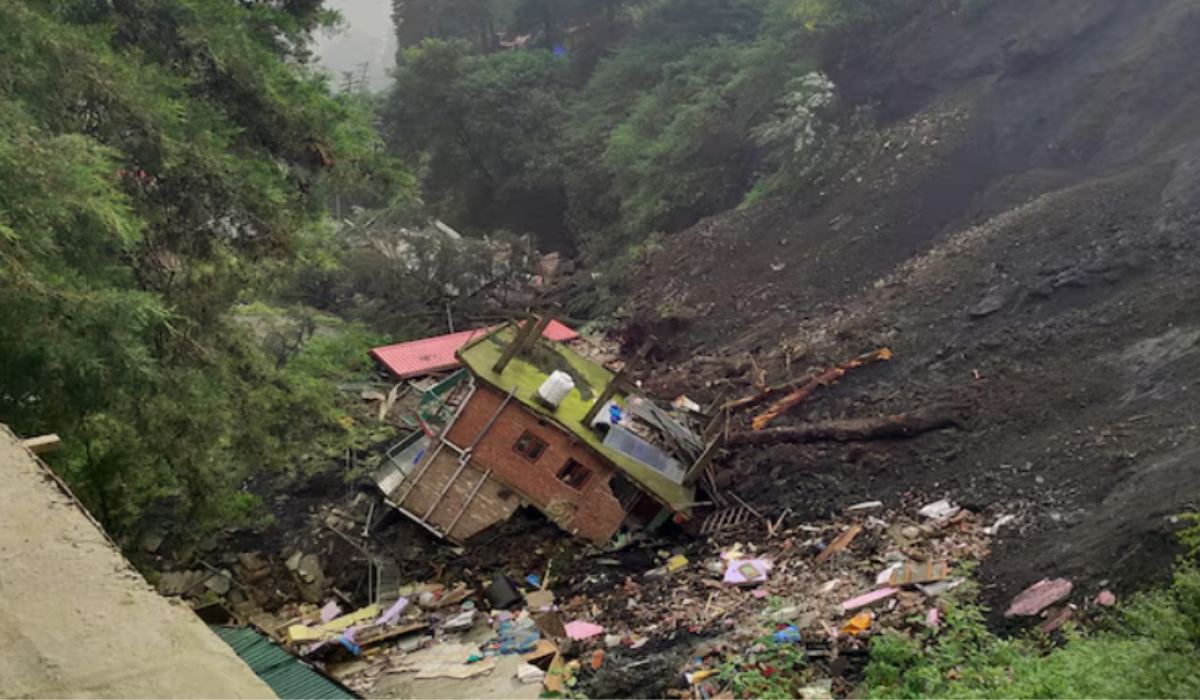
Himachal Pradesh, June 26, 2025 — In a horrifying turn of events, the Himachal Pradesh cloudburst and torrential rains wreaked havoc across the state on Wednesday. As a result, flash floods have already claimed two lives, while over 23 individuals—including laborers and residents—are feared to have been swept away. The districts of Kangra and Kullu bore the brunt of the disaster, with rivers breaching their banks, roads crumbling, and entire communities left devastated.
Cloudburst Triggers Deadly Flash Floods in Kangra
To begin with, the most tragic scene unfolded in Kangra district, where a sudden cloudburst over the Manuni Khad caused a violent surge in water levels. Officials recovered two bodies and reported that approximately 15 to 20 workers from the Indira Priyadarshini Hydroelectric Project remain missing.
These laborers, who were taking shelter in makeshift accommodations near the project site, had been resting after rain temporarily halted construction. However, floodwaters from both the Manuni Khad and surrounding drains unexpectedly diverted toward the labor colony, catching the workers off guard and sweeping them away in the roaring currents.
Consequently, teams from the State Disaster Response Force (SDRF), local revenue departments, gram panchayats, and district officials launched intense rescue and search operations. Hopes of finding the remaining project workers continue to fade, even though officials have reported some as safe.
Water levels in rivulets and main rivers have rapidly risen, prompting rescue efforts in Banjar, Manali, and Sainj, Kullu, Additional Deputy Commissioner Ashwani Kumar said.
Kullu Devastated by Multiple Cloudbursts
At the same time, things got significantly worse in the Kullu district. Authorities reported three separate Himachal Pradesh cloudburst incidents in Jeeva Nallah, Rehla Bihal (Sainj Valley), and Shilagarh (Gadsa region). The intense downpour triggered widespread flash floods, which washed away houses, bridges, roads, and even a school building.
Officials revealed that rising waters swept away three residents of Rehla Bihal—including one man and two women—while they tried to retrieve belongings from their homes. These tragic events caused by the Himachal Pradesh cloudburst starkly demonstrate the devastating consequences of underestimating flash floods in hilly areas.
Rescue operations are in progress in Banjar, Manali, and Sainj, where water levels in rivulets and main rivers have swiftly increased, according to Kullu Additional Deputy Commissioner Ashwani Kumar.
For instance, in Banjar’s Hornagad district, water invaded a government school, a bridge was washed away, and a cowshed along with a large tract of agricultural land was devastated.
Infrastructure Crumbles Under Nature’s Fury
Furthermore, the deluge not only disrupted daily life but also crippled essential infrastructure. The Beas River, swelled by constant rain, undermined a portion of the Manali-Chandigarh National Highway near Manali, causing partial damage. Even though traffic is still moving, there is still a considerable risk of further damage.
These tragic events starkly remind us of the consequences of underestimating flash floods in steep regions. As a result, flash floods have cut off several villages and severely hindered emergency response operations in those areas. In other parts of the Lahaul-Spiti region, landslides, debris flows, and overflowing drains have blocked the Kaza–Samdoh route, further challenging rescue teams and worsening the situation for stranded residents.
Social Media Footage Reveals the Havoc
Meanwhile, videos widely circulating on social media vividly reveal the gruesome extent of the devastation. Violent currents drag vehicles away, floodwaters inundate buildings, and helpless villagers cry out for help. These visuals not only underscore the tragic reality on the ground but also spark concern over the growing frequency and intensity of extreme weather events in the Himalayan region.
Weather Forecast Raises Alarm
On the other hand, the India Meteorological Department (IMD) has issued an orange alert for heavy to extremely heavy rainfall in Himachal Pradesh through June 29. The districts of Kangra, Kullu, Mandi, Shimla, Sirmaur, Solan, Hamirpur, and Una are probably going to be impacted.
The local meteorological office reports that Palampur had the most rainfall, 145.5 mm, followed by Jogindernagar (113 mm) and Nahan (99.8 mm). Moreover, thunderstorms hit regions like Sundernagar, while gusty winds reaching speeds of 56 kmph battered areas such as Tabo in Lahaul-Spiti. Una continued to have the highest temperature with 33.6°C, while Kukumseri recorded the lowest at 13.1°C.
Given the current conditions, the MeT Department has also advised locals and tourists to stay away from low-lying and landslide-prone areas in Chamba, Kangra, Mandi, Shimla, and Sirmaur, due to a moderate danger of flash floods.
Government Response: CM Issues Statewide Appeal
In response to the unfolding crisis, Chief Minister Sukhvinder Singh Sukhu issued an urgent public message, acknowledging the “distressing and heart-wrenching reports” pouring in from across the state. He confirmed that the state government instructed district administrations to carry out rescue and relief operations with maximum urgency and seriousness.
In a statement posted on the social media platform X, Sukhu said:
“I am in constant touch with the administrative officers of all districts. The situation is being monitored closely. The administration has been asked to stay alert and be fully prepared for any emergency.”
Additionally, the chief minister appealed to residents and tourists to stay away from rivers, streams, and hilly slopes, warning that further rainfall could trigger more landslides and flooding. Authorities have also urged the public to cooperate, avoid rumor-mongering, and remain vigilant to ensure safety.
Editorial Analysis: A Grim Reminder of Climate Vulnerability
More importantly, this catastrophe has once again exposed the fragile ecology and infrastructure of the Himalayan region. With climate change accelerating, such extreme weather events—whether cloudbursts or glacial lake outbursts—are becoming increasingly frequent and dangerous.
Himachal Pradesh, a state heavily reliant on hydroelectric projects, tourism, and scattered mountain settlements, now faces a dual challenge: promoting development while preserving ecological integrity. The rising frequency of cloudbursts in narrow valleys and highland areas underscores the urgent need for improved forecasting systems, community-based disaster preparedness, and stricter construction zoning near rivers and unstable slopes.
Despite enduring multiple disasters over recent years, the state’s infrastructure remains critically vulnerable, especially in remote regions where rescue missions can take several hours—or even days—to mobilize. Moreover, villages situated along riverbanks continue to suffer immense losses each monsoon, raising a fundamental question: Are we truly prepared for what’s next?
Conclusion
Search and rescue teams are intensifying efforts across Kullu, Kangra, and Lahaul-Spiti, while families wait in despair for news of their missing loved ones. The devastation left behind by the Himachal Pradesh cloudburst serves as a stark and painful reminder of how quickly nature can overpower human systems, particularly in a region as topographically and climatically fragile as Himachal Pradesh.
In light of this disaster, both state and central governments must urgently prioritize not just immediate relief but also long-term disaster mitigation strategies. This includes constructing resilient infrastructure, deploying early warning systems, and launching grassroots-level awareness programs to educate the public on flood and landslide preparedness.
Only through sustained planning, investment, and community involvement can Himachal Pradesh hope to protect its people and preserve its unique landscape from future catastrophes triggered by events like the Himachal Pradesh cloudburst.