For a decade, UPI has been free for everyone: no fees for sending money, no fees for paying a shopkeeper, nothing. That changes on October 15, 2026. The National Payments Corporation of India (NPCI) has introduced a Merchant Discount Rate (MDR) on certain UPI charges above Rs 2000, and the announcement has triggered a wave of confusion online. Will customers be charged? Is this a hidden tax? Does it affect your monthly grocery run?
Here’s a clear, accurate breakdown of what’s actually changing, who pays, and who doesn’t.
What Is MDR, and Why Is It Being Introduced?
MDR stands for Merchant Discount Rate, a fee that banks and payment service providers charge merchants for processing digital payments. It’s not new to the payments world; credit cards and debit cards have carried MDR fees for years. UPI, however, has been MDR-free since the government removed it in January 2020 to encourage digital adoption.
That free ride is now partially ending. On September 14, 2026, the finance ministry notified a new framework, and NPCI followed up with a detailed circular on September 15, 2026, introducing MDR on select UPI transactions. The change takes effect October 15, 2026.
The New Rule, in Plain Numbers
Here’s exactly what’s changing:
- A 0.4% MDR will apply to Person-to-Merchant (P2M) UPI transactions above Rs 2,000.
- The fee is capped at Rs 300 per transaction, and that cap applies once a transaction hits Rs 75,000.
- Transactions of Rs 2,000 or below carry zero MDR with no change there.
To put that in perspective:
| Transaction Amount | MDR Rate | Fee Charged |
| Rs 2,000 or below | 0% | Rs 0 |
| Rs 3,000 | 0.4% | Rs 12 |
| Rs 50,000 | 0.4% | Rs 200 |
| Rs 75,000 and above | Capped | Rs 300 (maximum) |
| Rs 1,00,000 | Capped | Rs 300 (not Rs 400) |
Certain categories don’t fall under the percentage-based structure at all. Railways, telecom, insurance, fuel, utility bills, electricity, and agricultural inputs will instead attract a flat Rs 5 fee per transaction above Rs 2,000, regardless of how large the payment is. A Rs 12,000 railway ticket, for example, attracts just Rs 5 in MDR, not Rs 48.
Who Actually Pays This Fee?
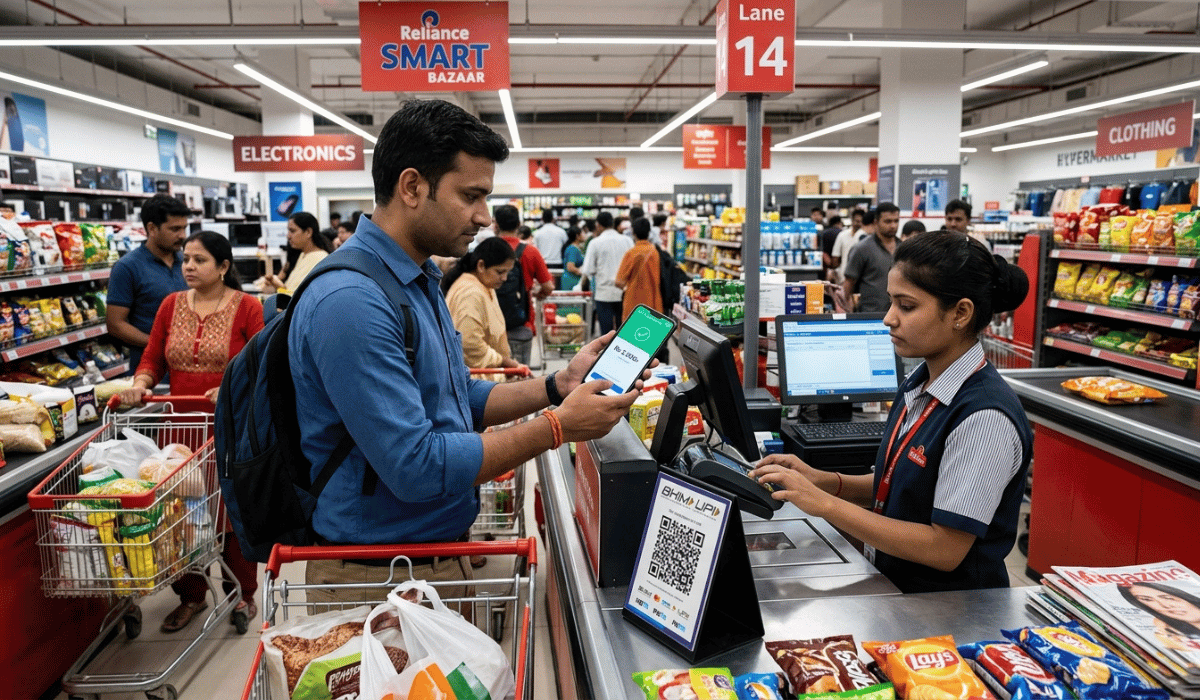
This is the single most misunderstood part of the announcement, and it’s worth repeating clearly: customers do not pay this fee. NPCI has explicitly stated that UPI remains free for the person making the payment. The MDR is charged to the merchant, not the buyer.
That said, there’s a real-world caveat. On paper, UPI stays free for consumers. In practice, some merchants may choose to build the 0.4% cost into their pricing or pass it on informally at the counter, though this hasn’t been widely observed yet. It’s a dynamic worth watching in the weeks after October 15.
Two categories stay untouched regardless:
- All person-to-person (P2P) UPI transfers remain completely free, with no MDR at all.
- Small merchants are exempt from the new fee, at least initially.
The government also used this notification to permanently lock in a separate protection: UPI transactions up to Rs 2,000 and all RuPay debit card transactions will remain free of charges going forward, closing the door on any future speculation about small-value UPI fees.
The Detail Most Articles Are Missing: Automatic Merchant Upgrades
If you run a small business, this is the part you actually need to know. Small merchants currently sit in a category called P2PM (Person-to-Pseudo-Merchant), which is exempt from MDR. But that exemption isn’t permanent or guaranteed.
Here’s the trigger: if a merchant’s inward UPI credit exceeds Rs 1 lakh per month for three consecutive months, NPCI automatically reclassifies that merchant from P2PM to regular P2M status. Once that happens, the 0.4% MDR kicks in on every transaction above Rs 2,000, with no paperwork, no application, no warning email to fill out; it’s an automatic system-level reclassification.
For a growing kirana store, boutique, or home-based business, crossing Rs 1 lakh a month in UPI collections for three straight months is genuinely easy to do, and most owners have no idea this threshold exists until they’re already past it.
How Does UPI’s New MDR Compare to Cards?
Even with the new charge, UPI remains dramatically cheaper for merchants than card payments:
- Credit card MDR: typically 1.5% to 2.5% per transaction
- Debit card MDR: capped at 0.9%
- UPI MDR (new): 0.4%, capped at Rs 300 per transaction, a ceiling that has no equivalent in the card ecosystem
So while this marks the end of a fully free UPI era, merchants are still getting a noticeably better deal than they would with cards.
Is This a New Tax? Clearing Up the Confusion
No, and this distinction matters. MDR is a processing fee charged by the payment ecosystem, not a government tax. Separately, the finance ministry has previously and explicitly clarified that there is no GST being levied on UPI transactions above Rs 2,000, calling such reports “completely false, misleading, and baseless” when they surfaced earlier. The MDR announcement is unrelated to GST and doesn’t reopen that question.
Quick Recap: What Changes on October 15, 2026
- UPI payments above Rs 2,000 to merchants attract a 0.4% MDR, capped at Rs 300.
- Railways, telecom, insurance, fuel, utilities, and agri-input payments attract a flat Rs 5 fee instead.
- Customers pay nothing extra; the fee is borne by merchants.
- All P2P transfers and payments up to Rs 2,000 stay completely free.
- Small merchants crossing Rs 1 lakh/month in UPI receipts for three consecutive months get automatically moved into the fee-paying category.
- This is not a tax, and there is no GST on UPI transactions.
Final Word
This is the biggest shift to UPI’s cost structure since its launch, but it’s a far narrower change than the headlines suggest. Everyday consumers making routine payments won’t feel a difference. The real impact lands on merchants, especially growing small businesses that may cross the Rs 1 lakh monthly threshold without realizing it. If you run a business that accepts UPI payments, now is the time to check where your monthly collections stand and plan for the reclassification before October 15.
This article is based on the NPCI circular dated September 15, 2026, and the finance ministry’s notification dated September 14, 2026. As implementation details can evolve before the effective date, verify current rules directly with NPCI or your payment service provider before making business decisions.