New Delhi, July 3, 2025 — India’s decades-long reliance on Russian military hardware is entering a new phase, if not ending altogether. In a subtle yet significant move, the Indian Navy on July 1 commissioned the INS Tamal, its last warship built by a Russian shipyard. This moment, although quiet, marks the symbolic end of an era dominated by Moscow’s heavy influence on India’s defense procurement.
It also signals a distinct shift as the Admiral Grigorovich-class frigate, outfitted with stealth technology, starts patrolling the Arabian Sea. India now plans to build all major warships domestically. A decision that reflects not just technological progress, but a broader strategic recalibration—one that places greater emphasis on self-reliance and diversification of defense partnerships.
From Strategic Ally to Legacy Partner
Russia once held an unshakable place in India’s defense framework. From tanks and fighter jets to submarines and missiles, Moscow was the backbone of India’s military modernization post-independence. However, the relationship is no longer what it used to be.
Although the S-400 air defense system is still being delivered—three out of five units have arrived, with the remaining two expected by 2026—India has drawn a line. There are no new contracts. No recent announcements. And notably, no signs of interest in Russia’s latest offers.
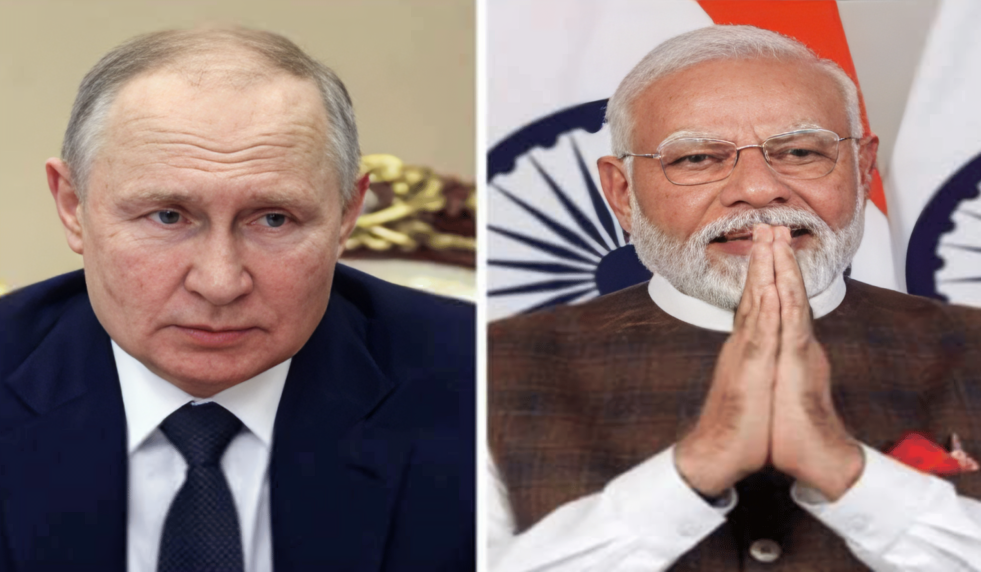
According to official sources, Russian President Vladimir Putin is set to visit India soonMoscow reportedly offered a number of significant deals in advance, including a nuclear submarine lease, more Kalibr cruise missiles, the next-generation S-500 missile defense system, and stealth Su-57 fighter fighters. Yet, New Delhi has shown little enthusiasm.
Strategic Shift Towards Indigenous Capability
What’s behind the cool response? A large part of the reason lies in India’s renewed focus on building its own military platforms. The Advanced Medium Combat Aircraft (AMCA) project is a prime example. Designed as a fifth-generation stealth fighter, AMCA is homegrown and central to India’s future air power.
Even with offers of tech transfer, India no longer finds the Su-57 attractive. The message is clear: build local, reduce dependence.
In addition, a proposed joint helicopter production deal with Russia has stalled indefinitely. There’s also been zero progress on the potential lease of another nuclear-powered submarine. These signs collectively suggest that India is stepping away from long-term hardware dependency on Russia.
Numbers That Reflect the Transition
The data paints a striking picture. In 2009, Russia accounted for 76% of India’s total arms imports. By 2024, that figure had dropped sharply to 36%—the lowest in over 60 years. At the same time, the United States and France have gained significant ground.
Since 2018, American defense companies alone have bagged contracts worth nearly $20 billion from India. French platforms like the Rafale fighter jet have also strengthened New Delhi’s Western pivot.
This shift doesn’t just underline a change in equipment preference. It indicates a broader geopolitical repositioning. One that balances global partnerships while reducing reliance on a single country.
No Disconnect, But a Redefined Relationship
Despite the sharp decline in big-ticket arms deals, India is not cutting Russia off entirely. Most of India’s operational platforms—like MiG fighters, T-90 tanks, and Kamov helicopters—are still of Russian origin. These systems need upgrades, spare parts, and continued technical support.
Therefore, Russia will likely remain a crucial partner in after-sales service and maintenance. The era of billion-dollar defense procurements, however, seems to be ending. What remains is legacy collaboration, not new commitments.
Energy Ties Still Growing
Interestingly, while defense relations cool, energy cooperation is intensifying. In May 2025, India became Russia’s second-largest energy customer, spending over €4.2 billion on imports—72% of which went toward crude oil.
However, this growing energy dependency could attract international scrutiny. U.S. Senator Lindsey Graham recently introduced a bill proposing sanctions on nations conducting large-scale trade with Moscow. India could find itself in Washington’s sights, especially as it balances strategic autonomy with international expectations.
A Deliberate, Calculated Pivot
India’s defense shift isn’t impulsive. It’s part of a deliberate, long-term strategy rooted in both capability development and global realignment.
With China and Pakistan posing persistent threats, India is rethinking its military posture. It no longer wants to depend on foreign-made equipment, especially from a partner facing global sanctions and internal supply chain constraints.
Even during the recent India-Pakistan standoff—where the S-400 system performed impressively—there was no move to procure additional units or transition to the S-500. That’s telling.
Final Deals: INS Tamal and S-400?
With the commissioning of INS Tamal and the nearing completion of the S-400 order, these may very well be the final flagship Russian deals in India’s arsenal. Going forward, the focus seems to be on joint ventures, local production, and multilateral procurement.
India’s defense outlook is evolving. It now prioritizes interoperability, resilience, and sovereignty over legacy loyalties.
Although symbolic, the commissioning of INS Tamal is more than just another warship launch. It’s the closing note of a strategic symphony played over decades. It signals not just the end of a buying spree, but the beginning of a new doctrine.
Conclusion
India is not turning its back on Russia, but it is redefining the terms. From arms deals to strategic posture, the focus is shifting inward and westward. With local projects like AMCA and new partnerships with the U.S. and France gaining momentum, India is charting a new course.
The legacy of Russian defense cooperation will continue—quietly, in repairs and contracts—but the era of frontline acquisitions from Moscow is ending. A new chapter has begun. Less nostalgic, more strategic. And entirely Indian.