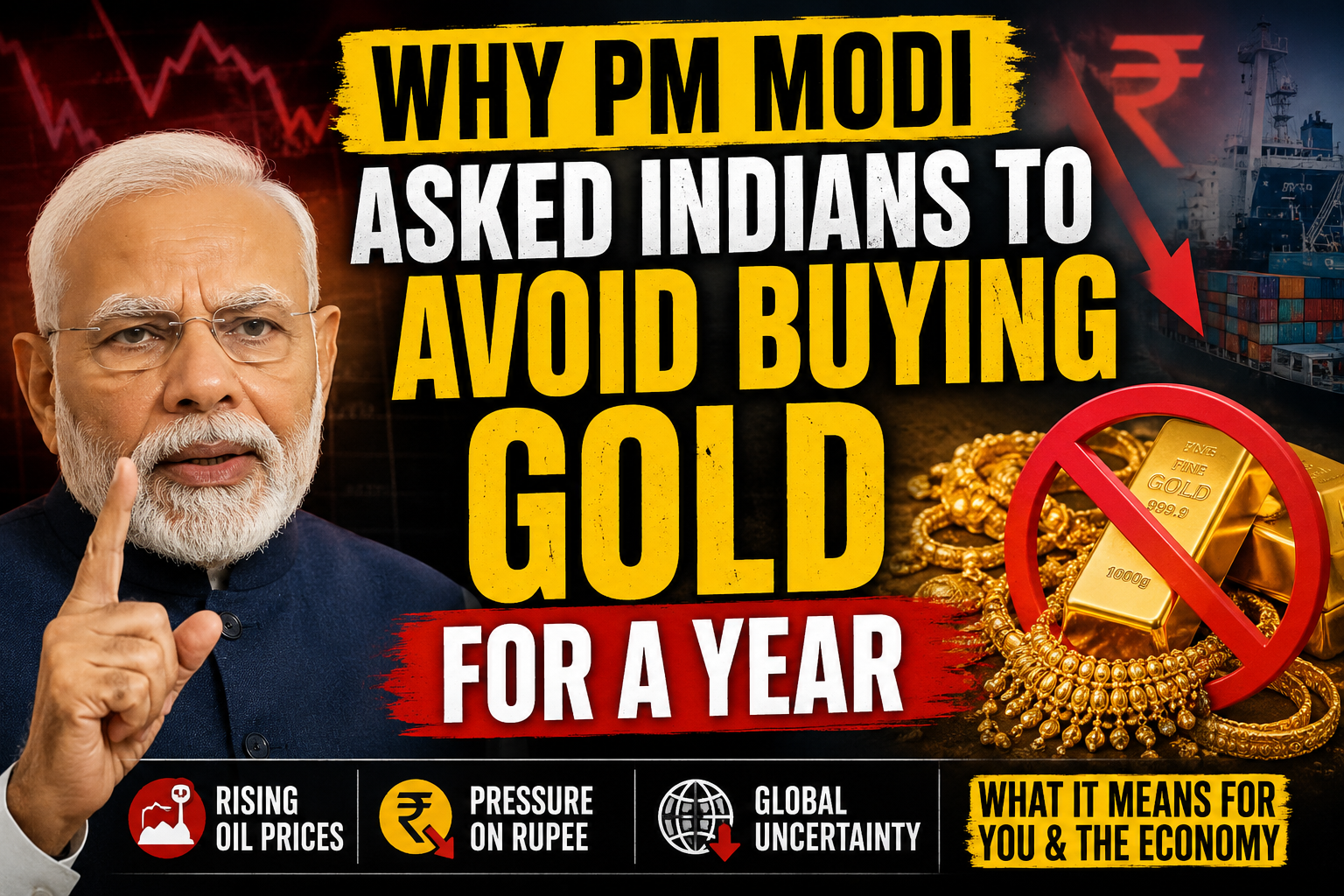
India is witnessing a new economic debate after Prime Minister Narendra Modi urged citizens to avoid buying gold for about a year. The statement has sparked massive discussion across social media, financial circles, jewelry markets, and political groups.
Many people are now asking:
- Is gold buying going to be banned?
- Is India facing an economic crisis?
- Should families stop buying jewelry for weddings?
- What happens to gold prices next?
Here’s the complete explanation behind PM Modi’s appeal and why it matters for every Indian household.
What Exactly Did PM Modi Say?
During a recent public address, PM Modi appealed to Indians to reduce unnecessary spending on imported goods, especially gold. He suggested that if people can postpone gold purchases for a year, it would help the Indian economy during a difficult global situation.
The statement came as:
- crude oil prices continue rising,
- global tensions increase,
- the Indian rupee faces pressure,
- and import bills become more expensive.
The Prime Minister also encouraged:
- saving fuel,
- using work-from-home where possible,
- reducing luxury imports,
- and supporting Indian-made products.
Why Is Gold So Important to India?
India is one of the world’s biggest gold consumers. Every year, Indians buy massive amounts of gold for:
- weddings,
- festivals,
- investments,
- and religious traditions.
Gold holds emotional and cultural value in Indian families. During occasions like:
- Diwali,
- Akshaya Tritiya,
- and weddings,
- gold purchases increase sharply.
But there’s one major issue:
India Imports Most of Its Gold
India does not produce enough gold domestically. That means the country imports huge quantities from abroad and pays in US dollars.
When gold imports rise:
- India spends more foreign currency,
- the trade deficit widens,
- and pressure increases on the rupee.
The Real Economic Concern Behind the Appeal
The government’s concern is mainly about foreign exchange reserves and rising import costs.
Currently, India is already spending heavily on:
- crude oil imports,
- defense needs,
- and essential commodities.
If gold imports remain extremely high at the same time, the economic pressure becomes larger.
How Gold Buying Affects the Economy
When Indians buy imported gold:
- India sends dollars abroad.
- Forex reserves decrease.
- The rupee can weaken.
- Imported products become more expensive.
- Inflation pressure may rise.
This is why the government wants citizens to reduce “non-essential” gold purchases temporarily.
Is Gold Buying Being Banned in India?
No.
This is not a ban.
People can still:
- buy jewelry,
- invest in gold,
- and purchase coins or bars legally.
PM Modi’s statement is only a public appeal asking citizens to cooperate voluntarily in the national interest.
There are currently:
- no restrictions,
- no legal punishment,
- and no gold purchase limits announced.
Why the Timing Matters
The appeal comes at a sensitive global moment.
Several international developments are affecting India:
- Middle East tensions,
- rising crude oil prices,
- global inflation,
- supply chain disruptions,
- and currency market volatility.
Since India imports most of its oil and gold, both sectors heavily impact the economy.
Experts believe the government wants to avoid a situation where:
- import bills rise sharply,
- the rupee weakens rapidly,
- and inflation becomes harder to control.
Political Reactions and Criticism
Opposition leaders quickly reacted to PM Modi’s statement.
Rahul Gandhi criticized the appeal and claimed it reflects economic weakness and policy failure.
Some critics argued:
- ordinary families should not bear the burden,
- wedding traditions cannot easily change,
- and gold is considered financial security for many households.
Others defended the Prime Minister, saying:
- temporary sacrifice can help stabilize the economy,
- reducing imports helps national finances,
- and citizens should support the country during global uncertainty.
How the Jewelry Industry Could Be Affected
India’s jewelry market may experience:
- reduced demand,
- slower sales,
- and changing consumer behavior.
Jewelry businesses especially depend on:
- wedding seasons,
- festivals,
- and investment buyers.
If people delay purchases:
- small jewelers may face difficulties,
- gold loan businesses could slow,
- and rural gold demand may weaken.
However, experts also believe cultural demand for gold in India is extremely strong and unlikely to disappear completely.
Should Investors Stop Buying Gold?
Financial experts say investors should avoid panic.
Gold is still considered:
- a safe-haven asset,
- an inflation hedge,
- and a long-term store of value.
But analysts suggest:
- avoiding emotional buying,
- watching global prices carefully,
- and diversifying investments instead of putting everything into gold.
For many Indians, gold remains both:
- an emotional asset,
- and a financial backup during emergencies.
What Happens Next?
The coming months will be important for:
- oil prices,
- the rupee,
- inflation,
- and India’s import situation.
If global conditions improve, the government may not need further public appeals.
But if economic pressure continues, India could witness:
- stronger import-control discussions,
- higher duties,
- or additional economic conservation measures.
For now, PM Modi’s message appears focused on voluntary public cooperation rather than strict regulation.
Final Thoughts
PM Modi’s request to avoid buying gold for a year is not about banning traditions or stopping people from investing. The government’s main concern is reducing economic pressure caused by massive imports during uncertain global conditions.
Gold remains deeply connected to Indian culture, emotions, and financial security. However, the appeal highlights how global economic events can directly impact everyday consumer choices in India.
Whether citizens follow the advice or not, one thing is clear:
the discussion around gold, imports, and India’s economy has now become a major national conversation.