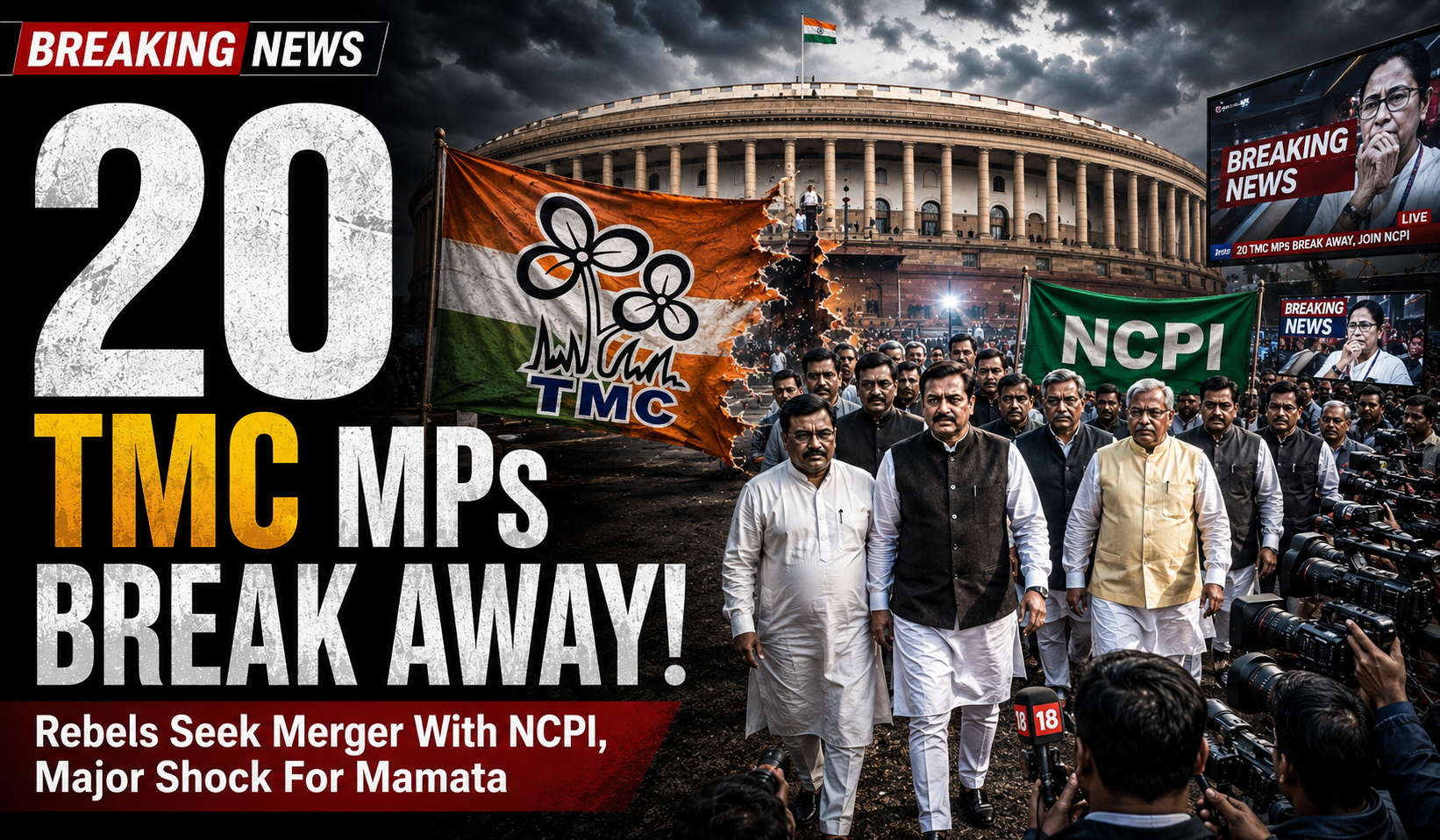
A major political storm has erupted in Indian politics after reports emerged that 20 rebel Members of Parliament (MPs) from the Trinamool Congress (TMC) have sought to merge with the Nationalist Citizens Party of India (NCPI), a little-known political party that is now suddenly at the center of national attention.
The development has sent shockwaves through West Bengal’s political landscape and could potentially alter the balance of power in Parliament if the move receives official recognition. The rebellion represents one of the biggest challenges faced by Chief Minister and TMC supremo Mamata Banerjee in recent years.
What Has Happened?
According to reports, a group of 20 TMC Lok Sabha MPs has informed Lok Sabha Speaker Om Birla about their intention to merge with the Nationalist Citizens Party of India (NCPI). The rebel lawmakers have also reportedly sought separate seating arrangements in Parliament, signaling a formal break from the Trinamool Congress.
The rebel faction is being led by senior TMC MP Kakoli Ghosh Dastidar, who has publicly indicated that the group intends to support the BJP-led National Democratic Alliance (NDA) after completing the merger process.
If the claim of 20 MPs is accurate, the group would represent a substantial majority of TMC’s Lok Sabha strength, making the development politically significant.
Why Is This Move Important?
The rebellion is important because it could significantly weaken the Trinamool Congress at the national level. TMC has long positioned itself as one of the strongest opposition parties against the BJP, particularly in West Bengal.
A split of this magnitude would not only reduce TMC’s parliamentary influence but could also strengthen the NDA numerically in the Lok Sabha.
Political analysts believe the move may have long-term implications for West Bengal politics, especially with future Assembly and parliamentary elections on the horizon.
Who Is the NCPI?
The Nationalist Citizens Party of India (NCPI) is a relatively small political party that has largely remained outside the national spotlight. Based in Tripura and registered in West Bengal, the party has had minimal presence in Parliament until now.
However, if the merger is recognized, NCPI could suddenly become one of the larger allies within the NDA framework, dramatically increasing its national relevance.
The party’s unexpected rise has sparked curiosity among political observers, many of whom had never considered it a major player in Indian politics.
The Anti-Defection Law Question
One of the biggest questions surrounding the rebellion is whether the move complies with India’s anti-defection law.
Under the Tenth Schedule of the Constitution, lawmakers can face disqualification if they defect from their party. However, provisions exist regarding mergers when a significant proportion of elected representatives support the move.
Legal experts are divided on whether the proposed merger meets all constitutional requirements. The final decision may ultimately rest with the Speaker and could face judicial scrutiny if challenged.
The issue is expected to trigger intense legal and political debates in the coming weeks.
TMC’s Likely Response
The Trinamool Congress is expected to strongly oppose the move. Party leaders have already indicated that they view the rebellion as a betrayal of the mandate received from voters.
Political observers believe the TMC leadership may seek the disqualification of the rebel MPs and challenge the merger before appropriate constitutional authorities.
For Mamata Banerjee, the episode represents not only a parliamentary challenge but also a test of her leadership ahead of future elections.
Impact on National Politics
The implications extend far beyond West Bengal.
A successful merger could:
- Strengthen the NDA’s position in Parliament.
- Reduce the opposition’s numerical strength.
- Trigger further political realignments ahead of future elections.
- Encourage similar rebellions in other regional parties.
The development is also being closely watched by opposition parties, which fear that a successful split could create a precedent for future defections and political restructuring.
What Happens Next?
The coming days are likely to be crucial. The Lok Sabha Speaker will have to examine the claims made by the rebel MPs and determine whether the proposed merger satisfies constitutional and parliamentary requirements.
Meanwhile, legal challenges from the Trinamool Congress appear almost certain. Political negotiations, public statements, and courtroom battles may all play a role in deciding the final outcome.
Until a formal decision is made, uncertainty will continue to surround the status of the rebel lawmakers and the future of the Trinamool Congress in Parliament.
Conclusion
The attempt by 20 rebel Trinamool Congress MPs to merge with the Nationalist Citizens Party of India has triggered one of the most dramatic political developments of the year. Whether the move ultimately succeeds or is blocked through legal and constitutional mechanisms, it has already exposed significant cracks within one of India’s most prominent opposition parties.
As the political and legal battle unfolds, the outcome could reshape both West Bengal politics and the broader national political landscape in the months ahead.