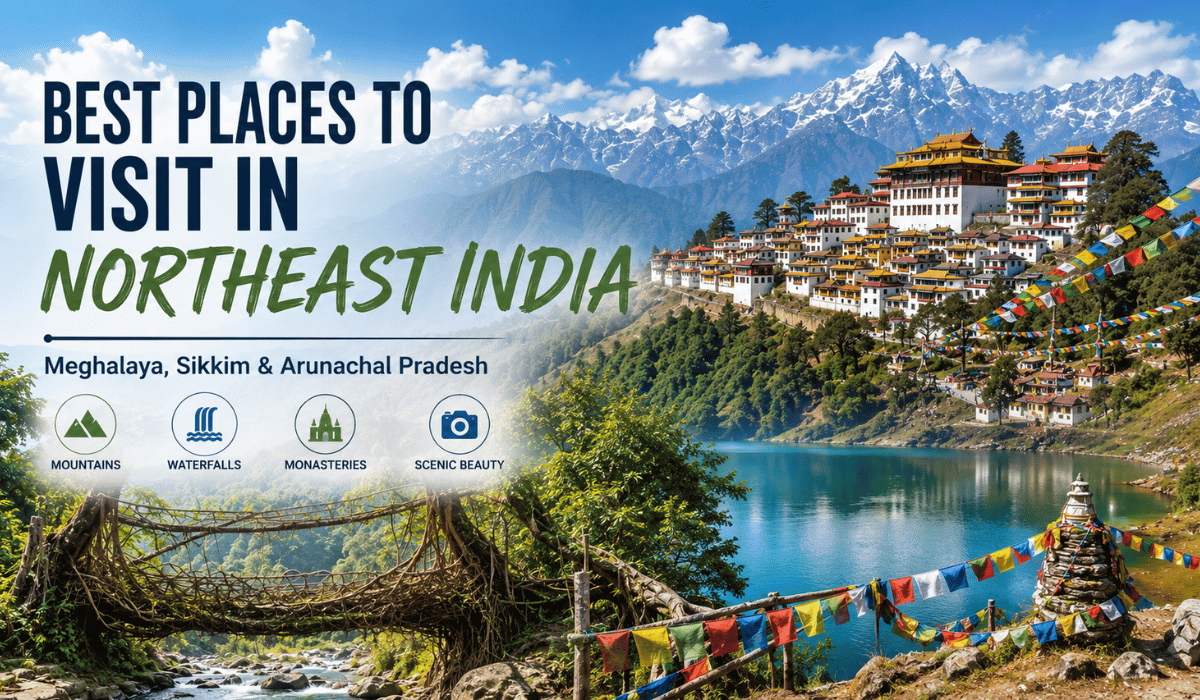
Northeast India remains one of the country’s most underexplored regions, despite offering some of its most dramatic landscapes: living root bridges, glacial lakes, snow-capped Himalayan passes, and centuries-old monasteries. The majority of major Indian cities may be reached in a few days. This guide covers the best places to visit across three of the region’s most rewarding states, Meghalaya, Sikkim, and Arunachal Pradesh, along with the permits, timing, and practical details you’ll actually need to plan the trip.
Meghalaya: Living Root Bridges and Waterfalls
Meghalaya is the easiest of the three states to visit, since Indian citizens don’t need any permit to enter. It’s known for its Khasi and Jaintia hill culture, some of the highest rainfall on Earth, and a genuinely unique style of “living” architecture built entirely from tree roots.
Shillong
The state capital and the natural base for most Meghalaya trips, Shillong is known for its cool climate, colonial-era architecture, and lively cafe culture. Nearby highlights include Elephant Falls, Shillong Peak for panoramic city views, and the Mawphlang Sacred Forest, a centuries-old grove protected by local tradition.
Cherrapunji (Sohra)
Once recorded as the wettest place on Earth (a title now held by nearby Mawsynram), Cherrapunji is home to some of the region’s most striking natural sites. The Double Decker Living Root Bridge in Nongriat village is the star attraction, a genuine feat of Khasi tribal engineering built by training rubber tree roots across a river over decades. Reaching it involves a trek of roughly 3,000 steps down into the valley, so it’s better suited to families with older kids or teens rather than very young children. Other highlights around Cherrapunji include Nohkalikai Falls, India’s tallest plunge waterfall, the Mawsmai limestone caves, and Seven Sisters Falls.
Dawki and Mawlynnong
Dawki sits on the India-Bangladesh border and is famous for the Umngot River, whose water is so clear that boats appear to float on air in photographs. Nearby Mawlynnong is often called Asia’s cleanest village, a small, spotless Khasi settlement with bamboo walkways and a laid-back, community-run tourism model.
Permits needed: None. Meghalaya is open to all Indian citizens without any inner line permit. Best time to visit: October to May for the clearest skies and easiest travel conditions. The monsoon months of June to September bring Meghalaya’s waterfalls to their most dramatic, but travel becomes considerably harder, with slippery trails and heavy rainfall to plan around.
Sikkim: Himalayan Lakes and Monasteries
Sikkim is generally considered the most accessible of the three states for first-time Northeast travelers, with good road and air connectivity and a well-developed tourism circuit around Gangtok.
Gangtok
Sikkim’s capital sits at around 1,650 meters in the Eastern Himalayas and serves as the base for most Sikkim itineraries. Key spots include MG Marg, a pedestrian-only promenade lined with cafes and shops, Rumtek Monastery, one of the largest monasteries of the Kagyu school of Tibetan Buddhism, and Enchey Monastery.
Tsomgo Lake and Nathu La Pass
Tsomgo Lake (also called Changu Lake), around 40 km from Gangtok at roughly 12,400 feet, is a glacial lake surrounded by snow-capped peaks, alpine flowers, and a small lakeside Shiva temple. Many visitors combine it with a trip to Nathu La Pass, one of the official trading border posts between India and China and among the highest motorable roads in the world, at over 14,000 feet.
Yumthang Valley
Often called the “Valley of Flowers of Sikkim,” Yumthang Valley in North Sikkim is known for its rhododendron blooms, typically at their best between February and June, along with snow-capped peaks and a nearby hot spring. It’s usually visited as part of a Lachung stay, roughly a five-hour drive from Gangtok.
Pelling
About 115 km from Gangtok in West Sikkim, Pelling offers close-range views of the Kanchenjunga range and is home to the Pemayangtse Monastery, one of Sikkim’s oldest and most important Buddhist monasteries.
Permits needed: Indian citizens do not need a general permit to enter Sikkim itself, but restricted zones, including Tsomgo Lake, Nathu La Pass, and the entire North Sikkim circuit (Lachen, Lachung, Yumthang Valley), require a Restricted Area Permit. This is typically arranged through a registered tour operator or local travel agency rather than applied for independently, and most Gangtok-based operators build it directly into their tour packages. Best time to visit: March to June and October to mid-December for the clearest weather and easiest road access. Winter (January to March) brings snow and frozen lakes, which look striking but can make road access to North Sikkim unpredictable.
Arunachal Pradesh: Monasteries and Mountain Passes
Arunachal Pradesh is the most remote and least-visited of the three states, bordering Tibet, Myanmar, and Bhutan, and it requires the most planning of the three, largely due to permit requirements and longer travel distances.
Tawang
Tawang, at around 3,000 meters, is home to Tawang Monastery, one of the largest Buddhist monasteries in India and second only to Lhasa’s Potala Palace in size within the region. The journey there from Guwahati is roughly 450 km and typically takes multiple days, with overnight stops at towns like Bomdila and Dirang along the way, which is why most Tawang itineraries run 7 to 8 days rather than being treated as a single destination trip.
Ziro Valley
Home to the Apatani tribe, Ziro Valley is known for its pine-covered hills, terraced rice fields, and unique tribal culture. It’s also home to the Ziro Festival of Music, an independent outdoor music festival usually held in September, which has become one of Northeast India’s most well-known cultural events.
Bomdila and Dirang
Both towns sit along the road between Tezpur and Tawang and are typically used as overnight stops rather than final destinations. Bomdila offers views of Kangto and Gorichen, Arunachal’s highest peaks, along with a large monastery known for its detailed murals. Dirang, tucked between Bomdila and Sela Pass, is known for natural hot springs, a centuries-old stone fortress called Dirang Dzong, and a yak research center.
Sela Pass
At over 4,000 meters, Sela Pass is one of the most scenic stretches on the route to Tawang, with a high-altitude lake and dramatic mountain views, and is typically crossed as part of the journey rather than visited as a standalone destination.
Permits needed: An Inner Line Permit (ILP) is mandatory for all Indian citizens who aren’t residents of Arunachal Pradesh, regardless of whether you’re traveling by road or air. Children aged 14 and above need their own ILP, while younger children can be included on a parent’s permit. It can be applied for online in advance or arranged through a travel operator. Foreign nationals require a separate Protected Area Permit (PAP) instead, and citizens of a small number of countries aren’t permitted entry into the state at all. Best time to visit: October to April for the most pleasant weather across the state. Summer (April to June) can get uncomfortably warm at lower altitudes, and the monsoon months of July to September often close roads and attractions due to heavy rainfall and landslides.
Comparing Permits Across the Three States
Since permit rules are one of the most common points of confusion for first-time Northeast travelers, here’s a quick comparison:
- Meghalaya: No permit required for Indian citizens.
- Sikkim: No permit required for the state itself, but a Restricted Area Permit is needed for Tsomgo Lake, Nathu La, and the North Sikkim circuit, usually arranged through a local operator.
- Arunachal Pradesh: An Inner Line Permit is mandatory for all Indian citizens for the entire state and applied for online or through a travel agency in advance.
Planning Tips for a Northeast India Trip
- Combine states where the geography allows it. Meghalaya and parts of Assam pair naturally together, while Sikkim is often combined with Darjeeling. Arunachal Pradesh, given its distances, is usually best treated as a dedicated trip rather than an add-on.
- Book permits and operators in advance for Sikkim and Arunachal. Since restricted area permits and ILPs are typically processed through registered agencies, arranging this a couple of weeks ahead avoids last-minute delays.
- Pack for altitude, even in summer. Places like Tsomgo Lake, Yumthang Valley, and Sela Pass sit well above 10,000 feet, and temperatures can drop sharply even during the warmer months.
- Avoid peak monsoon (June to September) for Arunachal and much of Sikkim’s North Circuit, since road access becomes unreliable. Meghalaya, by contrast, is genuinely worth visiting during monsoon if you don’t mind slower travel, since its waterfalls are at their most dramatic during this period.
- Build in buffer days. Mountain roads across all three states are prone to weather-related delays, so a rigid, tightly packed itinerary tends to cause more stress than it’s worth.
Final Thoughts
Meghalaya, Sikkim, and Arunachal Pradesh each offer a genuinely different flavor of the Northeast, from Meghalaya’s root bridges and waterfalls to Sikkim’s accessible Himalayan lakes and monasteries to Arunachal’s remote passes and tribal culture. None of the three require the same kind of planning, so it’s worth deciding early which state fits your timeline, comfort with permits, and appetite for longer travel days and building the itinerary around that rather than trying to force all three into a single short trip.
Frequently Asked Questions
Does visiting Meghalaya require a permit?
No. Meghalaya doesn’t require any Inner Line Permit or restricted area permit for Indian citizens.
Do I need a permit for Sikkim?
Not for the state itself, but you’ll need a Restricted Area Permit for Tsomgo Lake, Nathu La Pass, and the North Sikkim circuit (Lachen, Lachung, and Yumthang Valley). This is usually arranged through a local tour operator rather than applied for independently.
Is an inner line permit required for Arunachal Pradesh?
Yes, all Indian citizens who aren’t residents of the state need an ILP to enter Arunachal Pradesh, whether traveling by road or air. It can be applied for online or through a travel agency.
Which of the three states is easiest for a first Northeast trip?
Sikkim tends to be the most beginner-friendly, with good road and air connectivity, a well-developed tourism circuit, and simpler permit requirements than Arunachal Pradesh.
Can I visit all three states in one trip?
It’s possible but ambitious, since Arunachal Pradesh in particular involves long travel distances and its own permit process. Many travelers choose to focus on one or two states per trip rather than trying to cover all three at once.
What’s the best time of year to visit the Northeast overall?
October to April generally offers the most reliable weather across all three states, though Meghalaya is a partial exception, since its waterfalls are genuinely at their best during the monsoon months, despite the harder travel conditions that come with it.