The Constitution (130th Amendment) Bill, introduced by Union Home Minister Amit Shah, caused a political commotion in Parliament. The proposed law, which seeks to disqualify ministers, including the Prime Minister and Chief Ministers, if they are jailed for more than 30 days in serious criminal cases, has drawn fierce opposition. While the government describes the move as an attempt to raise ethical standards in politics, critics call it unconstitutional and a step toward authoritarianism.
At its heart, the Bill is about more than legislation—it is also about political optics. To understand its significance, one must look at its provisions, the objections it has raised, and the practical hurdles it faces.
What the Bill Proposes
The Constitution Amendment Bill seeks changes in three articles—75, 164 and 239AA—that deal with the Prime Minister, Chief Ministers, and ministers at both central and state levels. The key provision is that if any such officeholder is arrested and remains in custody for more than 30 days on charges that carry a minimum punishment of five years, they will automatically be removed from their post.
The law does not require a conviction. A mere allegation, coupled with custody beyond 30 days, is sufficient for disqualification. However, it allows the same individual to be reappointed once released.
The government justifies this on grounds of morality and public trust. The “statement of objects and reasons” says that ministers must act above political interests and that their conduct should be beyond suspicion. Allowing individuals facing grave charges to continue in office, it argues, damages good governance and diminishes people’s faith in the Constitution.
Opposition’s Objections
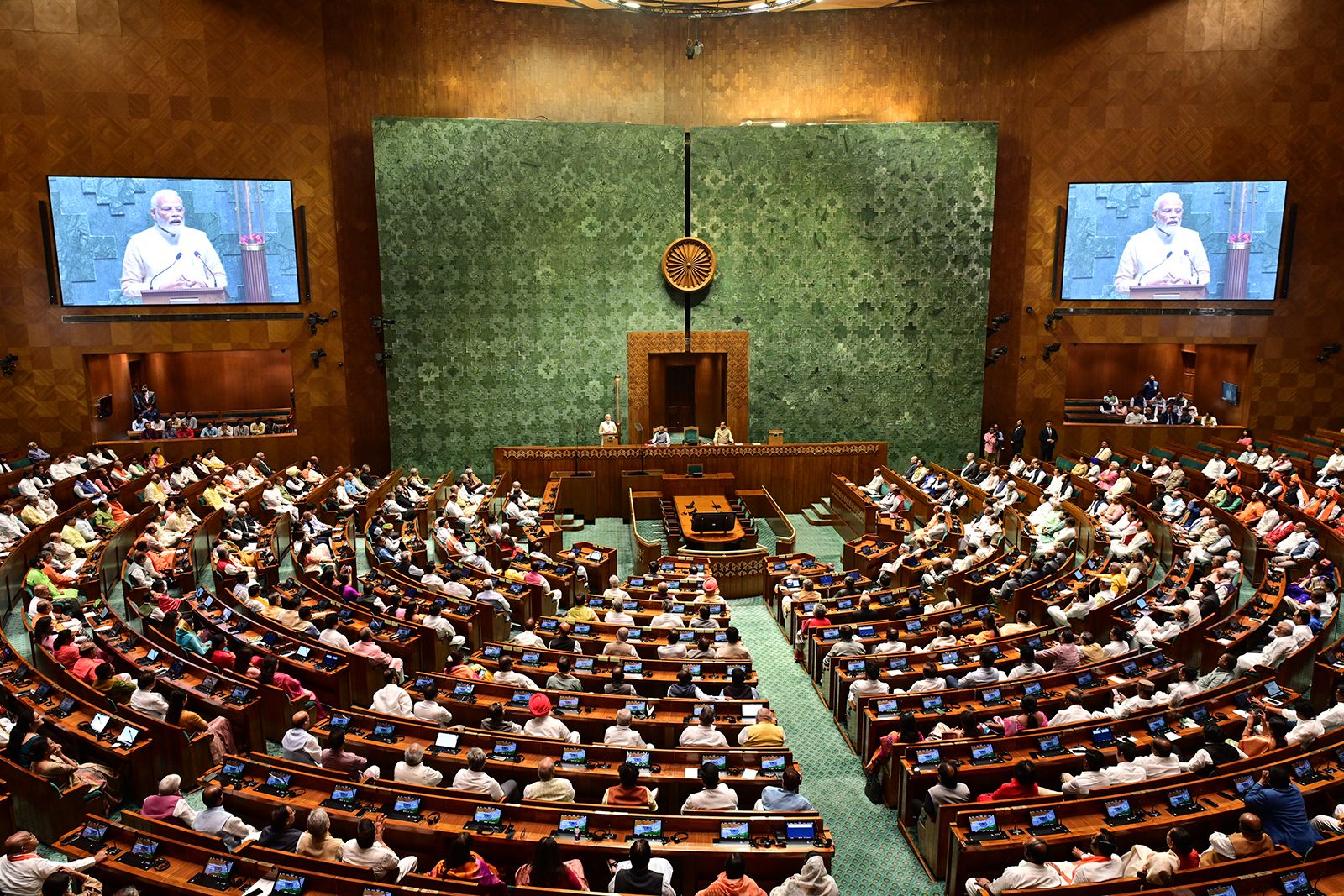
The Bill’s introduction triggered chaos in the Lok Sabha. Members of several opposition parties tore up papers and hurled them toward the Home Minister in protest.
The Opposition’s criticism is threefold:
- Misuse of agencies – Parties allege that the ruling BJP could misuse central agencies such as the CBI and ED to target non-BJP leaders, have them arrested, and destabilise state governments.
- Violation of constitutional principles – Critics say the proposal undermines the principle of “innocent until proven guilty”. Since disqualification would take place without a conviction.
- Threat to democracy – Leaders argue that the law would erode individual freedoms and push India closer to becoming a “police state”.
Congress leader Priyanka Gandhi Vadra called the bill “draconian”, while Trinamool Congress MP Abhishek Banerjee said it was designed to retain power without accountability. Shiv Sena (UBT) claimed it marked a step towards dictatorship. Also, AIMIM chief Asaduddin Owaisi described it as “the final nail in the coffin of elected governments.”
The Numbers Game
The bill must pass a correct constitutional process in order to become law. It takes a 2/3 majority in both Houses of Parliament to modify the constitution.
- In the Lok Sabha, with 542 members, at least 361 votes are needed. The NDA holds 293 seats, far short of the mark.
- In the Rajya Sabha, 160 votes are required. The NDA has only 132.
Even with the support of neutral or smaller parties, the government cannot secure the numbers. After passage in Parliament, at least half the states and union territories would also need to approve it. Legal experts further note that the Bill could face challenges in the Supreme Court for violating the Constitution’s basic structure.
Timing and Strategy
The Bill was started on the penultimate day of the Monsoon Session. Interestingly, its listing already suggested that it would be referred to a Joint Parliamentary Committee (JPC) for further study, rather than rushed through. The Speaker has now confirmed this, with a 31-member panel from both Houses set to examine the proposal. This process is expected to be lengthy.
The government is not in a rush, as seen by the scheduling and procedural decisions. Analysts suggest the aim may not be immediate legislation but rather to send a political message.
A Political Battle of Optics
Given the near-impossible numbers, why would the government introduce a Bill that it knows cannot pass? The answer appears to lie in shaping public perception.
By presenting the bill as an anti-corruption measure, the ruling party positions itself as a champion of clean politics. At the same time, it can portray the Opposition’s resistance as reluctance to act against criminality. This turns the political debate into one where the government claims the moral high ground, even without legislative success.
Amit Shah himself drew this contrast when he reminded the House that he resigned as Gujarat’s Home. Minister before his arrest in 2010, arguing that current leaders lack such moral standards.
Opposition leaders, on the other hand, see the move as a distraction. Trinamool MP Mahua Moitra asserted that the government is trying to divert criticism away from allegations of election fraud and is conscious of its numerical deficiencies.
Government’s Stand
Government sources insist the bill’s purpose is to address a constitutional gap exposed during the arrest of former Delhi Chief Minister Arvind Kejriwal. His refusal to resign, they argue, revealed that the Constitution offers no clarity on whether a minister in custody must step down.
Officials also suggest that waiting before introducing the Bill helped avoid the appearance of targeting one individual. They maintain that the legislation is not about persecution, as any accused leader can approach courts for relief.
Importantly, insiders admit that the Bill’s passage is not the ultimate goal. “Even if it does not become law, it puts the Opposition in the dock,” a source said. The underlying strategy is to build a narrative that the Opposition is soft on corruption if it resists the measure.
Conclusion
The Constitution (130th Amendment) Bill is unlikely to clear Parliament in its current form. The NDA lacks the numbers, legal challenges loom large, and state approvals would be required. Yet, as a political tool, the Bill has already served its purpose—triggering heated debate, spotlighting corruption in politics, and putting the Opposition on the defensive.
Also Read: Parliamentary Uproar Over Amit Shah’s Ambedkar Remarks; PM Modi Defends Home Minister