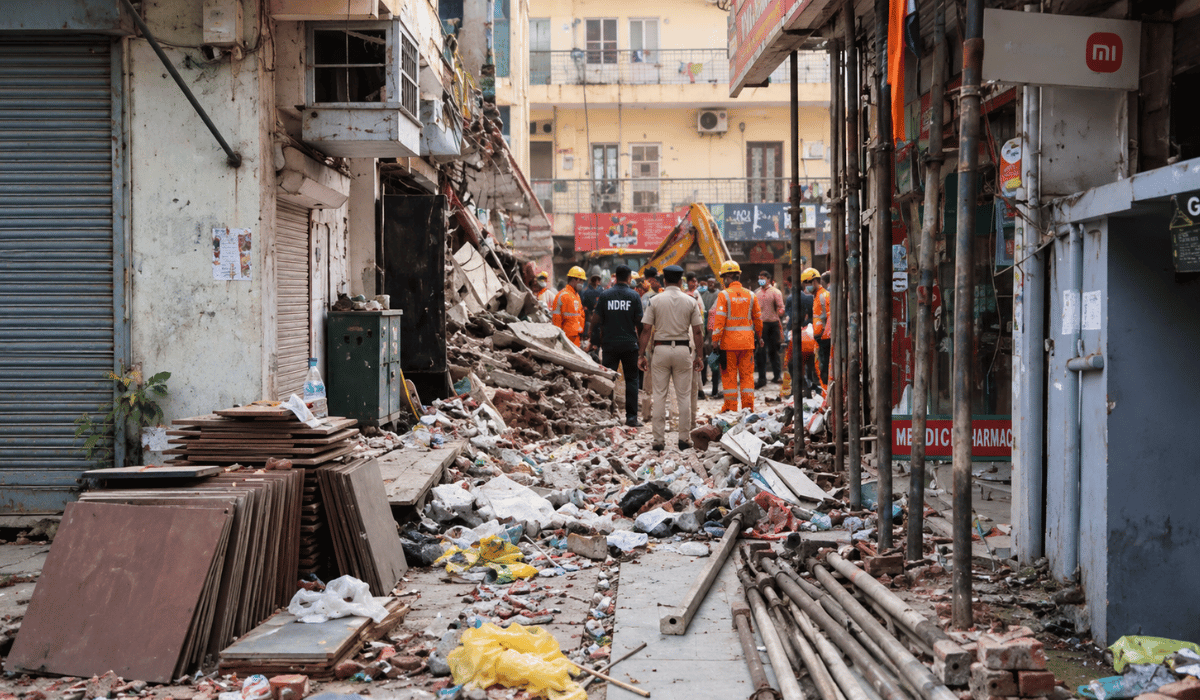
Delhi’s Satya Niketan, a neighborhood synonymous with student life near Delhi University’s South Campus, was thrown into chaos in early September 2026 when a decades-old building housing a boys’ PG hostel collapsed without warning. What followed was a frantic rescue operation, a confirmed death toll, a multi-state manhunt for the building’s owner, and now, a growing wave of allegations from students that the true scale of the tragedy hasn’t been fully disclosed. Here’s what’s known so far and what remains contested.
A Tragedy in Delhi’s Student Hub
On a Sunday afternoon in early September 2026, a decades-old five-story building housing a boys’ paying-guest (PG) hostel came crashing down in Satya Niketan, a densely packed residential pocket next to Delhi University’s South Campus. Within minutes, one of the city’s busiest student neighborhoods turned into a rescue site, with the National Disaster Response Force (NDRF), fire crews, and local police racing to pull survivors from the debris.
For anyone even loosely familiar with South Campus, the location is significant. Satya Niketan is where thousands of students from across India rent rooms every year, drawn by its proximity to college, its dense cluster of PGs, and rents that are (relatively) affordable for a city like Delhi. That same density, built up over decades with little oversight, is now at the center of the tragedy.
What Caused the Collapse
Early assessments point to a familiar and troubling combination: an aging structure, unauthorized construction, and neglected maintenance. The building was reportedly around 50 years old, located in a congested bylane, and had reportedly undergone basement repair work shortly before it gave way. Waterlogging in the area has also been flagged as a possible contributing factor, raising uncomfortable questions about civic oversight in a neighborhood that houses so many young residents.
Adjoining structures were found to be similarly fragile. Authorities installed iron support jacks on nearby buildings and evacuated an adjacent women’s PG as a precaution, underlining how widespread the risk in the area may be, not just in the single building that fell.
The Official Death Toll
Officials confirmed the death toll at seven, with around a dozen people rescued from the rubble, several of them requiring hospital treatment. Delhi’s government ordered an end-to-end rescue and clearance operation, with heavy machinery deployed to ensure no one remained trapped.
It’s worth being precise here: in the chaotic early hours after any building collapse, casualty figures tend to shift as rescue operations progress. The number seven is what has been officially confirmed by authorities; readers following the story should treat any unofficial or crowd-sourced figures with caution until confirmed through official channels.
Arrests and Accountability
In the days after the collapse, Delhi Police launched a multi-state manhunt for the building’s owner, identified in reports as Hari Ram (also referred to as Hariram Bansal), who had gone untraceable. He was eventually tracked down and arrested in Bhiwadi, Rajasthan, along with family members also named in the case. A Look Out Circular had been issued against him earlier, and an FIR was registered soon after the incident.
The fallout didn’t stop at the building’s owner. The Delhi High Court, hearing a plea related to the collapse, reportedly held Delhi University and the Municipal Corporation of Delhi (MCD) partly responsible as well, pointing to a broader failure of institutional oversight in a neighborhood where thousands of students live in largely unregulated private housing. The Delhi government has since ordered city-wide structural audits and a crackdown on unauthorized construction, particularly in areas with a high concentration of student housing.
Students Allege the Toll Was Misreported
As the visible crisis of rescue and rubble-clearing gave way to a demolition drive around the collapse site, a new controversy emerged: students in the area began alleging that the official death toll did not reflect the true scale of the tragedy. Some residents reportedly chose to vacate the neighborhood altogether as demolition work proceeded nearby, citing both safety fears and mistrust in how information was being communicated.
It’s important to be clear about the nature of this claim: as of now, it remains an allegation raised by students and residents, not an independently verified fact. Authorities have not confirmed any discrepancy in the official numbers. Still, the allegation itself speaks to a deeper trust deficit, one that isn’t unique to this incident. Students have drawn comparisons to the July 2024 case in Old Rajinder Nagar, where three civil services aspirants died after a coaching center basement flooded, another tragedy that triggered public anger over accountability and transparency in how authorities handled the aftermath.
Why This Story Matters Beyond Satya Niketan
Strip away the specifics, and this incident sits inside a much larger, recurring problem in Indian cities: aging buildings converted into dense, informal student housing with minimal regulatory scrutiny. Delhi’s South Campus is far from alone; most Indian university towns have some version of Satya Niketan, where landlords maximize every square foot of a structure never designed to hold that many residents, and civic bodies rarely inspect until something goes wrong.
The city-wide structural audit ordered in the aftermath is a start, but audits alone don’t fix decades of unauthorized construction, absent fire-safety norms, or a rental market where students have little bargaining power over the safety of the buildings they live in. Whether this collapse becomes a genuine turning point for regulation or another tragedy that fades from the news cycle once the visible crisis passes will depend on what happens in the months after the headlines move on.
The Bigger Question
For now, rescue operations have ended, arrests have been made, and structural audits are underway. But the questions students are raising, about transparency, about who is truly accountable, and about whether their landlords’ buildings are safe at all, are unlikely to be resolved as quickly as the debris was cleared.
For the latest developments and detailed background on the incident, readers can refer to Wikipedia’s ongoing coverage of the 2026 Satya Niketan building collapse and Outlook India’s reporting on the arrests and High Court proceedings.