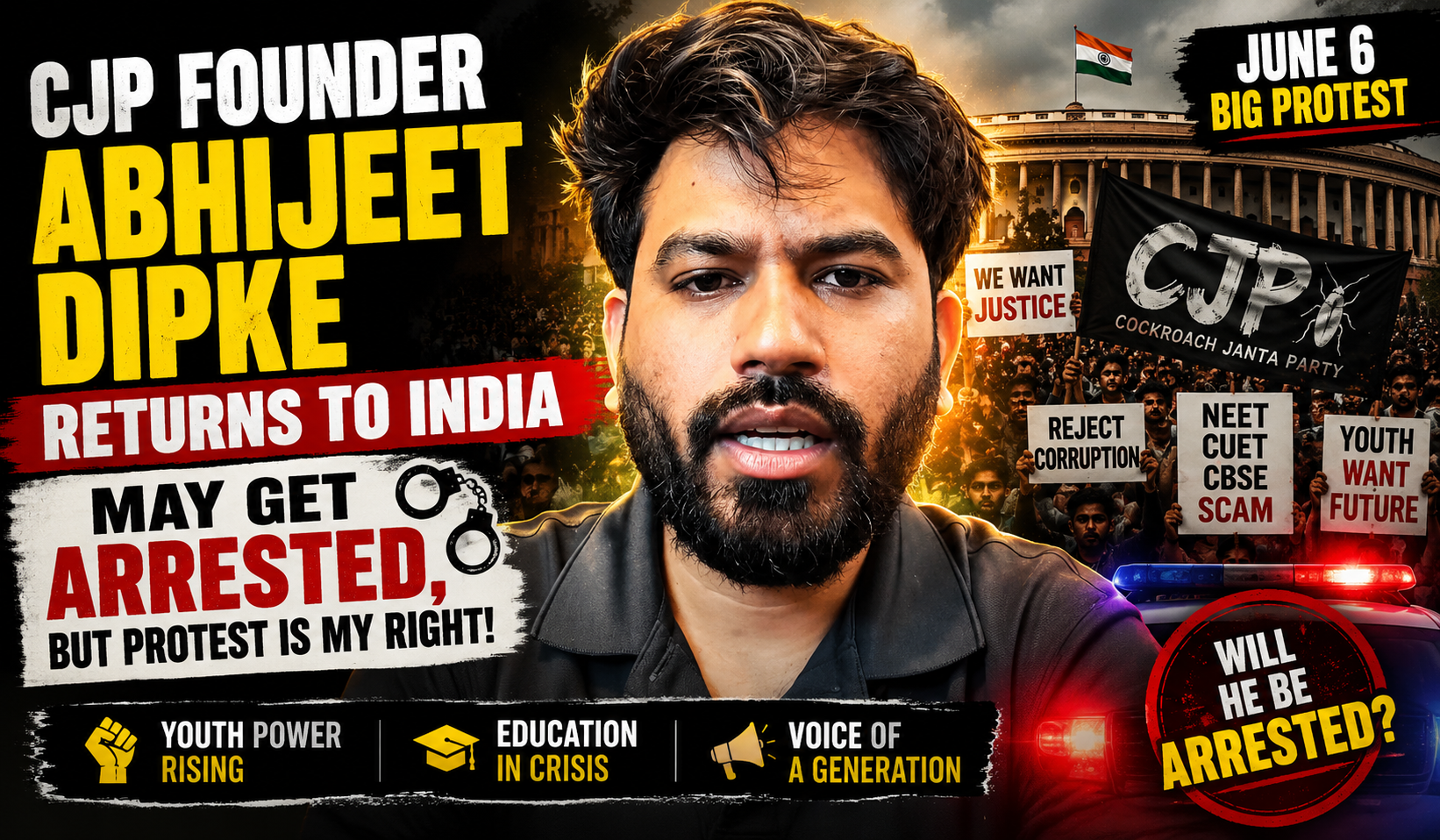
CJP Founder Abhijeet Dipke Says He May Be Arrested
A new youth-driven movement is rapidly gaining attention across India, fueled by frustration over education policies, examination controversies, unemployment, and government accountability. At the center of this movement is Abhijeet Dipke, founder of the Cockroach Janta Party (CJP), a social media phenomenon that has captured the imagination of millions of young Indians.
Dipke recently made headlines after announcing that he would return to India from the United States on June 6 to participate in a protest demanding accountability from the government, particularly concerning issues related to educational examinations. In a statement that quickly went viral, he acknowledged the possibility of being arrested upon arrival but insisted that peaceful protest is a constitutional right and that he intends to exercise it.
The announcement has sparked widespread debate about freedom of expression, youth activism, and the growing role of social media in shaping political discourse in India.
Who Is Abhijeet Dipke?
Abhijeet Dipke is the founder of the Cockroach Janta Party (CJP), a movement that began as a social media campaign but has evolved into a broader platform for youth concerns.
Unlike traditional political organizations, CJP relies heavily on digital engagement. Through viral videos, online discussions, and social media campaigns, the movement has attracted a large following among students and young professionals.
Dipke’s messaging often focuses on issues that directly affect younger generations, including:
- Examination transparency
- Employment opportunities
- Educational reforms
- Government accountability
- Youth participation in democracy
His straightforward style and willingness to challenge established institutions have helped him gain significant visibility online.
The Protest Announcement
The latest controversy began when Dipke announced plans to return to India and participate in a public demonstration scheduled for June 6.
According to his public statements, the protest seeks accountability over several education-related controversies, including concerns surrounding national examinations and student welfare.
Dipke has argued that peaceful protest is a fundamental democratic right and that citizens must be allowed to express concerns regarding public policy.
What attracted the most attention, however, was his acknowledgment that authorities could potentially detain or arrest him.
Despite that possibility, he stated that he intends to proceed with the planned protest, describing it as a matter of democratic principle rather than personal gain.