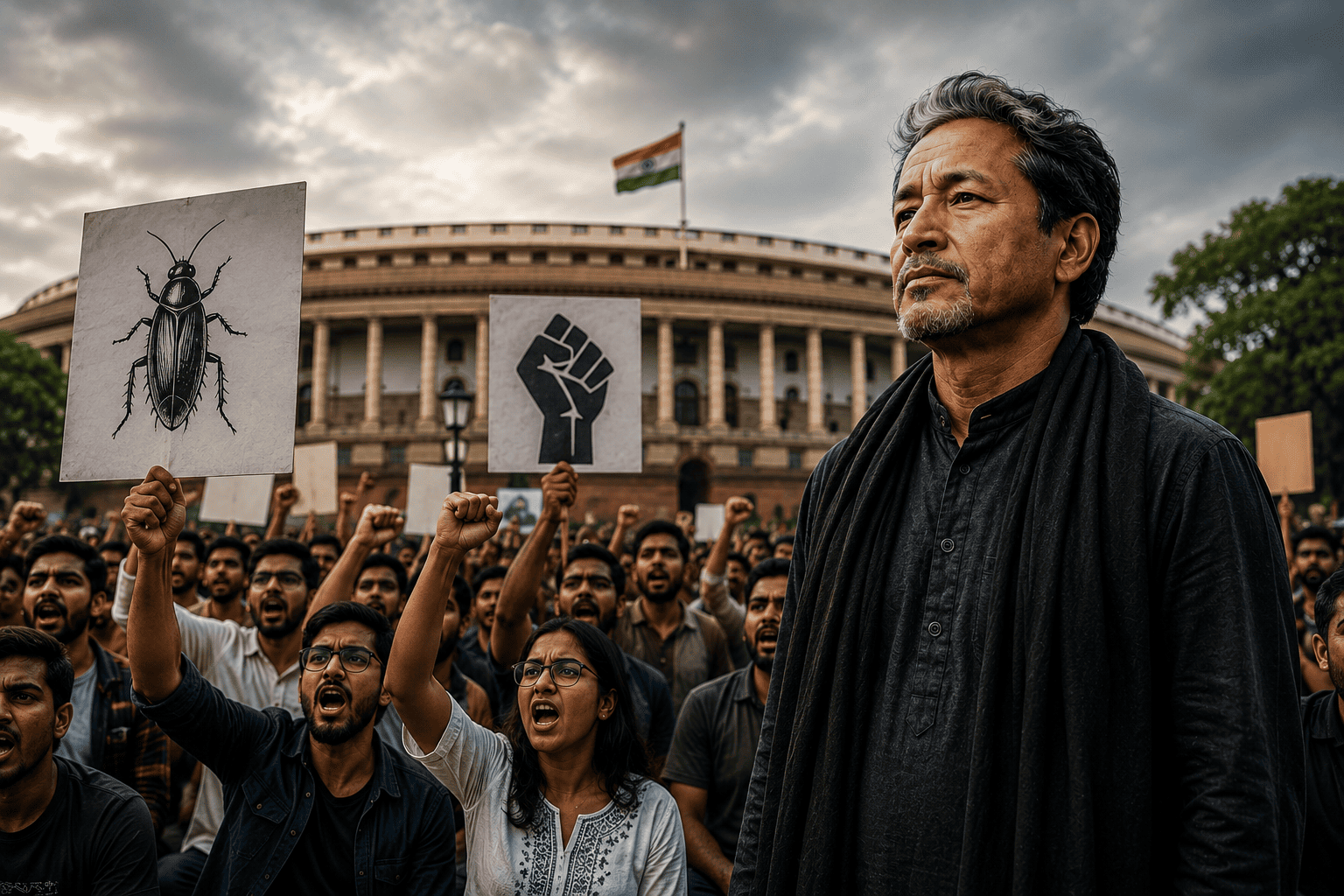
The CJP party, short for the Cockroach Janta Party, has driven one of the most disruptive protest movements India has seen in years. It has overshadowed this year’s Monsoon Session of Parliament with a month-long standoff at Jantar Mantar. Student anger over exam paper leaks sparked it. Now it has grown into a direct confrontation between the government and this Gen Z-led movement. Veteran activist Sonam Wangchuk sits at the center of it, fasting from a hospital bed in solidarity with the CJP party’s demands.
Here’s how the CJP party’s protest has developed and where things stand as of July 23, 2026.
How the CJP Party Started: A Paper Leak That Wouldn’t Go Away
The unrest traces back to a major NEET (National Eligibility cum Entrance Test) paper leak earlier this year. It affected millions of medical entrance exam aspirants across India. CBSE Class 12 portal glitches and delays in the CUET exam compounded the anger. Students began to see it as proof that India’s education system was failing them at a systemic level.
Out of that frustration came the CJP party (Cockroach Janta Party), a satirical, Gen Z-founded protest movement led by Abhijeet Dipke. Scattered demonstrations broke out in early June. They evolved into an organized sit-in at Jantar Mantar. Eventually, one demand rose above the rest: the resignation of Union Education Minister Dharmendra Pradhan.
Sonam Wangchuk Joins the CJP Party’s Fight
Sonam Wangchuk needs little introduction in India. They engineer-turned-education-reformer inspired the character Phunsukh Wangdu in the Bollywood blockbuster 3 Idiots. He has spent years campaigning for causes ranging from Ladakh’s statehood to climate action. On June 28, he joined the CJP party’s cause in solidarity and began an indefinite hunger strike at the Jantar Mantar protest site.
His condition visibly worsened as the fast stretched past two weeks. Opposition leaders, Bollywood figures, and public voices across the political spectrum appealed to him to stop. Wangchuk refused. He argued that ending the fast without any government response would send the wrong message. As his strike neared its 23rd day, he told fellow protesters he intended to stay alive “at any cost.” He warned he would “come back as a ghost” if the government didn’t respond by his self-set deadline.
July 20: The Day Delhi’s Streets Became a Battleground
Tensions reached a peak on July 20, the opening day of Parliament’s Monsoon Session. Permission for the march had been refused by Delhi Police. Thousands of students, parents, and older supporters marched toward Parliament anyway, under the banner “Chalo Sansad.”
What followed was one of the most visible clashes between protesters and police in recent memory:
- Police erected multiple layers of barricades along Sansad Marg as protesters approached.
- Demonstrators pushed through, and police responded with lathi-charges and tear gas at several locations across the city.
- Authorities shut metro stations and restricted internet access in parts of the capital.
- Delhi Police reported more than 70 detentions.
- Rahul Gandhi, opposition leader of the Lok Sabha, led a Congress sit-in outside the Prime Minister’s residence to demand Pradhan’s removal; police reportedly dragged him into a police bus.
Wangchuk was hospitalized by then, but he wrote a note from his bed requesting permission to leave and join the marchers. He said his health parameters were normal. Delhi Police also had to publicly deny a viral claim that officers had assaulted Wangchuk’s wife, Geetanjali Agmo, and a 12-year-old protester. Police called the allegations false and urged the public not to spread misinformation.
By evening, a delegation from the CJP party met with Union Health Minister JP Nadda. They submitted a memorandum with three core demands: Wangchuk’s unconditional release from hospital with no restrictions on his movement, Pradhan’s resignation or dismissal, and Rs 1 crore in compensation for the families of NEET aspirants who allegedly died by suicide after the paper leak.
The Legal Battle Over Wangchuk’s Hospitalization
Doctors admitted Wangchuk to the government-run Safdarjung Hospital, and his family took the fight to the courts. His wife petitioned the Delhi High Court to have him transferred to a hospital of his choosing. She cited concerns about surveillance and the confiscation of his personal devices at Safdarjung.
On July 21, the Delhi High Court ruled in her favor. A bench led by Chief Justice D K Upadhyaya ordered Wangchuk’s immediate transfer to Medanta Hospital in Gurugram. The court held that he had a right under Articles 19 and 21 of the Constitution to choose his own hospital. Solicitor General Tushar Mehta, representing the Centre, did not object to the transfer. He insisted, however, that any decision on Wangchuk’s eventual discharge should rest with his doctors, not with him. The court also ordered Safdarjung to hand over all his medical records to Medanta to ensure continuity of care.
Separately, India’s Chief Justice has publicly appealed to Wangchuk to end his fast. He suggested that talks with the government could happen at a neutral venue to resolve the underlying Ladakh-related issues that have long driven Wangchuk’s activism.
Where Things Stand Today
As of today, July 23:
- The Jantar Mantar sit-in has entered its 34th consecutive day.
- Parliament’s Monsoon Session runs until August 13, with 19 sittings scheduled. Lawmakers adjourned it within minutes of convening this morning amid continued uproar from the opposition.
- The government is under more strain this session due to the flood disaster in Assam. The death toll has climbed to 31 after 21 deaths in a single day, and floods have now affected more than 5.6 lakh people.
- Wangchuk remains under medical supervision at Medanta Hospital. No one has confirmed a timeline for when, or whether, he will end his fast.
Why the CJP Party’s Story Matters
The CJP party’s Chalo Sansad movement has become a flashpoint for a bigger question in Indian politics: how does a Gen Z-led, digitally organized protest movement, one without a traditional political structure, engage with the state? And how does the state treat it in return? The scale of the July 20 crackdown, the legal fight over Wangchuk’s hospitalization, and the involvement of established opposition leaders like Rahul Gandhi have all pulled a student-led exam grievance into the center of national politics. It’s happening right as Parliament tries to conduct its business.
The standoff could end in negotiation, escalate further, or simply fade as Wangchuk’s health forces a resolution. Either way, the CJP party has already reshaped how a chunk of India’s youngest voters see their relationship with the government. That shift will likely outlast the current news cycle.
This post reflects reporting as of July 23, 2026