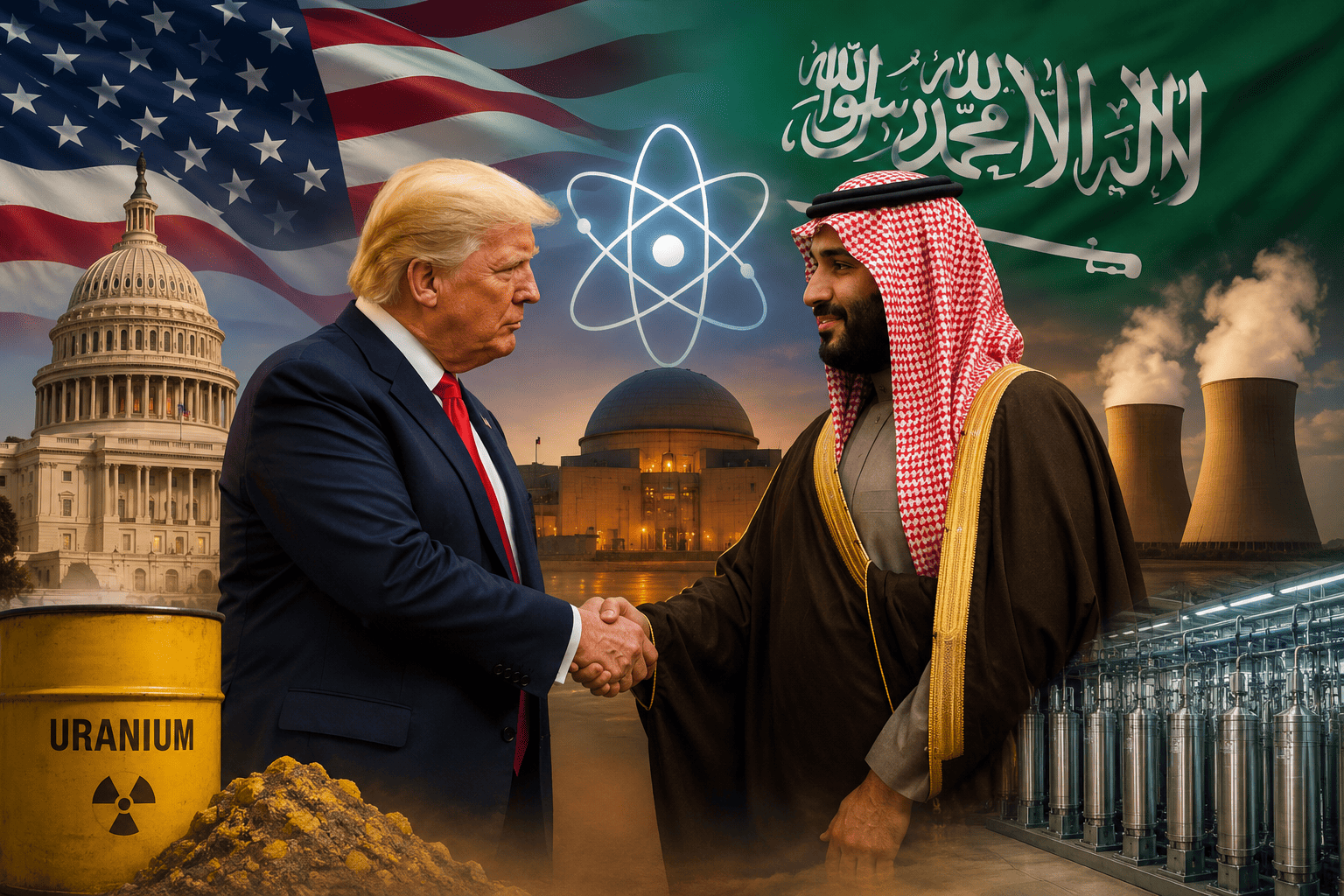
The Saudi Arabia nuclear deal opens a path to enrichment, and reignites fears of a Middle East nuclear race
The Saudi Arabia nuclear deal, signed by the Trump administration this week, could give Saudi Arabia the ability to enrich its own nuclear fuel, a capability that sits just one step away from the technology needed to build a nuclear weapon. The announcement, confirmed by the Department of Energy on July 22, 2026, marks one of the most consequential shifts in decades of American nuclear non-proliferation policy, and it lands at an extraordinarily sensitive moment: while the US is simultaneously at war with Iran over that country’s own nuclear ambitions.
Here’s what the Saudi Arabia nuclear deal actually says, why Saudi uranium enrichment has arms-control experts alarmed, and what could come next.
What Is the Saudi Arabia Nuclear Deal?
The agreement is what’s known in nuclear policy circles as a 123 agreement, a legal framework, named after Section 123 of the US Atomic Energy Act, that governs civilian nuclear cooperation between the United States and another country. Under this pact:
- The agreement is anticipated to be in effect for thirty years.
- American firms will help design, build, and supply Saudi Arabia’s civilian nuclear power program.
- The agreement will next go to Congress for a mandatory review period before it can take full effect.
- Crucially, it leaves the door open for Saudi Arabia to eventually build a uranium enrichment facility on its own soil, potentially following a joint US-Saudi feasibility study.
Unlike some past nuclear cooperation deals, this one reportedly does not include a formal ban on uranium enrichment or on reprocessing spent nuclear fuel, the two technical pathways that lead toward weapons-grade material.
Why Uranium Enrichment Is the Real Flashpoint in the Saudi Arabia Nuclear Deal
Most countries that operate civilian nuclear power plants don’t enrich their own fuel. Instead, they buy it pre-enriched from established suppliers, often the US or Russia, and receive it under tightly monitored, sealed shipments.
Uranium enrichment and plutonium reprocessing matter because they are the two primary routes to producing the core fissile material required for a nuclear weapon. Having the technical capability to enrich uranium doesn’t automatically mean a country can build a bomb; weaponization also requires mastering additional steps, such as precision high-explosive detonation systems. But enrichment does open that door, which is exactly the concern that has fueled years of international pressure over Iran’s nuclear program.
That’s what makes the Saudi Arabia nuclear deal so sensitive: the US is asking the world to accept enrichment capability for an ally, even as it wages war specifically to deny that same capability to a rival.
Missing the “Gold Standard”: No Additional Protocol
Arms control advocates have pointed to one specific gap in the deal: it does not include the International Atomic Energy Agency’s Additional Protocol, a stronger inspection framework that allows for more extensive monitoring, snap inspections, and verification of nuclear sites.
For comparison, the United Arab Emirates, Saudi Arabia’s Gulf neighbor, signed its own 123 agreement to build the Barakah nuclear power plant with South Korean assistance but explicitly gave up any right to enrich uranium domestically. Nonproliferation experts have long held up the UAE deal as the “gold standard” for civilian nuclear cooperation precisely because it paired US nuclear assistance with strict non-enrichment commitments. The Saudi deal breaks from that model.
Regional Stakes of the Saudi Arabia Nuclear Deal: Iran, Israel, and Pakistan
The timing and geopolitics around the Saudi Arabia nuclear deal add several layers of risk.
Iran war backdrop. The agreement comes as the US continues an active military campaign against Iran, including strikes tied to the ongoing crisis over the Strait of Hormuz. Critics argue that arming a regional rival with enrichment capability, even for civilian purposes, could inflame an already volatile conflict.
Stalled Israel normalization. A broader US-Saudi-Israel normalization framework had previously been treated as a condition for any Saudi enrichment deal, but Saudi leaders indicated that normalization wasn’t possible without real progress toward a Palestinian state. This nuclear pact appears to be moving forward independent of that broader diplomatic track.
Pakistan’s nuclear shadow. Saudi Arabia and nuclear-armed Pakistan already signed a mutual defense pact after Israel struck Hamas-linked targets in Qatar. Pakistan’s defense minister said at the time that Pakistan’s nuclear capability “will be made available” to Saudi Arabia if needed, a statement widely interpreted as a signal to Israel, long considered the region’s only nuclear-armed power.
Saudi Arabia’s own stated ambitions. Saudi Arabia’s crown prince has previously said the kingdom would pursue its own nuclear weapons program if Iran ever obtained a bomb, a standing threat that makes any enrichment capability inside the kingdom more than a theoretical concern.
Political Reaction in Washington
Lawmakers who are worried about non-proliferation have already criticized the agreement. Senator Ed Markey, a longtime advocate for nuclear non-proliferation, argued that granting Saudi Arabia enrichment capability risks destabilizing an already tense standoff between Iran, Saudi Arabia, and the United States and warned that Saudi Arabia has previously expressed interest in acquiring nuclear weapons outright.
Secretary of State Marco Rubio has pushed back on these concerns, telling reporters that the US “is not going to reach any agreement with any country in the world that leads to the risk of proliferation.” Rubio also credited China with taking a constructive public stance in support of freedom of navigation through the Strait of Hormuz, even as he declined to address whether Beijing or Moscow has provided Iran with military or targeting assistance during the current conflict.
Because the agreement now heads to Congress for mandatory review, lawmakers will have an opportunity to formally scrutinize its terms and potentially challenge the absence of the Additional Protocol before it is finalized.
What Happens Next
With the deal signed but still subject to Congressional review, several open questions will shape what comes next:
- Will Congress push back on the lack of IAEA Additional Protocol safeguards or move to amend the terms?
- Will a joint US-Saudi feasibility study move forward on an actual enrichment facility, and on what timeline?
- How will Iran interpret the deal amid its ongoing war with the US as a provocation, a deterrent, or both?
- Could this accelerate a broader regional enrichment race, drawing in other Gulf states or reviving Pakistan’s role as a nuclear “guarantor” for Saudi Arabia?
For now, the Saudi Arabia nuclear deal stands as one of the most significant non-proliferation policy shifts of the decade, one that experts say could reshape the nuclear balance of the Middle East for years to come.
Sources: CNN, The Washington Post, CBC News, NBC News, Fortune