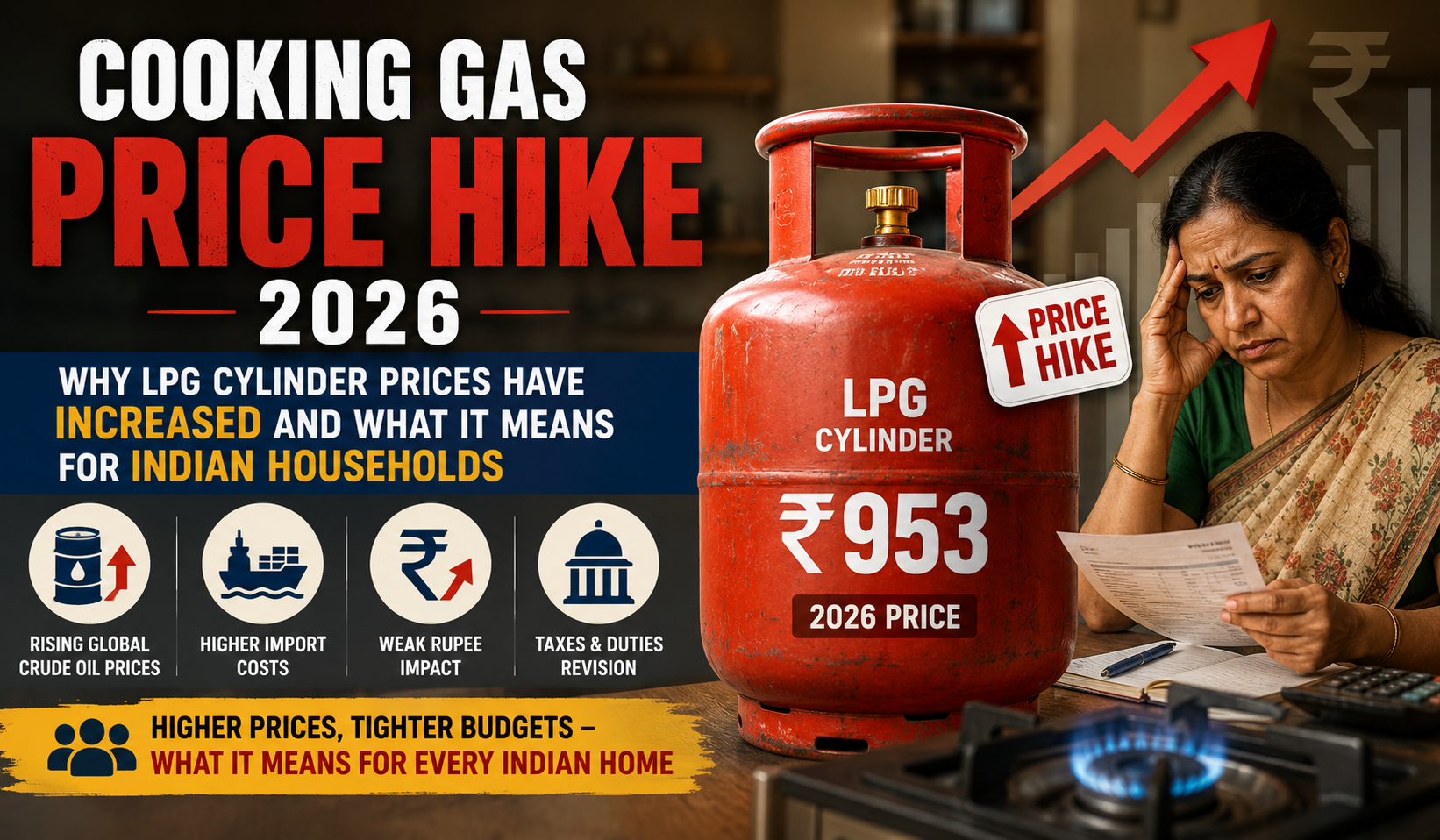
The Central Government’s decision to increase domestic LPG cylinder prices by ₹29 has sparked widespread discussion across the country. For millions of Indian families, cooking gas is an essential household necessity, and even a modest increase can have a noticeable impact on monthly budgets.
The government has defended the price hike by stating that domestic LPG prices in India remain among the lowest in the world despite rising international energy costs. Officials have also pointed to soaring global LPG benchmark prices and increasing import expenses as key reasons behind the revision.
As households adjust to higher cooking fuel costs, questions are being raised about why prices have increased, how India compares with other countries, and what the future may hold for LPG consumers.
LPG Price Hike: What Has Changed?
The latest revision has increased the price of a standard 14.2 kg domestic LPG cylinder by approximately ₹29. The revised rates came into effect immediately after the announcement, impacting households across urban and rural India.
This marks another increase in cooking gas prices in 2026, adding to concerns about inflation and rising household expenses. While the government maintains that the increase is necessary due to global market conditions, many consumers are worried about the cumulative effect of multiple price hikes during the year.
For families that depend entirely on LPG for daily cooking, the additional expense may seem small on a monthly basis but can become significant over the course of a year.
Why Has the Government Increased LPG Prices?
1. Rising Global LPG Prices
One of the primary reasons cited by the government is the sharp increase in international LPG prices.
India imports a substantial portion of its LPG requirements from global markets. When international benchmark prices rise, the cost of importing LPG also increases. Oil marketing companies then face higher procurement costs, putting pressure on domestic pricing.
Recent geopolitical tensions, supply chain disruptions, and fluctuations in crude oil markets have contributed to higher global energy prices, including LPG.
2. Growing Import Dependence
India’s demand for cooking gas has grown rapidly over the past decade. Government initiatives encouraging cleaner cooking fuels have increased LPG adoption, particularly in rural areas.
While this has improved living standards and reduced dependence on traditional fuels such as firewood and coal, it has also increased the country’s reliance on imported LPG.
As a result, international market volatility directly affects domestic prices.
3. Losses Faced by Oil Marketing Companies
According to government officials, oil marketing companies continue to sell domestic LPG below its actual market cost.
Authorities claim that despite the latest hike, companies are still absorbing significant losses on each domestic cylinder. The government argues that periodic price revisions are necessary to ensure the long-term sustainability of LPG distribution and supply networks.
4. Global Supply Challenges
Energy markets worldwide have experienced uncertainty due to geopolitical conflicts, shipping disruptions, and supply constraints.
When supply becomes limited while demand remains strong, prices naturally increase. These global pressures eventually affect countries like India that depend heavily on imports.
Government’s Stand on the Price Increase
The Centre has strongly defended the decision, emphasizing that Indian LPG prices remain comparatively affordable when measured against global benchmarks.
Officials have highlighted that consumers are not paying the full market price for LPG and that government support mechanisms continue to reduce the burden on households.
The government also argues that maintaining artificially low prices for extended periods could create financial stress for public sector oil companies and eventually disrupt supply chains.
From the government’s perspective, the increase represents a balancing act between consumer affordability and economic sustainability.
Impact on Indian Families
Urban Households
Urban families often rely exclusively on LPG for cooking. For middle-class households already facing rising expenses related to food, electricity, transportation, and education, any increase in utility costs adds pressure to monthly budgets.
Although ₹29 may not seem substantial, repeated increases throughout the year can accumulate into a significant annual expense.
Rural Households
The impact may be more pronounced in rural areas, where household incomes are often lower.
Many families adopted LPG under government welfare schemes aimed at promoting clean cooking fuels. Continued price increases could potentially affect refill frequency among economically weaker sections if affordability becomes a concern.
Small Businesses
Small food vendors, tea stalls, roadside eateries, and local restaurants also depend heavily on LPG cylinders.
Higher fuel costs can increase operating expenses, which may eventually be passed on to customers through higher food prices.
How Does India Compare with Other Countries?
One of the government’s key arguments is that LPG prices in India remain among the lowest globally.
Many countries allow cooking gas prices to fully reflect international market conditions. In contrast, India has historically used a combination of subsidies, government interventions, and pricing adjustments to moderate consumer costs.
While international comparisons vary depending on exchange rates, taxation, and local market structures, government officials maintain that Indian consumers continue to receive cooking gas at relatively affordable rates.
However, consumer groups argue that affordability should be measured against income levels rather than international comparisons alone.
Inflation Concerns and Public Reaction
The LPG price increase comes at a time when many households are already dealing with higher living costs.
Consumer organizations and opposition parties have criticized the move, arguing that essential commodities should remain affordable for ordinary citizens.
Public reactions have been mixed:
- Some accept the government’s explanation regarding global energy prices.
- Others believe additional support should be provided to low-income households.
- Many consumers are concerned about the possibility of further increases if international prices continue rising.
The debate highlights the challenge of balancing economic realities with public expectations.
Could LPG Prices Rise Further?
Future LPG prices will largely depend on several factors:
International Energy Markets
If global LPG and crude oil prices continue to rise, additional adjustments may become necessary.
Geopolitical Developments
Conflicts and tensions in major energy-producing regions can affect global supply and pricing.
Exchange Rate Movements
Since energy imports are typically priced in U.S. dollars, fluctuations in the Indian rupee can influence import costs.
Government Policy Decisions
Future subsidy programs, welfare measures, and pricing interventions could help cushion consumers from sharp increases.
As a result, LPG prices are likely to remain sensitive to both global and domestic economic conditions.
What Can Consumers Do to Reduce LPG Consumption?
Households can take several practical steps to improve fuel efficiency:
- Use pressure cookers whenever possible.
- Cover utensils while cooking to reduce cooking time.
- Regularly maintain burners for efficient flame output.
- Prepare ingredients before turning on the gas stove.
- Use appropriately sized utensils for burners.
- Minimize unnecessary reheating of food.
Small changes in cooking habits can help reduce LPG consumption and partially offset rising costs.
Conclusion
The latest ₹29 increase in domestic LPG cylinder prices reflects the growing challenges facing India’s energy sector amid rising global costs. While the government argues that Indian cooking gas remains among the most affordable in the world, many households are concerned about the cumulative impact of repeated price hikes.
As international energy markets remain volatile, LPG pricing is likely to remain a closely watched issue. Policymakers will continue facing the difficult task of balancing consumer affordability, energy security, and the financial health of oil marketing companies.
For millions of Indian families, cooking gas is more than just a commodity—it is an essential part of daily life. Any change in its price inevitably affects household budgets, making LPG policy a matter of national importance.