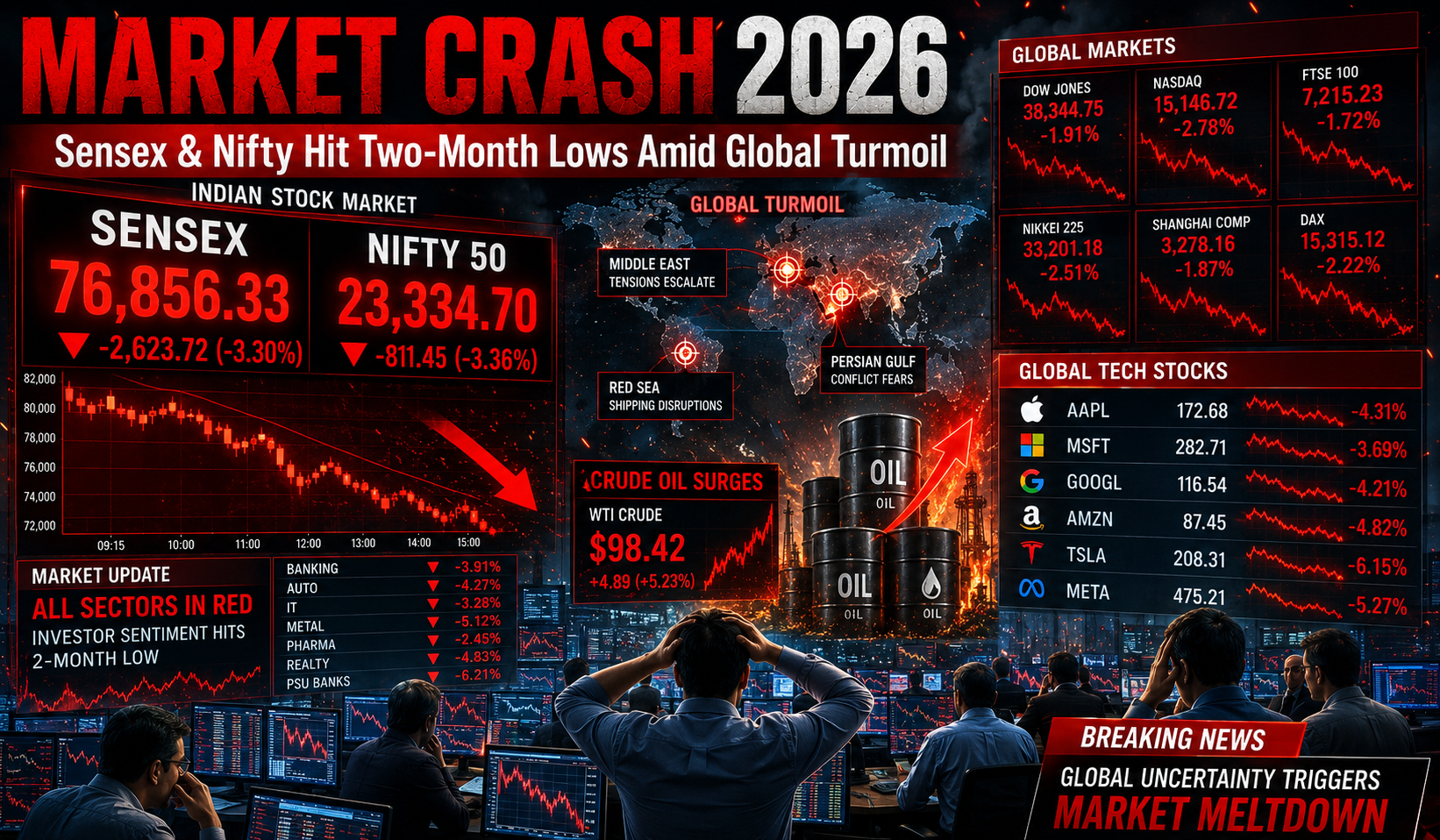
Indian stock markets witnessed a sharp decline as the BSE Sensex and NSE Nifty plunged to their lowest levels in nearly two months. The sell-off wiped out lakhs of crores in investor wealth and triggered concerns among retail and institutional investors alike. While market corrections are a normal part of investing, the latest downturn was fueled by a combination of global and domestic factors, including a worldwide technology stock sell-off, escalating tensions in the Middle East, rising crude oil prices, and persistent foreign investor outflows.
As investors assess the road ahead, understanding the reasons behind the recent market crash is crucial for making informed financial decisions.
Sensex and Nifty Register Sharp Declines
The benchmark indices came under heavy selling pressure during the trading session. The Sensex fell significantly, while the Nifty slipped below key support levels, reflecting broad-based weakness across sectors.
Technology, banking, financial services, and energy stocks were among the biggest losers. Market sentiment turned negative as investors rushed to reduce exposure to riskier assets amid growing global uncertainty.
The correction also impacted mid-cap and small-cap stocks, which had previously outperformed the broader market during recent rallies.
Global Tech Sell-Off Sparks Risk Aversion
One of the primary triggers behind the market decline was a sharp sell-off in global technology stocks.
Technology companies across major markets faced heavy selling due to concerns about stretched valuations, slowing earnings growth, and uncertainty surrounding future interest rate policies. Investors who had heavily invested in technology stocks during the artificial intelligence boom began booking profits, leading to widespread declines.
Because Indian IT companies generate a large portion of their revenue from international markets, weakness in global technology shares often spills over into Indian markets. Major IT stocks faced significant pressure, dragging benchmark indices lower.
The technology sector’s weakness created a domino effect, affecting investor confidence across multiple industries.
Rising Middle East Tensions Shake Global Markets
Geopolitical tensions in the Middle East added another layer of uncertainty.
Recent developments involving regional conflicts have raised fears about potential disruptions to global energy supplies. Whenever geopolitical instability emerges in major oil-producing regions, investors become cautious because of the potential economic consequences.
Financial markets generally dislike uncertainty. As concerns about conflict escalation grew, investors shifted money from equities into safer assets such as gold, government bonds, and defensive investments.
This risk-off sentiment contributed to the sell-off in global equity markets, including India.
Crude Oil Prices Surge
The Middle East tensions also triggered a sharp increase in crude oil prices.
India imports a significant portion of its crude oil requirements, making the economy particularly sensitive to fluctuations in global oil prices. Higher oil prices can increase inflationary pressures, widen the country’s trade deficit, and impact corporate profitability.
Several sectors feel the impact of rising crude prices:
- Aviation companies face higher fuel costs.
- Transportation firms experience increased operating expenses.
- Manufacturing industries see rising production costs.
- Consumers may eventually face higher prices for goods and services.
As crude oil prices climbed, investors began factoring in the potential economic consequences, leading to additional selling pressure in equities.
Foreign Institutional Investors Continue Selling
Foreign Institutional Investors (FIIs) have remained net sellers in Indian equities for several sessions.
Foreign investors often move funds between global markets based on risk perception, interest rates, currency movements, and economic outlooks. During periods of uncertainty, many international funds prefer safer investments and reduce exposure to emerging markets.
The continued outflow of foreign capital has placed downward pressure on Indian stocks.
FII selling is particularly important because foreign investors hold significant positions in large-cap companies. Heavy selling from these investors can create substantial volatility in benchmark indices.
Strong Dollar and Global Economic Concerns
Another factor influencing market sentiment is the strength of the U.S. dollar.
When the dollar strengthens, foreign investors often move capital toward U.S. assets, which are perceived as safer and more attractive. This can result in capital outflows from emerging markets such as India.
At the same time, concerns about slowing global economic growth have led investors to adopt a more cautious approach. Weak economic indicators from major economies have raised fears about reduced corporate earnings and slower international trade.
These concerns have further weighed on investor sentiment.
Banking and Financial Stocks Under Pressure
Banking and financial stocks, which carry significant weight in the Sensex and Nifty, also faced selling pressure.
Investors worry that prolonged market uncertainty, rising inflation risks, and global economic weakness could affect credit growth and financial sector performance.
As financial stocks declined, they amplified the fall in benchmark indices.
Since banks play a critical role in the overall economy, weakness in the sector often signals broader concerns about future growth prospects.
Impact on Retail Investors
The sharp correction has affected millions of retail investors across India.
Many investors who entered the market during recent rallies have seen the value of their portfolios decline. However, financial experts generally advise against panic selling during periods of volatility.
Market corrections are a normal part of long-term investing. Historically, markets have recovered from temporary downturns driven by geopolitical tensions, economic uncertainty, and investor sentiment shifts.
Investors with long-term goals are often encouraged to focus on fundamentals rather than short-term market movements.
Sectors That Could Face Challenges
Several sectors may continue experiencing pressure if current conditions persist:
Information Technology
Global technology weakness could affect investor confidence in IT stocks.
Aviation
Higher fuel costs resulting from rising crude oil prices could impact profitability.
Auto Sector
Rising input costs may create margin pressures for automobile manufacturers.
Chemicals and Manufacturing
Increased energy costs can raise production expenses.
Financial Services
Persistent market volatility may impact investor sentiment toward financial stocks.
Opportunities Hidden Within the Correction
While market declines create short-term pain, they can also present opportunities.
Long-term investors often view corrections as chances to accumulate quality stocks at more attractive valuations. Companies with strong balance sheets, consistent earnings growth, and competitive advantages may become more appealing during periods of market weakness.
Investors who maintain discipline and focus on long-term wealth creation often benefit from avoiding emotional investment decisions.
What Investors Should Watch Next
Several factors will determine the market’s direction in the coming weeks:
- Developments in Middle East tensions.
- Movement in global crude oil prices.
- Future Foreign Institutional Investor activity.
- U.S. Federal Reserve policy decisions.
- Global technology sector performance.
- Upcoming corporate earnings reports.
- Inflation and economic growth data.
Positive developments in any of these areas could help stabilize market sentiment.
Conclusion
The recent fall in the Sensex and Nifty highlights how interconnected global financial markets have become. A combination of global technology stock weakness, escalating Middle East tensions, rising crude oil prices, and continued foreign investor outflows has created significant pressure on Indian equities.
While the correction has understandably worried investors, market volatility remains a natural part of investing. The key for investors is to stay informed, maintain a long-term perspective, and avoid making decisions driven solely by fear.
As global uncertainties evolve, Indian markets will continue responding to both domestic fundamentals and international developments. Investors who remain patient and focused on quality investments may be better positioned to navigate the current turbulence and benefit from future market recovery.