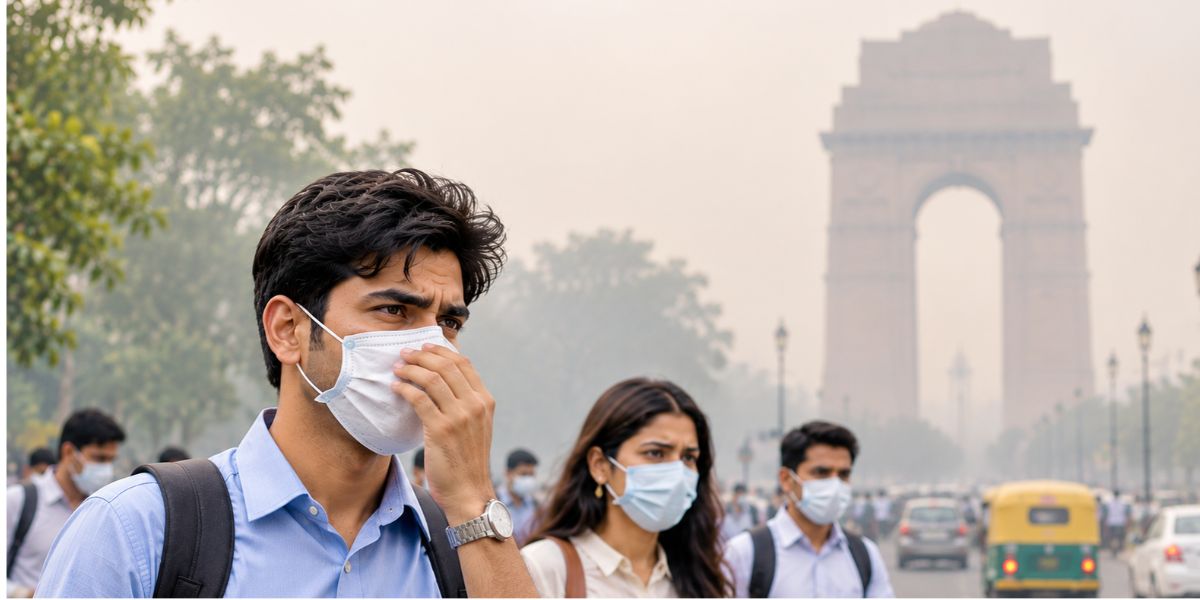
Every winter, Delhi’s air quality follows the same pattern. It starts in the poor range, slides into very poor, touches severe, then drops back to very poor before the cycle begins again. Despite tougher rules, administrative action and repeated court interventions, residents are left wondering whether the city is actually solving its pollution problem or simply reacting to it each season.
A Seasonal Routine With Familiar Results
Over the last two months, authorities have put hundreds of water sprinklers, mechanical road sweepers and anti smog guns on the streets to keep dust down. The Supreme Court has pressed the government on the sheer volume of vehicles on the roads, the High Court has examined how the city’s green cover is being protected, and civic agencies have expanded their cleaning equipment. Still, people who step outside each morning see little change.
Lost in this routine are the thousands of migrant workers who rely on construction and other physical labour for their income. Whenever restrictions under the Graded Response Action Plan, known as GRAP, are tightened, building work stops, and so do their wages. Most have no other source of money to fall back on. That raises a fair question: is Delhi tackling pollution at its roots, or relying on short term bans that push the heaviest burden onto the people with the least cushion?
More Machines on the Road
Research by the Centre for Science and Environment points to vehicle exhaust as the biggest contributor to Delhi’s winter smog, with road dust adding to the problem. The Municipal Corporation of Delhi, which looks after a large part of the city’s roads, says it is trying to close gaps in its cleaning network.
The MCD currently has 207 water sprinkling machines. Forty of these are anti smog guns, though only 28 are working at the moment. Twelve more guns joined the fleet last month. The corporation also runs 64 mechanical sweepers, each covering about 53 to 54 kilometres a day over nearly twelve hours, clearing dust and silt before passing traffic lifts it into the air. To reach narrower lanes, it is buying around 70 more sweepers from Switzerland and Italy, built for roads under 60 feet wide. Officials expected delivery in two to three months, but the Gulf conflict has pushed the timeline back.
The New Delhi Municipal Council has its own fleet of 11 large and four small sweepers, four ride on scrubbers and 20 litter pickers, with plans to add four large sweepers, four medium ones and four leaf pickers. Vice Chairperson Kuljeet Singh Chahal said staff have been told to focus on cleaning at night so dust is cleared before the morning rush. Collected silt goes to the Okhla plant for proper disposal, although lasting results will depend on how often and how widely roads are cleaned.
Water is another tool. The NDMC uses 13 pressure jetting machines and 18 water tankers, ten of them fitted with sprinklers. Each tanker holds between 5,000 and 10,000 litres and covers 20 to 25 kilometres daily in two to three trips. The council wants to raise its pressure jetting machines to 20. It also plans overhead misting on 1,200 electric poles along 26.69 kilometres of road in the 2026 to 2027 period. Six stretches already have it, including Man Singh Road, Shahjahan Road, Bhagwan Das Road, Tilak Marg, Subramania Bharati Marg and Dr Zakir Hussain Marg. Six more should follow within a week, twelve roads are lined up for November, and Sher Shah Suri Marg for December. The council looks after 416 kilometres of roads across 42.7 square kilometres.
What the Courts Have Said
In a suo motu case on the rules governing air pollution, the Supreme Court has described vehicle emissions as a major cause of the crisis. It asked for immediate, medium term and long term action, and told Delhi, Uttar Pradesh, Haryana and Rajasthan to explain how they are keeping old and non compliant vehicles off the road.
The bench also raised the issue of severe congestion across Delhi and nearby NCR towns, noting heavy traffic on routes linking the capital with Ghaziabad, Greater Noida, Gurugram and Faridabad. The Chief Justice remarked that the air quality index was already close to 400 and that the real problem was visible on any road. Yet restrictions limited to Delhi’s own boundaries are unlikely to fix a problem that spreads across the region.
The court further noted that economically weaker groups, especially daily wage workers who spend their days outdoors, are most exposed, and that the festive season is often their best chance to earn. On stubble burning, it stressed teaching farmers about machine based alternatives. The Centre presented measures aimed at five pollution sources and said stubble burning contributed 14 percent on November 5. The matter was listed for further orders on November 16.
The Delhi High Court has been monitoring air pollution in a suo motu case begun in 2015, and in a March order it questioned how seriously the Delhi Police, the DDA and the Forest Department were protecting notified forest land. In a separate ruling, Justice Amit Mahajan allowed advocates and judicial staff living in the NCR to use outside registered vehicles that do not meet BS VI norms, which shows how hard it is to enforce such bans in a region where thousands cross state lines every day.
When Restrictions Mean Lost Wages
Ramphal Kumar, a construction worker from Bihar’s Khagaria district, says he has nowhere else to turn for income. Workers like him came to Delhi to labour, and when work is halted, they have nothing to live on. He believes limits on vehicles should come before limits on workers.
Without savings or a regular salary, even a few idle days can upset a worker’s budget, making rent, food and money sent home hard to manage. The uncertainty over when curbs will end also makes many reluctant to return to the city.
Suresh Kumar, a painter, is still working because his trade is not covered by the GRAP ban. But men from his village in Moradabad, Uttar Pradesh, keep calling him to ask when restrictions will ease, since they do not want to spend on travel without knowing if jobs await. Some informal workers continue to earn while others lose everything, even though none of them control the sources of pollution. There is also no proper support system for those who lose income during long GRAP periods.
The Annual Blame Game
As every year, political parties trade accusations. The BJP, which governs Delhi, blames stubble burning in Punjab, while the AAP, which runs Punjab, accuses the other side of manipulating air quality data and points to vehicle and industrial emissions.
Delhi Environment Minister Manjinder Singh Sirsa questioned how Punjab has handled farm fires despite progress in paddy harvesting. He recalled that on November 4, 2022, Chief Minister Bhagwant Mann had accepted responsibility for dealing with stubble burning, and that Arvind Kejriwal had promised fewer fires the following year. The BJP also pointed to a rise in incidents around Diwali, citing satellite data that showed 100 to 125 fires on November 5, 6 and 7, jumping to nearly 1,200 on the evening of November 8.
Why Air Quality Numbers Don’t Match
The Central Pollution Control Board and the Swiss firm IQAir have reported very different readings. The CPCB stayed below 500, while IQAir showed figures of 1,000 and even 1,500. A CREA analysis also found that over 20 monitoring stations sent no data between midnight and 2 am on Diwali night, right when smog peaked.
Gufran Beig, founder and project director of SAFAR, explained that India’s AQI is capped at 500. Once pollution goes beyond the severe level, the index stops rising even if actual concentrations keep climbing. He warned against comparing the national index with IQAir, which uses a different method. A capped scale, he said, can hide how bad an extreme episode really is. He also noted that during the November 11 episode, air quality entered the severe plus range early in the day but was formally declared only by evening, which could delay GRAP measures tied to AQI thresholds.
A Response That Falls Short
Pollution controls affect people unequally. A daily wage worker loses work, a gig worker faces more health risk, and a wealthier resident may only face some inconvenience or extra cost. Machines can clean roads, but their impact depends on how large the pollution load is and how consistently they are used. Citizens say any plan must also tackle vehicle emissions, industry, construction violations and crop residue burning.
A city doctor, Dr Maqsoof, said the real test for the government is whether these steps lead to lasting improvement without making the most vulnerable carry even more of the cost. The Supreme Court’s push for a coordinated Delhi NCR approach underlines that air pollution does not stop at city limits, and that people need accurate, timely information, especially when readings reach the top of the scale.
The yearly fight against smog cannot be won through seasonal machinery, temporary bans and political exchanges alone. Until the gap between what is promised and what is felt on the ground closes, Delhi’s battle will stay only half won.
Read More : 10 Unmissable South Indian Destinations for Your Next Getaway
Frequently Asked Questions
Why does Delhi’s air quality get worse every winter?
Vehicle emissions, road dust, industrial pollution, construction activity and crop residue burning in nearby states all add to the load. Cooler weather and low wind speeds then trap these pollutants close to the ground, creating dense smog.
What is GRAP and how does it affect daily wage workers?
GRAP stands for the Graded Response Action Plan, a set of steps that become stricter as air quality worsens. Bans on construction and similar activities can stop work for labourers who depend on daily pay, leaving many without income.
Why do CPCB and IQAir show different AQI numbers?
India’s national AQI is capped at 500, while IQAir uses a different method and can show much higher values. Experts say the two cannot be compared directly, though the cap can hide how severe an episode really is.
What equipment is Delhi using to control dust?
The MCD uses water sprinklers, anti smog guns and mechanical sweepers, while the NDMC uses sweepers, pressure jetting machines, water tankers and overhead misting systems on selected roads.
What has the Supreme Court said about Delhi’s pollution?
The court called vehicle emissions a major cause, asked Delhi and three neighbouring states to report on keeping old and non compliant vehicles off the roads, flagged heavy congestion, and stressed support for vulnerable workers and farmer education on stubble alternatives.
Can Delhi solve its pollution problem on its own?
Unlikely. Air moves across state borders, so experts and the courts stress a coordinated approach across Delhi and the NCR, with action against all major sources and reliable, timely air quality information.