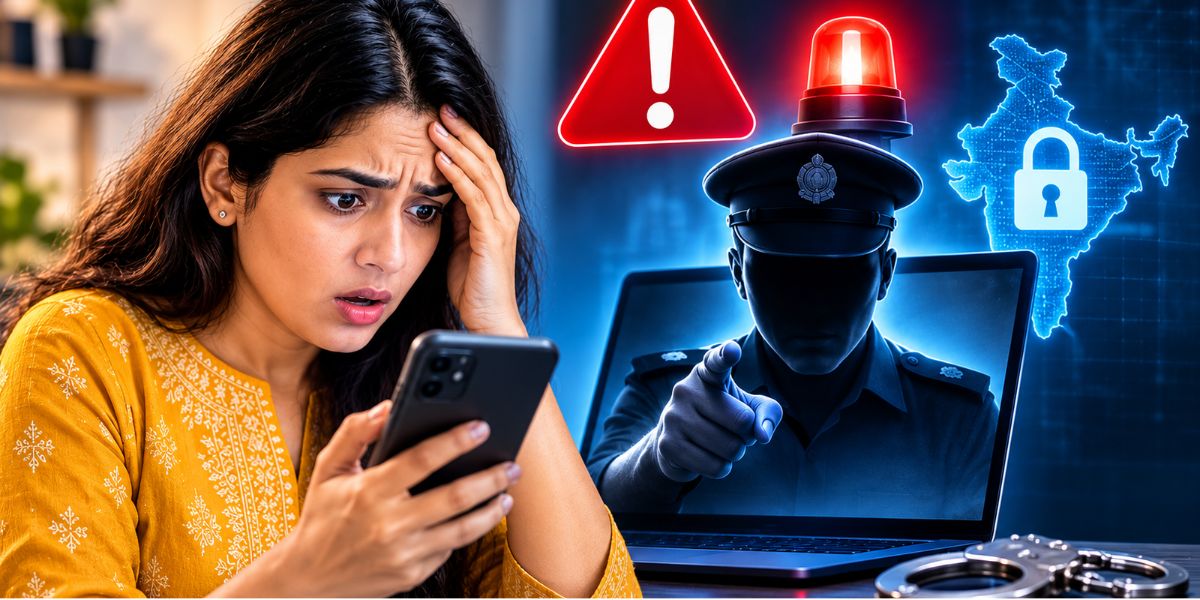
The phone rings at 11 AM. The caller says he is from the courier company, and a parcel in your name has been seized with illegal items inside. Before you can protest, the call is “transferred” to a police officer on a video call, wearing a uniform, sitting in what looks like a station. He tells you not to hang up, not to tell anyone, and not to leave the camera. You are now, in his words, under digital arrest. Within hours, people have emptied life savings this way. Here is how the trick works, and how to see through it.
What Is a Digital Arrest Scam?
A digital arrest scam is a fraud where criminals pretend to be officials from agencies such as the police, the Central Bureau of Investigation, the Narcotics Control Bureau, customs, the Enforcement Directorate, or the telecom regulator. They contact a victim by phone or video call and claim the person is linked to a serious crime. The victim is then kept on the call for hours, sometimes days, while being pressured to transfer money to a “safe” or “verification” account.
The important thing to understand is that digital arrest does not exist in Indian law. No police force, court, or investigative agency in India can place you under arrest over a video call. Arrests happen in person, with proper procedure, and you always have the right to contact a lawyer and your family. The term itself is an invention of the scammers, designed to sound official and frightening.
Why These Scams Work So Well
These frauds succeed not because victims are foolish, but because the scripts are built on well-studied psychology. Criminals know that a frightened mind makes poor decisions, and they engineer fear from the first sentence.
Fear of legal trouble is powerful in India, where many people have limited contact with the justice system and worry about the shame an arrest could bring to the family. Scammers exploit that anxiety. They also play on respect for authority. A person who would never hand money to a stranger may comply when the stranger appears to be a senior officer.
Another reason is isolation. By insisting that the case is “confidential” and that speaking to relatives will “obstruct the investigation,” the fraudsters cut the victim off from the one thing that would break the spell: a calm second opinion.
The Typical Script, Step by Step
Most cases follow a similar pattern. Knowing the order of events makes it easier to spot when you are in the middle of one.
Step one: the opening call. An automated message or a person claims that a parcel, SIM card, or bank account linked to your name is involved in illegal activity. Common stories include drugs found in a courier, a SIM used for harassment, or money laundering through your account.
Step two: the transfer to “officials.” The call is passed to a supposed police or agency officer. Often this happens over a video platform, with a fake police station background, official-looking logos, and forged documents sent on messaging apps.
Step three: the threat. The caller says an arrest warrant exists, that your Aadhaar or PAN has been misused, or that your family could be dragged into the case.
Step four: the lockdown. You are told to stay on camera, keep the call running, and speak to no one. Some victims are even asked to stay in a room alone and report their movements.
Step five: the payment demand. To “prove your innocence,” you must move your money into a government-verified account, to be refunded after the check. Of course, it never is.
Warning Signs You Should Never Ignore
Memorize these, and share them with your family, especially older relatives.
1. A government agency contacts you by phone or video to accuse you of a crime. Genuine agencies send written notices through official channels and conduct investigations in person.
2. You are told not to disconnect or speak to anyone. No legitimate officer demands secrecy from you or forbids you to consult a lawyer or relative.
3. Money is requested for any reason. Police and courts do not ask you to transfer funds for verification, bail, or safekeeping. This single point settles the matter.
4. You are pushed to act immediately. Urgency is the scammer’s main weapon. Real legal processes give you time.
5. The caller knows some of your details. Names, phone numbers, and even partial Aadhaar details are easy to obtain from data leaks. Knowing them proves nothing.
6. The communication uses personal messaging apps. Official notices do not arrive through casual chat apps with stock photos of officers.
7. The caller uses a fake uniform and background on video. A uniform and a flag behind the desk are cheap to fake. Do not treat them as proof.
8. You are asked to install an app or share your screen. This can give criminals direct access to your banking apps and OTP messages.
Who Is Most at Risk?
Anyone can be targeted, and reports suggest that educated professionals, retired government employees, doctors, and business owners have all lost large sums. Senior citizens are especially vulnerable because they are often alone during the day and more likely to trust an official tone. Young people and students are targeted too, usually with stories involving exam fraud, drug parcels, or sim card misuse.
Do not feel ashamed if you or someone you know has been caught. These operations are run by organized networks, some operating across borders, with trained callers and carefully written scripts.
What To Do the Moment a Suspicious Call Arrives
Your best defence is a short, practical routine.
Stay calm and end the call. Hanging up is always allowed. The “do not disconnect” rule is a lie.
Do not share personal or banking information. This includes OTPs, card numbers, Aadhaar, PAN, and passwords.
Do not transfer a single rupee. No official process requires it.
Talk to someone you trust. Even a five-minute chat with a family member or neighbour is often enough to expose the fraud.
Verify independently. If you are worried, look up the real contact number of the agency from its official website and call it yourself, rather than using any number the caller gave.
What If You Have Already Paid?
Speed matters enormously. Act in the first hour if you can.
Call the national cyber crime helpline at 1930 straight away. This number is built to quickly flag and freeze fraudulent transactions. Then file a complaint on the National Cyber Crime Reporting Portal at cybercrime.gov.in. Inform your bank at once so they can attempt to hold or trace the transfer. Keep screenshots, call logs, phone numbers, account details, and any messages as evidence, and also report the number to the Sanchar Saathi portal run by the Department of Telecommunications.
The sooner the report is made, the better the chance that money can be stopped before it moves through multiple accounts.
How Families Can Protect Each Other
Most successful protection happens at home, not online. Sit down with parents and grandparents and walk through the script described above. Tell them plainly that no officer will ever arrest someone through a video call and that any request for money is proof of fraud.
Agree on a simple family rule: before any money moves in response to a scary call, the person must speak to at least one other family member. This single habit defeats the isolation tactic the scammers depend on.
You can also reduce risk by being careful with personal data. Avoid posting identity documents online, be cautious with unknown links, and think twice before giving your phone number to unfamiliar websites. Setting up transaction limits and alerts on your bank accounts adds one more layer of safety.
The Role of Awareness and Community
Cyber fraud thrives on silence. Many victims stay quiet out of embarrassment, which allows the same scripts to be reused on the next person. When people speak openly, the tactic loses its power. Share this article in your family group, housing society chat, or workplace. Mention it to the domestic helper, the driver, the neighbour who lives alone. A warning passed along in time can save someone’s life savings.
Banks, telecom providers, and government bodies have also stepped up public alerts, and many phone networks now play awareness messages before calls. These help, but personal vigilance remains the strongest barrier.
Read More : Delhi Breathes Toxic Air Again While Daily Wage Workers Pay the Price for Pollution Curbs
Final Thoughts
The people behind digital arrest scams are betting on one thing: that fear will beat logic for just long enough. Your task is to give logic a head start. Know the script, recognize the warning signs, and remember that a real officer will never ask you to stay on camera, stay silent, and send money. If a call makes your heart race and demands your bank details, that is your signal to hang up, breathe, and talk to someone you trust. A few seconds of doubt can protect a lifetime of savings.
Frequently Asked Questions
What is a digital arrest scam?
It is a cyber fraud where criminals pose as police, CBI, Enforcement Directorate, customs or other officials. Digital arrest scams are among the fastest-growing cyber frauds in India, with fraudsters posing as police officers, CBI, ED or customs officials. They accuse you of a crime, keep you on a call, and pressure you to transfer money.
2. Is digital arrest a real legal procedure in India?
No. There is no such thing as digital arrest in the law. No agency can arrest you over a phone or video call. Real arrests follow legal procedure and happen in person.
3. Why do scammers tell me not to disconnect the call?
Keeping you on the line stops you from thinking clearly or calling a relative who could expose the lie. The “do not disconnect” order is a scam tactic. You can hang up at any time.
4. Will the police or any government office ask me to transfer money for verification?
Never. No court, police station or investigating agency asks you to move funds to a “safe account” or pay a fee to prove your innocence. Any money demand tells you the call is a fraud.
5. What should I do if I get a suspicious call?
Stay calm and end the call. Do not share OTPs, card details, Aadhaar, PAN or banking passwords, and do not install any app or share your screen. Disconnect immediately, verify the claim through official channels, and report it to the cybercrime helpline 1930 or the National Cyber Crime Reporting Portal.
6. What should I do if I have already sent money?
Act immediately. Contact the financial helpline 1930 within 15 to 20 minutes to freeze any transfer, and file a complaint with your local cybercrime cell. Inform your bank at once and keep call logs, screenshots and transaction details as evidence.
7. Where can I report a digital arrest scam in India?
You have three main options:
- Call the national cyber crime helpline 1930
- File a complaint at cybercrime.gov.in
- Report suspicious numbers on the Sanchar Saathi portal run by the Department of Telecommunications