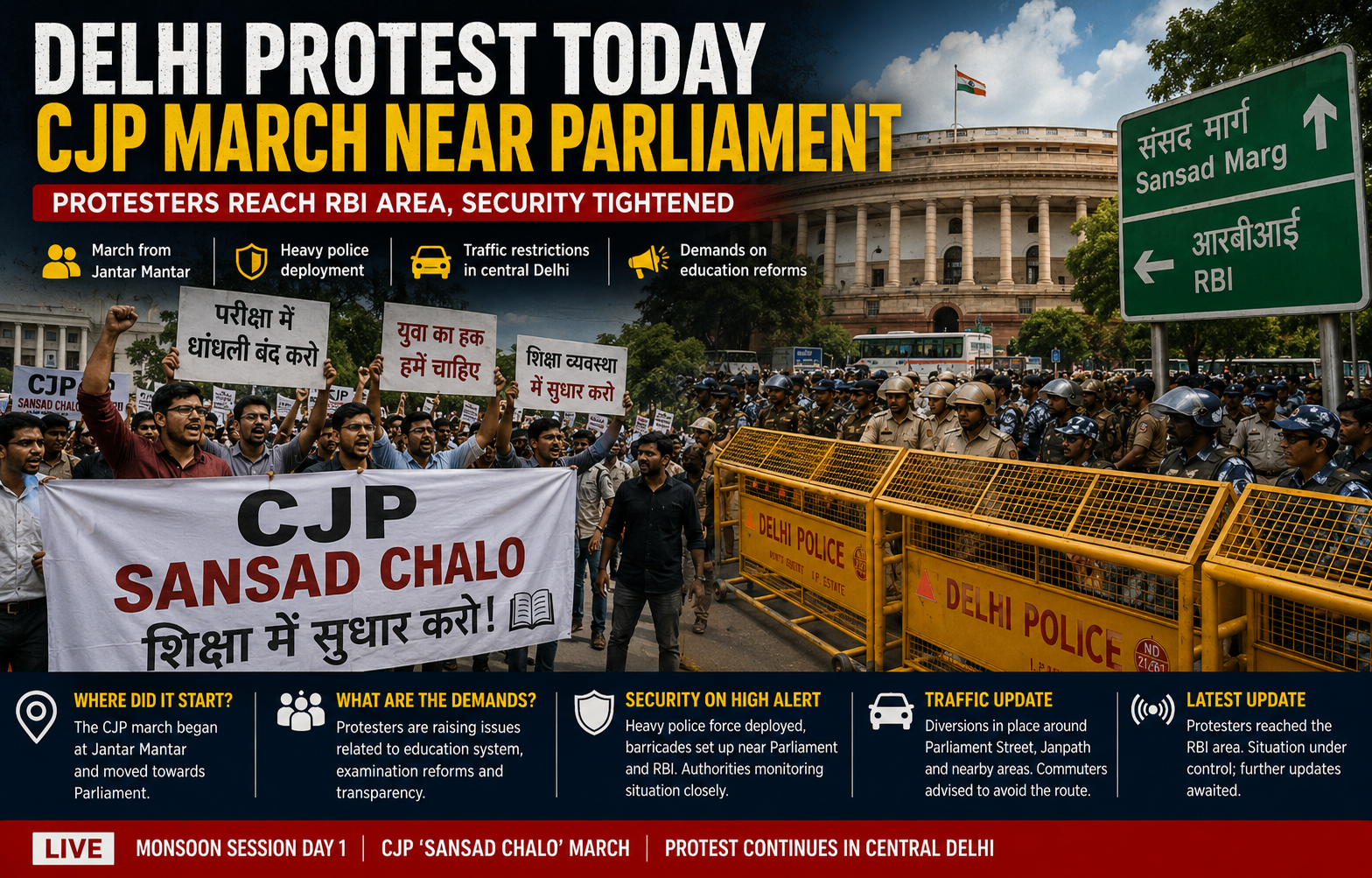
The opening day of Parliament’s Monsoon Session on Monday turned into one of the most closely watched political events in the capital this year, as thousands of supporters of the Cockroach Janata Party (CJP) marched from Jantar Mantar towards Parliament under the banner of “Sansad Chalo.” What began as a satirical youth-led movement barely two months ago has grown into a full-fledged street mobilization capable of shutting down central Delhi, drawing in opposition leaders, triggering police action, and putting the government on the back foot on the opening day of a crucial session. By the time the procession reached the Reserve Bank of India (RBI) area near Parliament, the roads of Lutyens’ Delhi had turned into a standoff between demonstrators and a heavily reinforced police force, setting the tone for what promises to be a turbulent monsoon session.
CJP Protest Reaches RBI Area Near Parliament
Security was tightened across central Delhi on Monday after CJP supporters marched towards Parliament, moving through several key roads before reaching the RBI area, where protesters raised slogans under the watchful eye of Delhi Police. Given the location’s proximity to Parliament and other government offices, authorities deployed additional personnel and erected barricades to regulate movement, closely monitoring the demonstration as crowds gathered along the route.
The situation escalated as the march progressed. Police maintained that no formal permission had been granted for the demonstration, and officers used force, including lathi charges and tear gas, to try to disperse the crowd as protesters pushed towards Parliament. In the chaos, CJP founder Abhijeet Dipke was reportedly detained by police, a development that further galvanized supporters at the protest site. Despite the crackdown, some sections of the march broke through police barricades as they advanced towards central Delhi’s most sensitive security zone.
Why Are CJP Protesters Demonstrating?
The “Sansad Chalo” march, according to organizers, aims to highlight concerns about India’s education system and recent examination controversies. Party leaders say they want lawmakers to discuss these issues during the Monsoon Session and push for greater transparency and accountability.
The movement’s roots trace back to mid-May 2026, when Chief Justice of India Surya Kant, while hearing a case on fraudulent professional credentials, described unemployed youth as being like “cockroaches” who drift into media, social media and activism without finding proper employment. The remarks sparked immediate online backlash, and within a day, Abhijeet Dipke, a political communications strategist previously associated with the Aam Aadmi Party, announced a “platform for all the “cockroaches’ out there,” encouraging unemployed individuals, frequent internet users, and anyone unhappy with the system to participate. A satirical social media response quickly evolved into an organized political movement.
The CJP’s central demand has since crystallized around the resignation of Union Education Minister Dharmendra Pradhan, whom protesters hold responsible for a string of examination failures, notably the NEET-UG paper leak and alleged irregularities in CBSE’s on-screen marking process. Organizers argue these lapses reflect a structural failure in India’s education system affecting millions of aspirants. Dipke, a Boston University graduate who returned to India in June to lead the agitation, says he turned down job offers abroad, framing the movement as a “youth-led” push for accountability rather than a conventional political party.
The party has faced criticism over timing, with some protests coinciding uncomfortably close to NEET-UG re-examination dates. Even so, the movement has expanded beyond Delhi, with solidarity rallies in Pune, Lucknow, Bengaluru, and Nagpur and a sustained sit-in at Jantar Mantar.
Monday’s participants carried banners and chanted slogans en route to Parliament, timing the march to coincide with the Monsoon Session’s start.
Heavy Security Across Central Delhi
Police presence was visible throughout Parliament Street, Janpath, Ashoka Road, and nearby government zones. Security teams monitored the movement of protesters while restricting access to sensitive locations, and forces including the Rapid Action Force were deployed to manage the crowd as tensions rose closer to Parliament.
Authorities also implemented precautionary measures to ensure that Parliament proceedings and routine public movement were not disrupted. Barricades and traffic diversions were introduced at multiple points as crowds approached the RBI area, and commuters across several arterial roads faced significant delays through the day. Officials urged protesters to maintain peace while advising the public to avoid affected roads wherever possible.
Adding another layer to the day’s developments, CJP activist Sonam Wangchuk, who has been undergoing treatment after an extended hunger strike lasting more than three weeks, reportedly submitted a formal request to hospital authorities in Delhi seeking permission to leave, even temporarily, in order to join Monday’s march. In his letter, Wangchuk stated that his health parameters were normal and that he wished to be present at the protest site, underscoring the emotional weight the movement has taken on for many of its supporters.
Political Significance of the Protest
The timing of the protest has made it politically significant. Organizing the march on the first day of the Monsoon Session ensured that the demonstration received national attention while lawmakers were assembled in the capital. Political observers believe protests held during parliamentary sessions often generate greater public discussion because they directly coincide with legislative proceedings, putting additional pressure on the government to respond publicly.
The demonstration has also drawn reactions from established opposition parties. Leaders from the Congress, the Samajwadi Party, and the Aam Aadmi Party have criticized the police response to the march, particularly the use of force against student demonstrators, while some have voiced support for the CJP’s underlying demands around examination reforms. Whether the demonstration leads to further political debate or concrete policy discussions inside Parliament will become clearer in the coming days, as the Monsoon Session progresses and opposition MPs decide how forcefully to raise the issue on the floor of the House.
Public Reaction and Latest Updates
The CJP protest drew widespread attention across social media, with videos and images from the march circulating throughout the day. While some people agreed with the protesters’ objectives, others questioned the idea of widespread street mobilization so near to Parliament and voiced concerns about the traffic jams in downtown Delhi. during an active session.
As of the latest updates, police continue to monitor the situation around Parliament and the RBI area, with reports of ongoing negotiations between CJP representatives and government officials over the demonstrators’ demands. Authorities have urged commuters to follow traffic advisories, while further developments are expected as the protest continues into the evening.
Where Things Stand Now
As the situation develops, authorities are expected to continue monitoring the protest while maintaining security around Parliament and nearby government institutions. Additional updates may be issued regarding traffic arrangements; police action; the status of detained CJP members, including founder Abhijeet Dipke; or responses from political leaders inside and outside Parliament.
Conclusion
What began in mid-May as a sardonic response to a single remark from the Chief Justice of India has, within weeks, transformed into one of the more disruptive youth movements the capital has seen in recent years. Monday’s scenes near the RBI, tear gas, barricades broken, a founder detained, and a hunger-striking activist petitioning to leave the hospital to join the march, capture just how quickly the Cockroach Janata Party has moved from viral hashtag to street-level political force. With Parliament now in session and opposition MPs signaling they may raise the issue formally, the coming days will test whether this energy translates into any real movement on the CJP’s central demand: accountability for the exam failures that triggered it all. For now, central Delhi remains on edge, and readers are advised to follow verified official announcements and reliable news sources for the latest developments as the story unfolds.