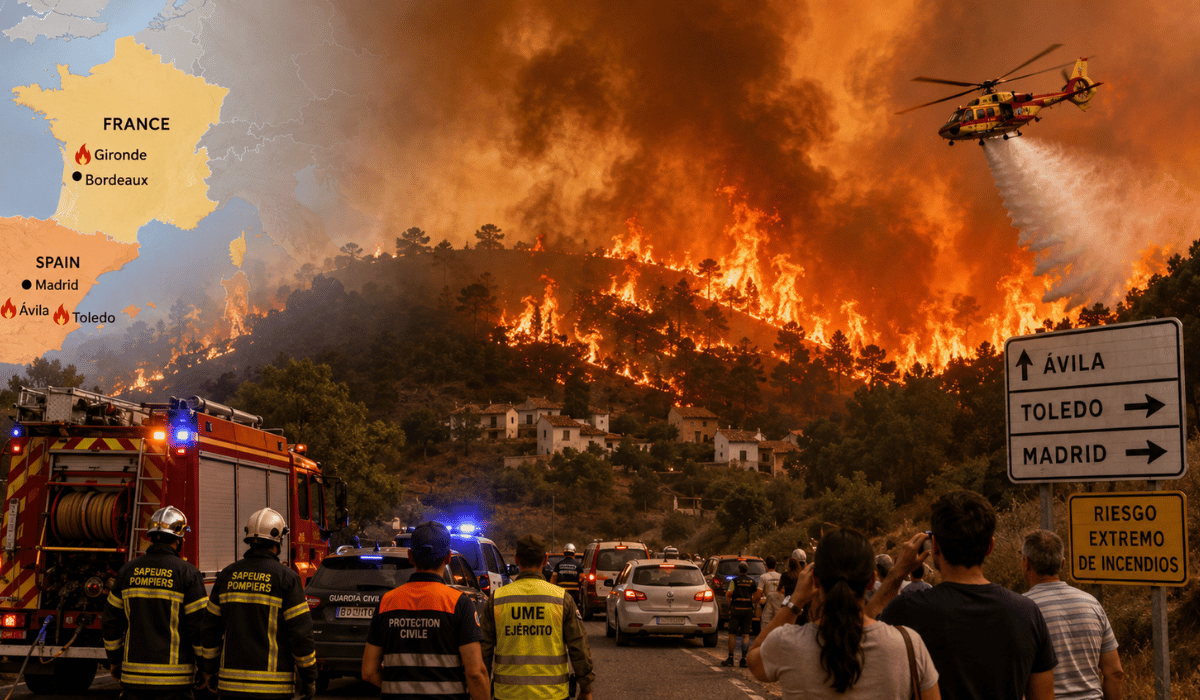
Southern Europe is battling one of its most severe wildfires crises in recent memory. Since late July 2026, massive blazes have torn through southwestern France and central Spain, forcing more than 320,000 people to evacuate their homes, destroying property, and putting immense pressure on emergency services in both countries.
In this post, we’ll break down what’s happening, why these fires have grown so intense, and what officials are doing to bring the situation under control.
What’s Happening in France?
The worst-hit area in France is the Gironde region near Bordeaux, one of the country’s most famous wine-producing areas.
- Roughly 220,000 to 250,000 people have been evacuated across France, according to different updates from French authorities.
- The main blaze has burned through around 42,000 hectares, an area about four times the size of Paris.
- Officials have described this as France’s biggest peacetime evacuation since World War II.
- The Gironde fire is not isolated. Fires are also affecting the Landes, Var, Hautes-Alpes, and Tarn regions.
- France’s Interior Minister Laurent Nuñez has called the scale of this year’s fires a “historic record,” with around 100,000 hectares burned nationwide since the start of 2026.
- French authorities have recorded an unprecedented 13,566 fires or fire outbreaks so far this season.
There’s some good news, too. As of the most recent updates, the main fire around Bordeaux has stopped growing, giving firefighters a small window to gain ground before conditions worsen again.
What’s Happening in Spain?
Spain is facing a parallel crisis, with wildfires burning through the Madrid region, Ávila, and Toledo.
- Around 100,000 people have been evacuated or told to shelter in place across the affected Spanish regions.
- More than 63,000 people were forced to evacuate specifically from the Madrid, Toledo, and Ávila areas.
- At least one person has died: a 78-year-old man with reduced mobility who was caught near his orchard in Manises, close to Valencia.
- The Spanish government has declared a national emergency over the fires.
- Firefighters, including Spain’s Military Emergency Unit, have been working to stop two major wildfires west of Madrid from merging into a single, larger blaze.
- Fires in the eastern Castellón province have also forced entire towns, like La Vall d’Uixó, to evacuate.
Spanish Prime Minister Pedro Sánchez has described the wildfires not as isolated incidents, but as part of a broader climate emergency affecting the country.
Why Are These Wildfires So Severe?
Several factors have combined to make this year’s fire season particularly dangerous:
- Extreme heat and drought: A prolonged heatwave has dried out vegetation across southern Europe, turning forests and grasslands into easily ignitable fuel.
- Unusually wet winter followed by dry summer: Europe’s wetter-than-usual winter led to dense vegetation growth, which then dried out completely in the summer heat, creating more material for fires to burn.
- Strong, shifting winds: Winds have repeatedly changed direction, making it harder for firefighters to predict how fires will spread and forcing new evacuation orders with little warning.
- Rising fire frequency: According to Europe’s climate change service, Copernicus, France has already seen 3.4 times its annual average number of fires this year, while Spain has seen 1.7 times its average.
- A pattern climate scientists warned about: Researchers studying desertification have noted that this kind of intensified fire activity is consistent with long-standing warnings about the effects of rising global temperatures.
Adding to the concern, a fresh heatwave is expected to hit both France and Spain later this week, with temperatures forecast to cross 40 degrees Celsius in some areas. This raises the risk of existing fires flaring up again or new ones breaking out.
How Are Authorities Responding?
Both governments have mobilized large-scale emergency responses, and international support has also stepped in:
- The European Union has deployed aircraft and helicopters from its rescEU fleet to support French firefighting efforts.
- Greece sent two firefighting aircraft to Spain under the EU Civil Protection Mechanism to help contain fires west of Madrid.
- French President Emmanuel Macron held a crisis cabinet meeting and personally thanked firefighters in Bordeaux, warning that the coming weeks would remain difficult.
- Spanish Prime Minister Pedro Sánchez visited affected regions, including Valencia, to assess the damage and coordinate the response.
- Thousands of firefighters and military emergency personnel are working around the clock in both countries, backed by water-bombing aircraft.
- Temporary shelters have been set up for displaced residents, with some housing hundreds of evacuees at a time.
Despite these efforts, officials in France have warned that some fires may not be fully extinguished for weeks, or even months.
Impact on People and Local Life
Beyond the numbers, these wildfires have deeply disrupted everyday life for residents across both countries:
- Entire towns and villages have been left with damaged homes, scorched land, and disrupted routines.
- Evacuees are sheltering in sports centers and community facilities, some for several days at a stretch.
- Tourist areas, including coastal regions in France, have also been affected, disrupting the busy summer travel season.
- For many residents, this isn’t their first experience with wildfires. Some evacuees have described similar fires affecting the same areas in previous years, pointing to a recurring seasonal risk rather than a one-off event.
Interestingly, wine producers in Bordeaux have said that, so far, this year’s grape harvest has not been directly affected, since the vineyards have avoided major fire damage and the grapes aren’t yet developed enough to absorb smoke.
Final Thoughts
The wildfires sweeping through France and Spain highlight just how quickly extreme heat, dry conditions, and strong winds can combine to create a large-scale emergency. With more than 320,000 people evacuated, a national emergency declared in Spain, and another heatwave on the way, the situation remains serious and fast-changing.
As firefighters race against time and weather conditions, the focus for both countries remains the same: protecting lives, homes, and the vast stretches of land still at risk. Given how quickly these fires have evolved; it’s worth following official updates from local authorities for the latest, most accurate information.