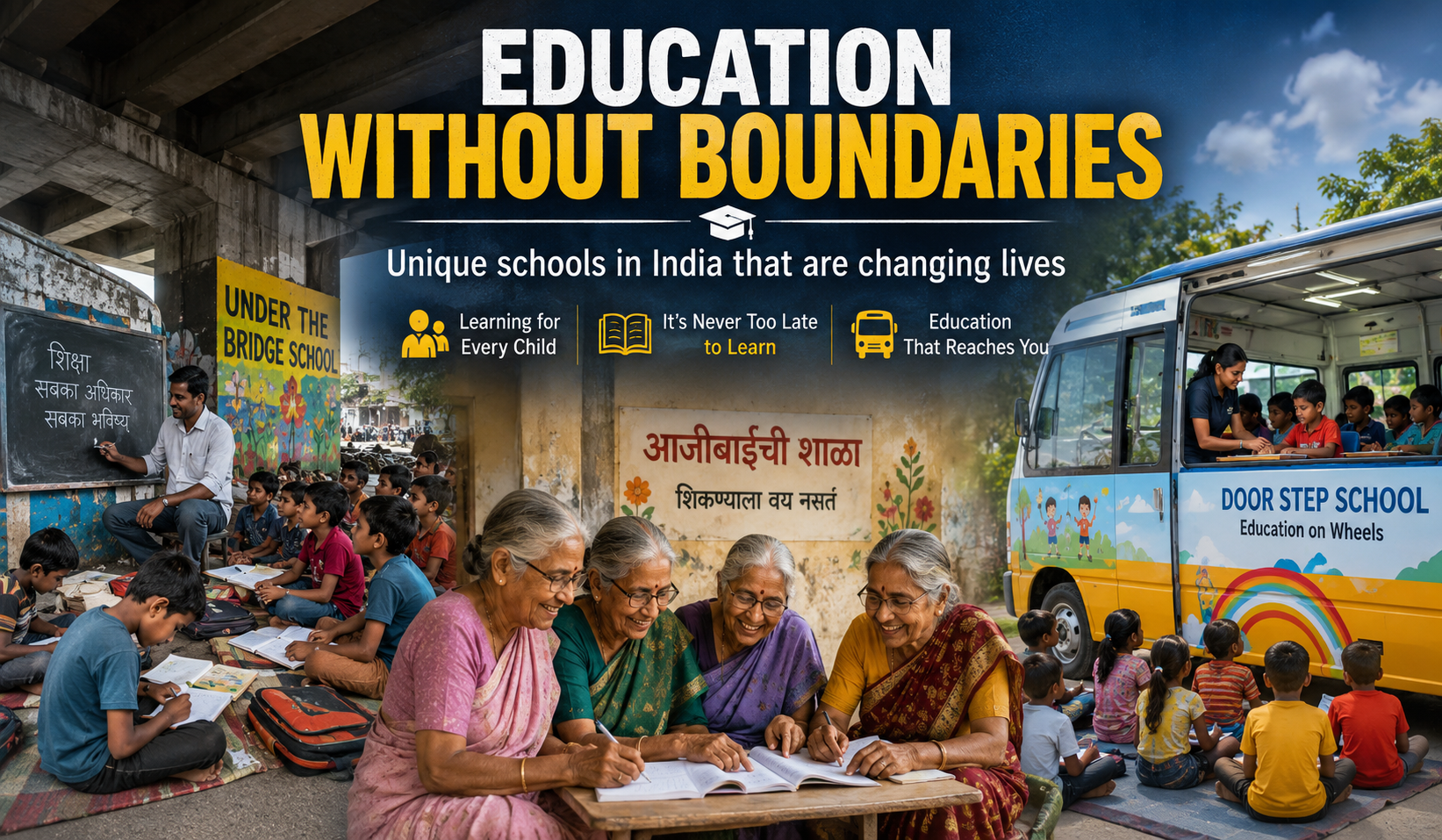
Education in India is evolving in remarkable ways, often driven by individuals and organizations that refuse to let social or economic barriers stand in the way of learning. While most people imagine a school as a traditional building with classrooms and playgrounds, several inspiring initiatives across the country have redefined what a school can be.
From classes conducted beneath a metro bridge for underprivileged children to learning centers where senior women pursue literacy in their 60s and beyond, and even mobile classrooms operating inside buses, these institutions demonstrate that education can flourish in the most unexpected places.
Under the Bridge School: A Classroom Built on Determination
One of the most inspiring examples is the “Under the Bridge School” in Delhi, where children from economically disadvantaged families receive free educational support in a classroom set up beneath a metro bridge. The initiative was launched in 2006 by educator Rajesh Kumar Sharma after he noticed many children in nearby slum communities spending their days without access to proper schooling.
The school primarily serves children whose families face financial hardships or live far from quality educational facilities. Many students walk long distances every day to attend classes before continuing to their formal government schools. Volunteer teachers provide lessons in subjects such as Hindi, mathematics, and general studies while helping younger children build strong academic foundations.
What makes this initiative exceptional is its commitment to accessibility. There are no tuition fees, allowing families with limited resources to give their children an opportunity to learn and grow. Despite operating in an unconventional environment, the school has become a symbol of hope for hundreds of students over the years.
A School Where Grandmothers Become Students
In Maharashtra, another extraordinary educational initiative focuses not on children but on elderly women who never had the chance to attend school during their youth. Commonly known as “Aajibaichi Shala” (Grandmothers’ School), this unique institution encourages women above the age of 60 to learn reading, writing, and basic literacy skills in a supportive environment.
The school was established with the belief that education has no age limit. Many participants spent their younger years managing households or working to support their families, leaving little opportunity for formal education. By attending classes later in life, they gain confidence, independence, and the satisfaction of fulfilling a lifelong dream.
Teachers adapt their methods to suit senior learners, offering patient guidance and personalized attention. Lessons often include language skills, basic mathematics, drawing activities, and practical knowledge that can be applied in everyday life. The atmosphere is lively and welcoming, proving that learning remains possible at any stage of life.
Learning on Wheels: The Door Step School Bus
Another innovative concept is the Door Step School initiative, which takes education directly to underserved communities through specially designed buses converted into mobile classrooms. Instead of expecting children to travel long distances, the school travels to them.
Inside these buses, students participate in structured lessons covering languages, mathematics, science, creative activities, and life skills. Teachers also work closely with parents and local communities to encourage regular attendance and reduce school dropouts. Educational materials are generally provided free of cost, ensuring that financial constraints do not prevent children from learning.
The mobile classroom model is particularly effective in reaching children living in informal settlements or families with unstable working conditions, helping bridge the gap between marginalized communities and mainstream education.
Breaking Traditional Barriers
These unconventional schools highlight a common principle: education should adapt to people’s circumstances rather than expecting people to overcome impossible obstacles on their own. Whether classes are conducted under a bridge, inside a bus, or for senior citizens who missed formal schooling decades ago, each initiative demonstrates creativity, compassion, and community involvement.
Such models also encourage volunteerism and social responsibility, inspiring educators and citizens to rethink how learning opportunities can be expanded for those who need them most.
The Impact Beyond Classrooms
The benefits of these schools extend far beyond academics. Children gain confidence and improved prospects for higher education, elderly women achieve literacy and independence, and communities begin to value education as a tool for long-term social change.
By removing barriers related to poverty, distance, or age, these institutions contribute to greater inclusion and help create opportunities that might otherwise remain out of reach.
Conclusion
India’s most unique schools prove that quality education does not depend solely on buildings or infrastructure—it depends on dedication, innovation, and the determination to make learning accessible for everyone. Whether operating beneath a bridge, on wheels, or for students well past retirement age, these initiatives stand as inspiring examples of how education can transform lives and strengthen communities.
Their success serves as a reminder that when people come together with a shared vision, classrooms can exist anywhere and learning truly becomes a lifelong journey.