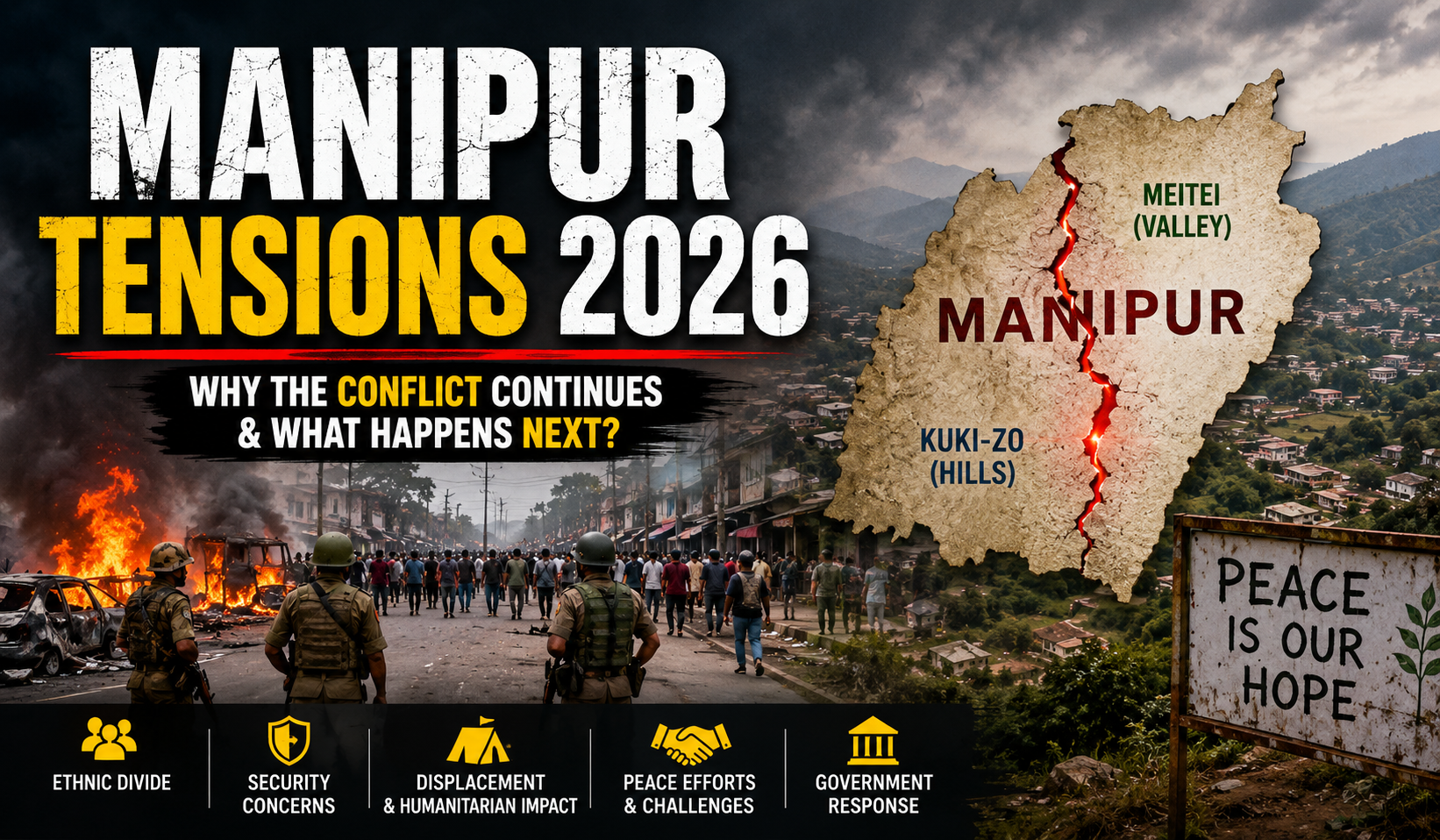
More than three years after violence first erupted in Manipur, the northeastern state continues to face significant security, political, and humanitarian challenges. What began as ethnic clashes between the Meitei and Kuki-Zo communities in 2023 has evolved into a prolonged crisis involving displacement, security operations, political disagreements, and growing concerns about long-term peace.
Recent developments in 2026 have once again brought Manipur into national headlines, with reports of fresh tensions, security deployments, and concerns about the stability of the region. As the government works to restore normalcy, many residents remain displaced, and trust between communities remains fragile.
This article explains the roots of the conflict, recent developments, the role of the government, and what lies ahead for Manipur.
Understanding the Origins of the Manipur Conflict
Manipur is a diverse state with several ethnic communities living across different geographical regions.
The state’s population is broadly divided into:
- Meitei community, concentrated mainly in the Imphal Valley.
- Kuki-Zo tribal communities, living primarily in the hill districts.
- Naga tribes, spread across various hill regions.
- Other smaller indigenous groups.
For decades, tensions have existed regarding land rights, political representation, access to resources, and cultural identity.
The immediate trigger for the 2023 violence was a dispute over the demand for Scheduled Tribe status for the Meitei community. Tribal groups opposed the move, arguing that it could affect existing protections for hill tribes and alter land ownership patterns.
Protests quickly escalated into violent clashes that spread across multiple districts, leading to widespread destruction and loss of life.
How the Violence Escalated
What initially appeared to be a political and legal dispute soon transformed into one of the most serious internal conflicts India has witnessed in recent years.
Several factors contributed to the escalation:
Breakdown of Trust
Communities that had coexisted for decades became increasingly polarized. Rumors, misinformation, and social media narratives intensified tensions.
Armed Groups
The presence of armed organizations in the region complicated efforts to restore peace. Security agencies faced challenges in preventing attacks and maintaining order.
Geographical Division
The valley and hill districts became increasingly segregated, making reconciliation more difficult.
Large-Scale Displacement
Thousands of families fled their homes as villages and neighborhoods came under attack. Relief camps became home to many displaced residents.
Humanitarian Impact of the Crisis
The conflict has left a deep humanitarian impact on Manipur.
Displacement
Thousands of people remain displaced from their homes. Many families have spent years in temporary shelters and relief camps.
Education Disruptions
Schools in affected areas faced closures, interruptions, and security concerns. Students preparing for crucial examinations experienced significant challenges.
Economic Damage
Businesses, markets, transportation networks, and local industries suffered losses due to violence and instability.
Mental Health Concerns
Continuous uncertainty and trauma have affected people across communities, especially children and elderly residents.
Why Tensions Persist in 2026
Many observers expected the situation to improve significantly by 2026. While large-scale violence has reduced compared to the peak of the crisis, tensions remain.
Several reasons explain why the conflict continues to be a concern.
Community Separation
Many communities continue to live in segregated areas with limited interaction.
Security Concerns
Authorities continue to deploy additional security personnel in sensitive districts to prevent fresh clashes.
Political Disagreements
Different groups continue to demand solutions that often conflict with one another.
Rehabilitation Challenges
Returning displaced families to their homes remains a complex process involving security, infrastructure, and trust-building.
Recent Developments in 2026
Recent months have witnessed renewed concerns regarding stability in the state.
Increased Security Deployment
The Central Government has reinforced security measures in vulnerable areas to prevent fresh outbreaks of violence.
Fresh Localized Incidents
Authorities have reported sporadic incidents involving various ethnic groups, highlighting the fragile nature of peace in certain districts.
Continued Monitoring
Security agencies continue conducting operations aimed at maintaining law and order and preventing armed confrontations.
Administrative Efforts
Government officials are working with community leaders and civil society organizations to encourage dialogue and reconciliation.
The Role of the Central Government
The Union Government has adopted a multi-pronged approach toward managing the crisis.
Key measures include:
- Deployment of additional security forces.
- Peace-building initiatives.
- Rehabilitation programs for displaced persons.
- Infrastructure restoration projects.
- Continuous monitoring of sensitive districts.
The government has repeatedly emphasized its commitment to restoring normalcy and ensuring the safe return of displaced families.
Challenges to Lasting Peace
Despite ongoing efforts, achieving lasting peace remains difficult.
Deep Ethnic Divisions
Years of mistrust cannot be resolved quickly. Rebuilding relationships between communities will require long-term engagement.
Competing Political Demands
Different groups seek different political and administrative arrangements, making consensus difficult.
Security Risks
Even isolated incidents can reignite broader tensions if not addressed promptly.
Economic Recovery
Sustainable peace often depends on economic opportunities, employment, and development. Many affected areas still require substantial investment.
What Residents Want Most
Across communities, many residents share common priorities despite political differences.
These include:
- Safety and security.
- Return to normal daily life.
- Education for children.
- Employment opportunities.
- Restoration of damaged infrastructure.
- Long-term peace and stability.
For ordinary citizens, the desire for a peaceful future often outweighs political disagreements.
Can Manipur Achieve Lasting Stability?
Experts believe lasting peace is possible, but only through sustained efforts involving all stakeholders.
Successful peacebuilding will likely require:
Inclusive Dialogue
Every major community must have a voice in discussions regarding the state’s future.
Trust Building
Programs encouraging interaction between communities can help reduce hostility.
Economic Development
Investment in infrastructure, education, healthcare, and employment can create incentives for stability.
Strong Governance
Effective administration and impartial law enforcement are essential for maintaining confidence among all groups.
Conclusion
The Manipur conflict remains one of India’s most complex internal challenges. While large-scale violence has reduced since the devastating clashes of 2023, tensions continue to affect daily life across the state in 2026.
The crisis is rooted in issues of identity, land rights, political representation, and historical grievances. Solving these challenges requires patience, dialogue, and cooperation among communities, state authorities, and the central government.
For the people of Manipur, the ultimate goal is simple yet profound: a return to peace, security, and normalcy after years of uncertainty. Whether that goal can be fully achieved will depend on the willingness of all sides to prioritize reconciliation over conflict and build a future based on trust rather than division.