India’s Monsoon Session of Parliament has been rocked by ongoing disruptions as Opposition MPs press the government over the NEET-UG 2026 paper leak controversy. With demands ranging from the resignation of Union Education Minister Dharmendra Pradhan to the withdrawal of police cases against student protesters, the standoff has grown into one of the most politically charged issues facing the government this year. Here’s a complete breakdown of what triggered the crisis, how it escalated, and where things currently stand.
Background: The NEET-UG 2026 Paper Leak Controversy
The NEET-UG 2026 examination, conducted by the National Testing Agency (NTA) for admission to medical courses across the country, came under scrutiny after allegations surfaced that the question paper had been compromised. According to sources, the leak was tracked back to persons involved in the paper’s translation process, including professors and subject experts who had legitimate access to exam information. An FIR in the matter was registered in May 2026, and the CBI has since arrested multiple individuals allegedly linked to the leak, with the investigation reportedly uncovering a financial trail involving the sale of the leaked paper for lakhs of rupees.
The controversy deepened following the death of a NEET aspirant, Riya Thapa, which student groups link to distress over the alleged exam irregularities. Her case has become a rallying point for protesters demanding accountability from the government and the National Testing Agency.
The ‘Chalo Sansad’ March and Police Action
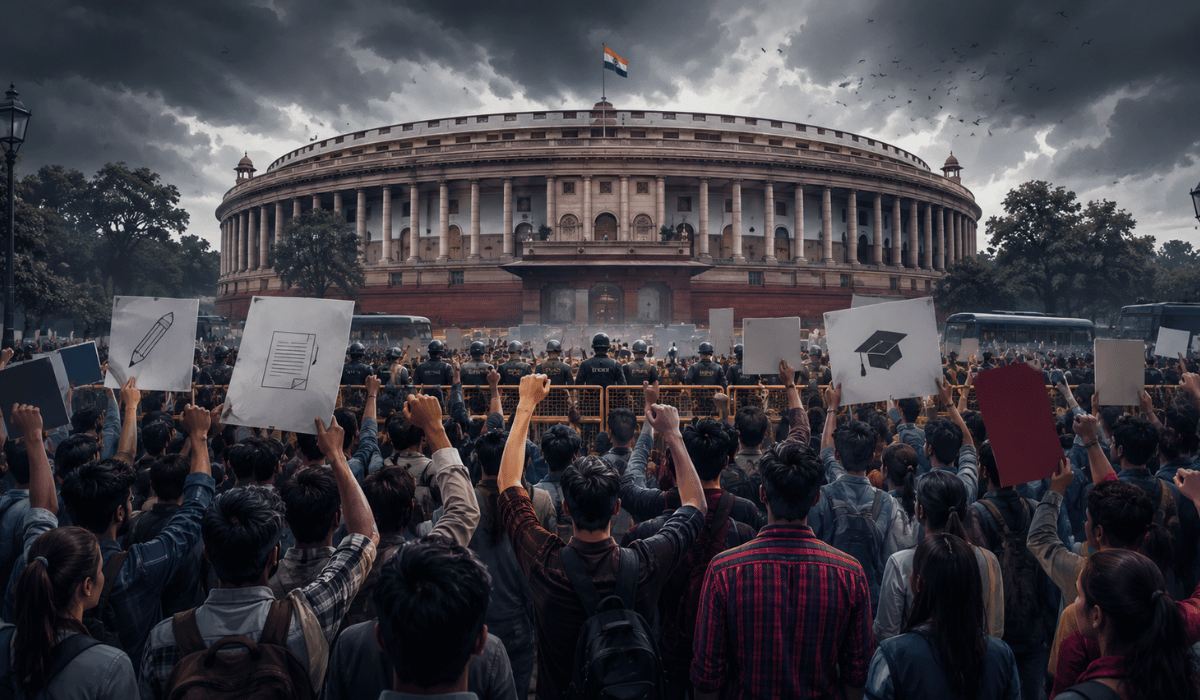
Tensions escalated sharply when the Cockroach Janata Party (CJP), a student-led political outfit, organized a ‘Chalo Sansad’ (March to Parliament) demonstration. Protesters, many of them NEET aspirants, traveled from states including Uttar Pradesh, Haryana, Punjab, Bihar, Rajasthan, Maharashtra, Assam, and Madhya Pradesh, gathering at Jantar Mantar before attempting to march toward Parliament.
Delhi Police had imposed prohibitory orders under Section 163 of the Bharatiya Nagarik Suraksha Sanhita across the New Delhi district ahead of the march. When protesters attempted to proceed toward Parliament Street, police responded with baton charges and tear gas near Shastri Bhawan and Raisina Road, resulting in multiple detentions across central Delhi. According to police, around ten FIRs have been registered in connection with the march.
CJP founder Abhijeet Dipke, who had been on an indefinite hunger strike over the issue, was persuaded by Riya Thapa’s father to end his fast and lead the march instead. Separately, activist Sonam Wangchuk has also been on a hunger strike in support of the students’ demands and remains hospitalized while continuing the protest.
Opposition Escalates: Dharna Outside PM’s Residence
A day after the CJP march, opposition leaders including Leader of the Opposition Rahul Gandhi, Congress MP Priyanka Gandhi Vadra, and Samajwadi Party leader Akhilesh Yadav staged a dharna near Prime Minister Narendra Modi’s residence, protesting the police action against the student demonstrators. Delhi Police forcibly removed the leaders from the site, and several were detained and taken to nearby police stations, with Congress Parliamentary Party chairperson Sonia Gandhi later visiting a police station where some leaders were held.
The core demands from the Opposition have remained consistent: a full investigation into the NEET-UG 2026 paper leak, withdrawal of FIRs filed against student protesters, and the resignation of Education Minister Dharmendra Pradhan.
Parliament Disruption Continues
Inside Parliament, Opposition MPs have repeatedly disrupted proceedings during the Monsoon Session, moving adjournment motions to force a discussion on the NEET issue. Congress MP KC Venugopal noted that the party had been pushing for a debate for several days but said the government was unwilling to allow a structured discussion under an appropriate rule. The Opposition has said it will continue its agitation until its three central demands are addressed.
Government’s Response
Union Education Minister Dharmendra Pradhan broke his silence on the controversy, accusing Rahul Gandhi and the Congress party of using students as political tools to disrupt the Monsoon Session rather than engaging constructively. He argued that the center had already expressed willingness to hold a comprehensive discussion in Parliament and that the opposition’s decision to protest outside the prime minister’s residence was an attempt to manufacture confrontation instead.
In an effort to de-escalate the situation, Union Minister Jitendra Singh visited the protesting students directly and has also met with hospitalized activist Sonam Wangchuk. Meanwhile, government representatives have indicated an openness to discussing the issue in Parliament, though disagreements over the format and rules of such a debate have so far prevented progress.
Why This Issue Has Become a Major Political Flashpoint
Several factors have combined to turn this from a routine exam-related controversy into a full-blown political crisis:
- Student safety and mental health concerns, following the death of a NEET aspirant, have added significant emotional weight to the protests.
- Allegations of heavy-handed policing against student demonstrators have drawn criticism from opposition parties and civil society groups.
- Repeated Parliament disruptions have stalled other legislative business during the Monsoon Session, raising the political stakes for both sides.
- Direct confrontation near the prime minister’s residence marked an unusual escalation, with senior opposition leaders themselves facing detention.
What Happens Next
As of now, the standoff remains unresolved. The Opposition continues to demand a structured parliamentary debate on the NEET-UG 2026 paper leak, along with accountability measures including Dharmendra Pradhan’s resignation and the withdrawal of FIRs against students. The government, while signaling willingness to discuss the issue, has yet to agree to the Opposition’s specific terms for that debate.
With the CBI investigation ongoing and student groups continuing their protests, the NEET paper leak controversy is likely to remain a dominant issue in Parliament for the remainder of the Monsoon Session, with implications for both the government’s handling of examination integrity and its relationship with student communities across the country.
Key Takeaways
- The NEET-UG 2026 paper leak controversy has triggered protests, a CBI investigation, and major disruptions in Parliament.
- The CJP-led ‘Chalo Sansad’ march faced police action, resulting in detentions and multiple FIRs.
- Opposition leaders, including Rahul Gandhi, were detained during a protest near the PM’s residence.
- The central demands are a full investigation, withdrawal of FIRs against students, and the resignation of Education Minister Dharmendra Pradhan.
- The government has expressed openness to discussion, but disputes remain over the terms of a parliamentary debate.
This is a developing story. Details may continue to evolve as investigations proceed and Parliament’s Monsoon Session continues.