The question is no longer quiet, it is trending. After YouTuber and political commentator. Dhruv Rathee publicly called out Rajya Sabha MP Raghav Chadha for allegedly purchasing fake Instagram followers, the internet erupted. And then, within 24 hours of Chadha switching parties from AAP to BJP on April 24, 2026, something remarkable happened: over one million followers vanished from his account overnight.
That sudden mass exodus raised a question even louder than before if so many followers could disappear so fast, were they ever real?
Who Is Raghav Chadha and Why Does This Matter?
Raghav Chadha, 37, was one of the Aam Aadmi Party’s most prominent young faces. He cultivated a carefully crafted image as a Gen Z-friendly politician, someone who understood urban India, spoke about gig workers, questioned airport food prices, and even worked a shift as a Blinkit delivery partner to understand the gig economy. His Instagram profile, @raghavchadha88, became a political weapon, racking up over 14.6 million followers before his party switch.
But that massive follower count was always a subject of quiet suspicion among political observers. Dhruv Rathee himself a creator with over 17 million Instagram followers and 25 million YouTube subscribers decided to make that suspicion public.
What Did Dhruv Rathee Say?
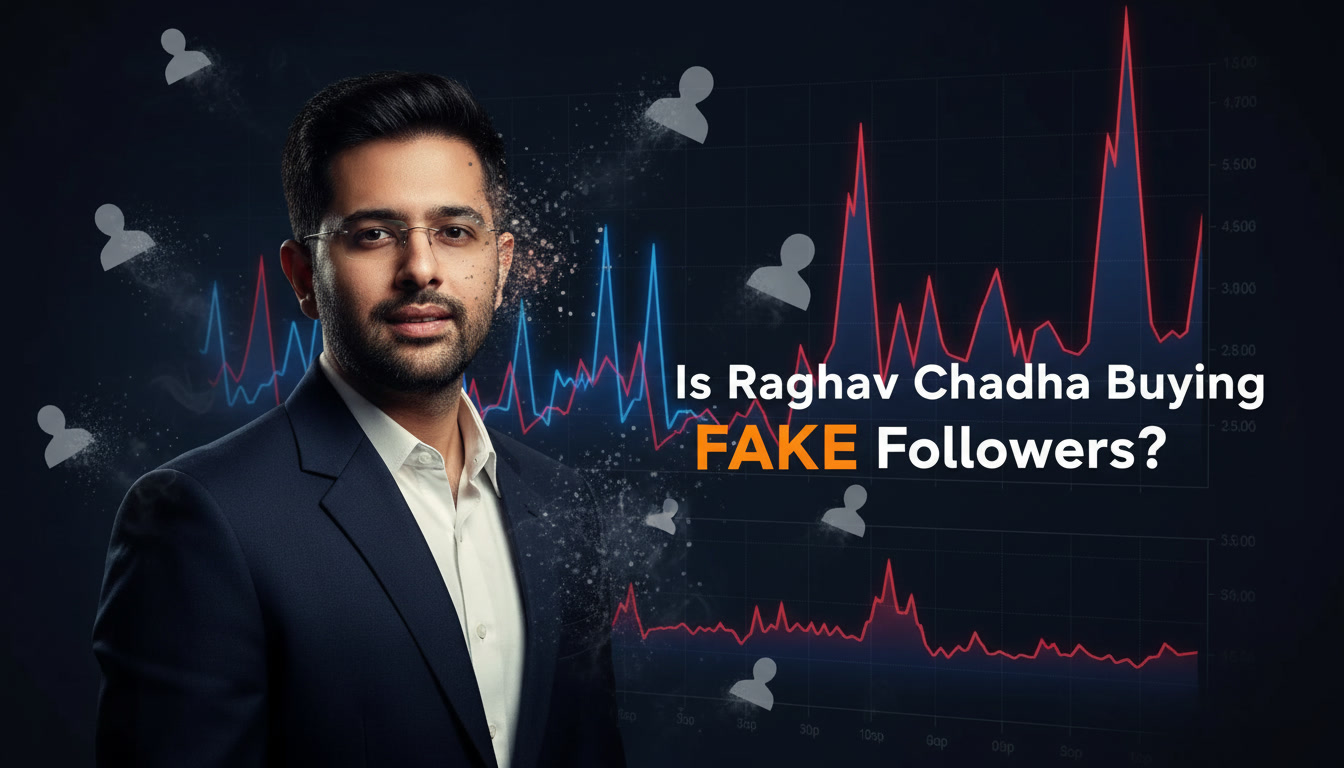
In a widely shared Instagram post titled “Raghav Chadha Buying FAKE Followers?? Here’s the proof”, Rathee laid out a case built on analytics and follower growth data. His core argument centred on unnatural spikes in Chadha’s followers count sharp, near-vertical jumps in the growth graph that are inconsistent with how organic audiences behave.
Rathee, reacting to Chadha’s party switch, also posted a scathing video (https://www.instagram.com/reel/DXo7ZQQDZJV) on Instagram in Hindi: “Raghav Chadha jitna bada dhokebaaz shayad hi kabhi dekha ho” meaning, “You’ve probably never seen a bigger fraud than Raghav Chadha.” While that comment addressed the political betrayal, his earlier post focused specifically on the follower manipulation allegation with data-driven evidence.
Here is what Rathee’s analysis pointed to:
1. Abnormal follower spikes: Organic growth on Instagram, even for popular accounts, follows a relatively smooth curve gradual peaks during viral content, slow dips otherwise. Chadha’s follower graph reportedly showed cliff-like jumps with no corresponding viral moment to explain them.
2. Low engagement-to-follower ratio: A classic red flag for bought followers is a mismatch between follower count and actual engagement. Fake accounts do not like, comment, or share. Analysts and third-party tools flagged that Chadha’s engagement rate was disproportionately low for an account of his size.
3. The party switch follower collapse: When Chadha announced his exit from AAP on April 24, 2026, his followers dropped from 14.6 million to approximately 13.3 million within 24 hours — a loss of over one million accounts. Real followers, even angry ones, tend to unfollow gradually. The speed and scale of this collapse was consistent with Instagram’s automated bot-purging system, which periodically sweeps accounts when unusual activity is detected often triggered when platform algorithms flag mass inorganic follows. NCP(SP) spokesperson Anish Gawande noted publicly: “The internet can make you a hero overnight. The internet can also bring you down to zero overnight.”
The Numbers Tell a Story
Before the party switch, Chadha stood at 14.6 million Instagram followers, a number that would make him one of the most-followed politicians in India. For context, Dhruv Rathee himself, with years of widely viewed political commentary and tens of millions of YouTube subscribers, sits at around 17 million Instagram followers.
After the mass unfollowing campaign triggered by his AAP exit and what appears to be a simultaneous Instagram purge of bot accounts Chadha’s count dropped to approximately 12.4 million, a decline of over 2 million in just days.
What makes this particularly noteworthy is the pattern of the loss. While a Gen Z “unfollow campaign” with the hashtag #UnfollowRaghavChadha was indeed circulating, organic campaigns rarely produce drops this large this fast. The speed strongly suggests that inorganic followers bots and purchased accounts were among those purged.
Is This Confirmed? What Can We Definitively Say?
It is important to be precise here. Rathee’s post presents circumstantial evidence based on publicly available analytics data follower growth graphs, engagement rates, and statistical anomalies. Instagram has not officially confirmed or denied that Chadha’s account contained purchased followers. Chadha himself has not addressed the allegation directly.
However, the evidence points strongly in one direction:
- His follower growth curve showed irregular, unexplained spikes inconsistent with organic activity.
- His engagement rate was below what would be expected for an account of his claimed size.
- The sudden massive follower loss upon switching parties aligns with patterns seen when Instagram’s bot-detection systems remove inauthentic accounts in bulk.
Verdict: The evidence is highly suggestive. While no platform-level confirmation exists, the combination of abnormal growth patterns, low engagement ratios, and the speed of the follower collapse creates a compelling case that a significant portion of Raghav Chadha’s follower count was artificially inflated.
Why Does This Matter Beyond the Numbers?
In modern Indian politics, follower counts are not just vanity metrics they are used as proof of political relevance, public support, and media influence. A politician with 14 million followers commands more coverage, more brand deals, more speaker invitations, and more perceived legitimacy than one with 2 million.
If those followers are fake, it is not just dishonest it is a deliberate manipulation of public perception of political support. Voters, journalists, and party hierarchies make real decisions based on these numbers. Inflated social media clout can manufacture a false sense of political capital.
Rathee’s intervention forces a broader conversation: how many Indian politicians are using purchased followers to game their public image? And should there be accountability for this kind of manufactured influence?
What Happened to Chadha After the Controversy?
The political drama has, for now, overshadowed the fake followers story. Chadha’s switch to the BJP along with six other AAP Rajya Sabha MPs was the bigger news cycle. Actor Prakash Raj took a dig at Chadha’s follower loss, posting a meme that went viral. Old clips of Chadha harshly criticising the BJP resurfaced, painting his switch as ideologically hypocritical.
Despite all this, his current follower count of approximately 12.4–13 million still exceeds the combined Instagram presence of AAP’s entire top leadership which, as Republic World noted, is roughly 8.3 million combined. The unfollow storm dented his numbers, but his digital footprint remains significant.
FAQs
Did Raghav Chadha officially respond to allegations of buying fake followers?
As of the time of writing, Raghav Chadha has not publicly addressed or denied the allegations made by Dhruv Rathee regarding fake followers. His team has not issued any statement on the matter.
What proof did Dhruv Rathee present?
Rathee’s post highlighted abnormal spikes in Chadha’s Instagram follower growth graph sharp, unexplained jumps inconsistent with organic audience behaviour along with a disproportionately low engagement rate relative to his total follower count.
Why did Chadha lose over a million followers after joining the BJP?
The drop combined two factors: a genuine Gen Z “unfollow campaign” (#UnfollowRaghavChadha) driven by anger at his political switch, and what analysts believe was an Instagram automated purge of inauthentic bot accounts, which often gets triggered when unusual activity patterns are detected on an account.
Is buying Instagram followers illegal in India?
Buying Instagram followers violates Instagram’s Terms of Service and can result in account suspension or removal of fake followers. It is not a criminal offence under Indian law, but it is widely considered deceptive and unethical, especially for public figures and politicians who use follower counts to claim popular support.
How can you tell if someone has bought followers?
Common signs include sudden, unexplained spikes in follower count with no viral trigger, a very low engagement rate (likes and comments) relative to the total follower count, a high proportion of followers with no profile pictures or posts, and follower counts that recover suspiciously quickly after dips.
Did this controversy affect Chadha’s political standing?
The fake follower controversy has been largely eclipsed by the bigger political story of his party switch. However, it has added another layer to the public trust deficit he faces, particularly among younger voters who valued authenticity above all else and who now feel doubly deceived.