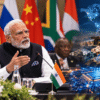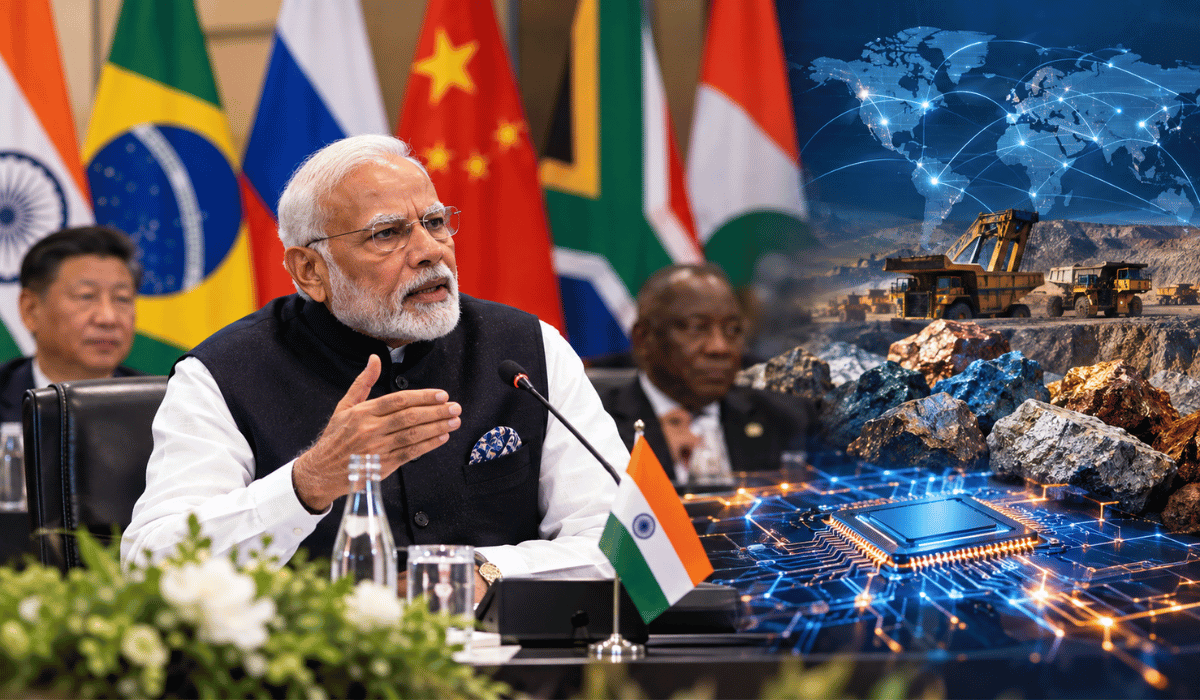
The 18th BRICS Summit wrapped up in New Delhi this past weekend, and one line from Prime Minister Narendra Modi’s closing address is already dominating headlines, a pointed warning about the weaponization of technology and critical minerals. Delivered at Bharat Mandapam with Chinese President Xi Jinping and Russian President Vladimir Putin in the room, the remark wasn’t just diplomatic language. It touched a nerve that’s been building across global supply chains for years.
Key Takeaways
- PM Modi cautioned that turning technology and critical minerals into tools of leverage could set back the shared progress the world has made and called instead for more inclusive access to technology.
- His remarks landed amid mounting global unease over China’s tightening control on critical mineral exports and its guarded approach to sharing advanced technology.
- The summit closed with all 11 BRICS members unanimously signing off on the sweeping New Delhi Declaration.
- That declaration touched on UN reform, cross-border payment systems, AI cooperation, terrorism, and stronger representation for the Global South, alongside the minerals issue.
- Over its chairmanship year, India pushed a slate of initiatives spanning digital infrastructure, startups, healthcare, and supply-chain resilience.
What Did PM Modi Actually Say?
Speaking at a summit session focused on resilience and inclusive growth, Modi urged fellow BRICS leaders to take seriously the risks of turning technology and mineral resources into instruments of pressure between nations. His broader point was that global crises no longer stay contained to one region. Pandemics, climate shocks, and supply-chain breakdowns have all shown how quickly disruption spreads once it starts.
He returned to the theme again in a separate session on global governance, specifically flagging how restricting access to critical minerals could stall collective growth across the bloc. Notably, he avoided naming any single country. But the timing made the target fairly easy to read. China sat in the room as the world’s leading processor of several critical minerals, including rare earths, at a moment when its export policies have drawn growing scrutiny from trading partners worldwide.
Why Critical Minerals Have Become a Flashpoint
Rare earths, lithium, cobalt, and a handful of other minerals now sit at the center of modern manufacturing. Electric vehicles, defense hardware, and the chips that power AI systems all depend on them. When processing capacity for these materials is concentrated in just one or two countries, a single policy shift on exports can send shockwaves through industries thousands of miles away almost overnight.
That’s the underlying risk Modi was pointing to. By framing it as a shared vulnerability for the whole BRICS grouping rather than a grievance against one member, he kept the tone diplomatic while still putting a real fault line on the table, one that could quietly strain the “win-win” cooperation the bloc has spent two decades building.
What the New Delhi Declaration Actually Delivered
Modi’s warning fed directly into the summit’s biggest output, the New Delhi Declaration, a wide-ranging document that BRICS leaders adopted unanimously to mark the bloc’s 20th anniversary. A few things worth knowing about it:
- Scope: It’s a 140-point declaration covering everything from UN Security Council reform to trade policy, with China and Russia both backing expanded roles for India and Brazil at the UN.
- Security stance: The declaration firmly condemned terrorism in all forms, specifically referencing the April 2025 attack in Jammu and Kashmir, and called for a ceasefire and two-state resolution to the Gaza conflict.
- Technology and AI: Leaders committed to international cooperation on AI that is safe, secure, and broadly accessible, alongside expanded work on healthcare, energy security, and food supply resilience.
- Trade posture: The bloc pushed back against unilateral tariffs and coercive economic tactics, while encouraging wider use of local currencies in trade and investment.
- What it isn’t: It’s worth being clear-eyed about the limits here too. The declaration doesn’t launch a new global currency or attempt to replace institutions like the IMF or World Bank. Analysts have described it more as a set of frameworks that could deepen cooperation gradually, not a sudden reordering of the global economy.
India’s Broader Agenda as BRICS Chair
Beyond the weaponization warning, Modi used his time at the podium to highlight a set of India-driven initiatives from its chairmanship year: a logistics and supply-chain cooperation framework, a network to connect startups and incubators across member countries, a proposed startup innovation fund, and a digital agriculture initiative meant to bring AI and geospatial tools directly to farmers.
That agenda reflects how India approached its year running the bloc more generally. Over roughly twelve months, India hosted several hundred BRICS-related meetings and engagements across dozens of cities, touching political, economic, and cultural cooperation alike. Fresh proposals included a shared digital public infrastructure repository, a network of health training hubs, and a new center focused on industrial and manufacturing cooperation across member states.
Why This Matters Beyond the Summit Room
BRICS now accounts for close to half the world’s population and roughly two-fifths of global GDP, which means a shared stance on technology and mineral access carries genuine weight, even if it doesn’t reshape policy overnight. Whatever comes of the New Delhi Declaration in practice, Modi’s remarks pointed to where the bloc’s biggest economies see the next major friction point forming, not in the usual tariff disputes, but in who controls the raw materials and tools that nearly every other industry now runs on.
The BRICS chairmanship now passes to China for 2027, with the next summit set to take place there. Whether the inclusivity Modi called for actually shapes policy or whether critical minerals end up as a sharper point of tension within BRICS itself will likely define much of the bloc’s next chapter.
FAQs
What did PM Modi say about weaponization at the BRICS Summit?
He warned that treating technology and critical minerals as tools of pressure could undermine shared global progress and called for more inclusive access to technology worldwide.
When and where was the 18th BRICS Summit held?
It took place on September 12–13, 2026, in New Delhi, at Bharat Mandapam, under India’s chairmanship.
What is the New Delhi Declaration?
It’s a 140-point document unanimously adopted by BRICS leaders, covering UN reform, AI cooperation, cross-border payments, terrorism, health, food security, and technology.
Which countries are part of BRICS now?
BRICS started with Brazil, Russia, India, China, and South Africa and has since grown to include Egypt, Ethiopia, Iran, the UAE, and Indonesia.
Who chairs BRICS after India?
China takes over the BRICS chairmanship in 2027, and the next summit is expected to be held there.