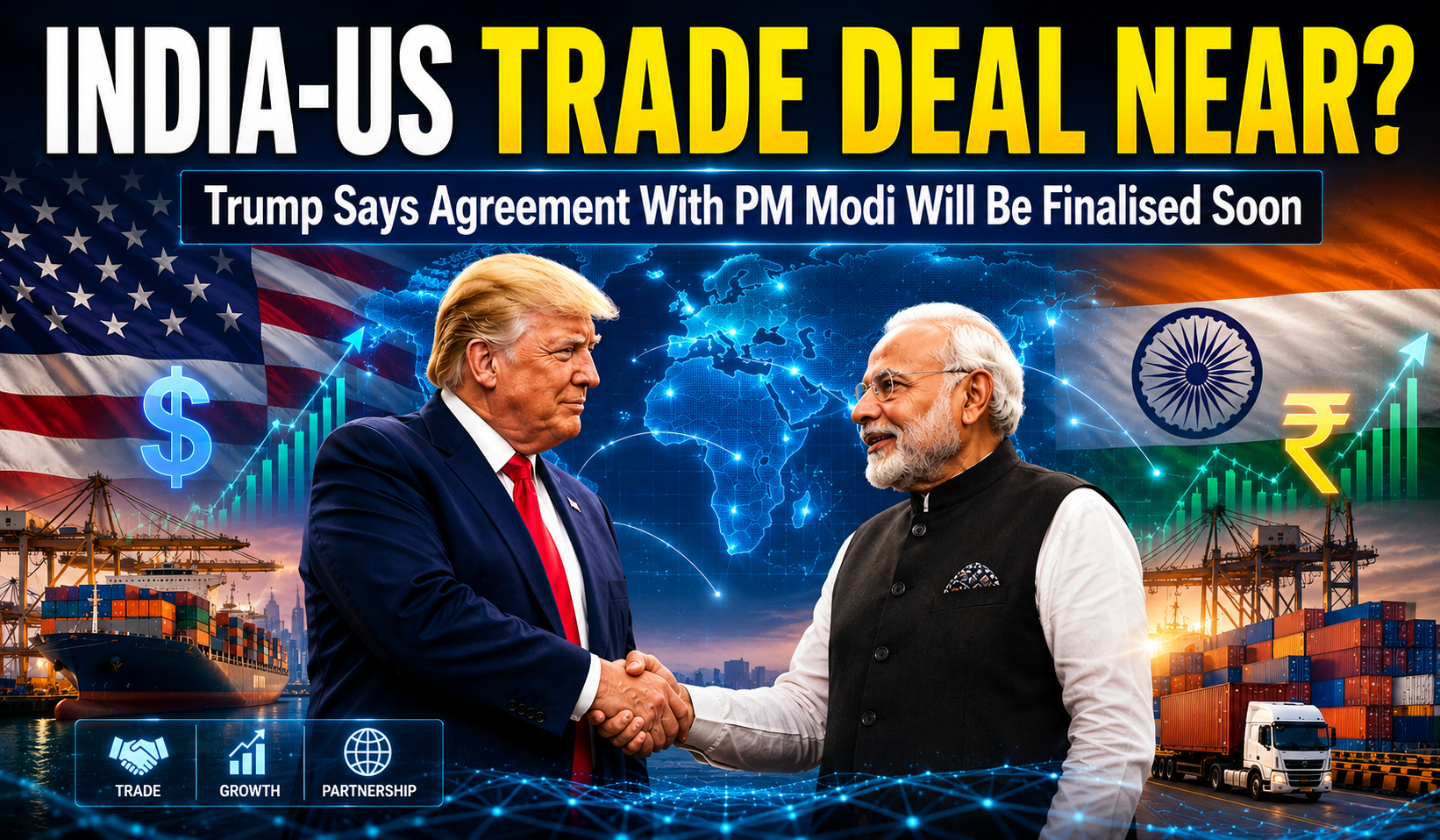
The economic relationship between India and the United States may be on the verge of a significant breakthrough. U.S. President Donald Trump has expressed optimism that a long-awaited trade agreement between the two countries will soon be finalized, describing Indian Prime Minister Narendra Modi as a “good friend” and highlighting the growing economic cooperation between the world’s largest and fifth-largest economies.
Trump’s remarks come at a crucial time when trade negotiations between New Delhi and Washington have intensified, with both sides seeking to resolve outstanding issues related to tariffs, market access, and investment opportunities. The potential agreement is expected to strengthen bilateral ties and create new opportunities for businesses and consumers in both countries.
Trump Expresses Confidence in Upcoming Trade Agreement
Speaking about ongoing discussions with India, President Donald Trump stated that the United States is “making a lot of money with India” and indicated that both nations are close to reaching a comprehensive trade deal.
Trump’s comments suggest a positive shift in negotiations that have been underway for several months. He emphasized the strong personal relationship he shares with Prime Minister Narendra Modi and expressed confidence that both governments are committed to finding common ground on key trade issues.
The U.S. President’s remarks have generated significant interest among economists, investors, and policymakers, as the agreement could have far-reaching implications for global trade and economic growth.
Strengthening India-US Economic Relations
India and the United States have witnessed remarkable growth in bilateral trade over the past decade. The two nations have become important economic partners, with trade spanning sectors such as technology, pharmaceuticals, agriculture, manufacturing, energy, and defense.
The United States remains one of India’s largest export destinations, while India has emerged as a crucial market for American products and services. As global supply chains continue to evolve, both countries are exploring ways to deepen economic cooperation and reduce trade barriers.
A successful trade agreement could further enhance these ties by creating a more predictable and business-friendly environment for companies operating across borders.
Key Issues Under Discussion
Negotiators from both countries have been working to address several important issues that have previously complicated trade relations.
Tariff Reductions
One of the primary topics of discussion involves tariffs imposed on various products. Both nations have sought greater market access for their domestic industries while protecting sensitive sectors.
Reducing tariffs could make products more affordable for consumers and increase competitiveness for exporters on both sides.
Market Access
Businesses in both countries have advocated for improved access to each other’s markets. The proposed agreement may include measures designed to simplify trade procedures and remove barriers that currently limit commercial opportunities.
Digital Trade and Technology
As technology becomes increasingly important in global commerce, discussions have also focused on digital trade regulations, data flows, and cooperation in emerging technologies.
India’s rapidly growing digital economy and America’s leadership in technology innovation make this an important area of collaboration.
Investment Opportunities
The agreement could also encourage greater foreign direct investment by providing clearer regulations and stronger protections for investors.
Such measures may help create jobs, stimulate innovation, and support long-term economic growth.
Why the Trade Deal Matters
The potential India-US trade agreement is significant for several reasons.
Boosting Economic Growth
Improved trade relations can contribute to economic growth by increasing exports, attracting investment, and creating employment opportunities. Businesses would benefit from reduced costs and greater access to international markets.
Enhancing Supply Chain Resilience
Global supply chains have faced numerous challenges in recent years. Strengthening economic ties between India and the United States could help diversify supply chains and reduce dependence on a limited number of markets.
Strategic Partnership
Beyond economics, the trade agreement would reinforce the broader strategic partnership between the two democracies. Both nations share interests in maintaining stability, promoting innovation, and supporting economic development in the Indo-Pacific region.
Benefits for Consumers
Consumers in both countries could benefit from increased product availability, lower prices, and improved competition resulting from reduced trade barriers.
PM Modi and Trump’s Personal Relationship
President Trump’s reference to Prime Minister Narendra Modi as a “good friend” reflects the strong personal rapport that has characterized their interactions over the years.
The leaders have frequently emphasized the importance of India-US cooperation and have participated in several high-profile events aimed at strengthening bilateral relations. Their personal relationship has often been viewed as a positive factor in advancing diplomatic and economic initiatives.
Political observers note that strong leadership-level engagement can play an important role in overcoming obstacles during complex negotiations.
Business Community Welcomes Positive Signals
Industry groups and business leaders have largely welcomed the latest developments. Many believe that a finalized trade agreement would provide certainty and encourage greater cross-border investment.
Sectors expected to benefit include:
- Information Technology
- Pharmaceuticals
- Manufacturing
- Agriculture
- Renewable Energy
- Automotive Industries
- E-commerce
- Telecommunications
Business organizations in both countries have repeatedly called for measures that simplify trade and reduce regulatory challenges.
Challenges That Remain
Despite the optimistic tone, some issues still require resolution before a final agreement can be signed.
Differences over tariffs, agricultural imports, intellectual property rights, and certain regulatory standards have historically posed challenges. Negotiators will need to bridge these gaps while ensuring that the interests of domestic industries are protected.
Trade experts caution that while progress appears promising, final agreements often require extensive technical discussions and political approvals.
Global Impact of the Agreement
An India-US trade deal would be closely watched by governments and businesses around the world. As two of the largest economies globally, decisions made by New Delhi and Washington can influence international trade patterns and investment flows.
The agreement could also serve as a signal that major economies remain committed to strengthening economic partnerships despite ongoing geopolitical and economic uncertainties.
Conclusion
President Donald Trump’s latest comments have renewed optimism about the future of India-US trade relations. By expressing confidence that a deal with Prime Minister Narendra Modi’s government is nearing completion, Trump has highlighted the growing importance of economic cooperation between the two nations.
While several issues remain under negotiation, the positive signals from both sides suggest that a breakthrough may be closer than ever. If finalized, the agreement could strengthen bilateral trade, create new business opportunities, attract investment, and further deepen one of the world’s most important strategic partnerships.
As negotiations continue, businesses, investors, and policymakers will be watching closely to see whether India and the United States can transform years of discussions into a landmark trade agreement that benefits both economies.