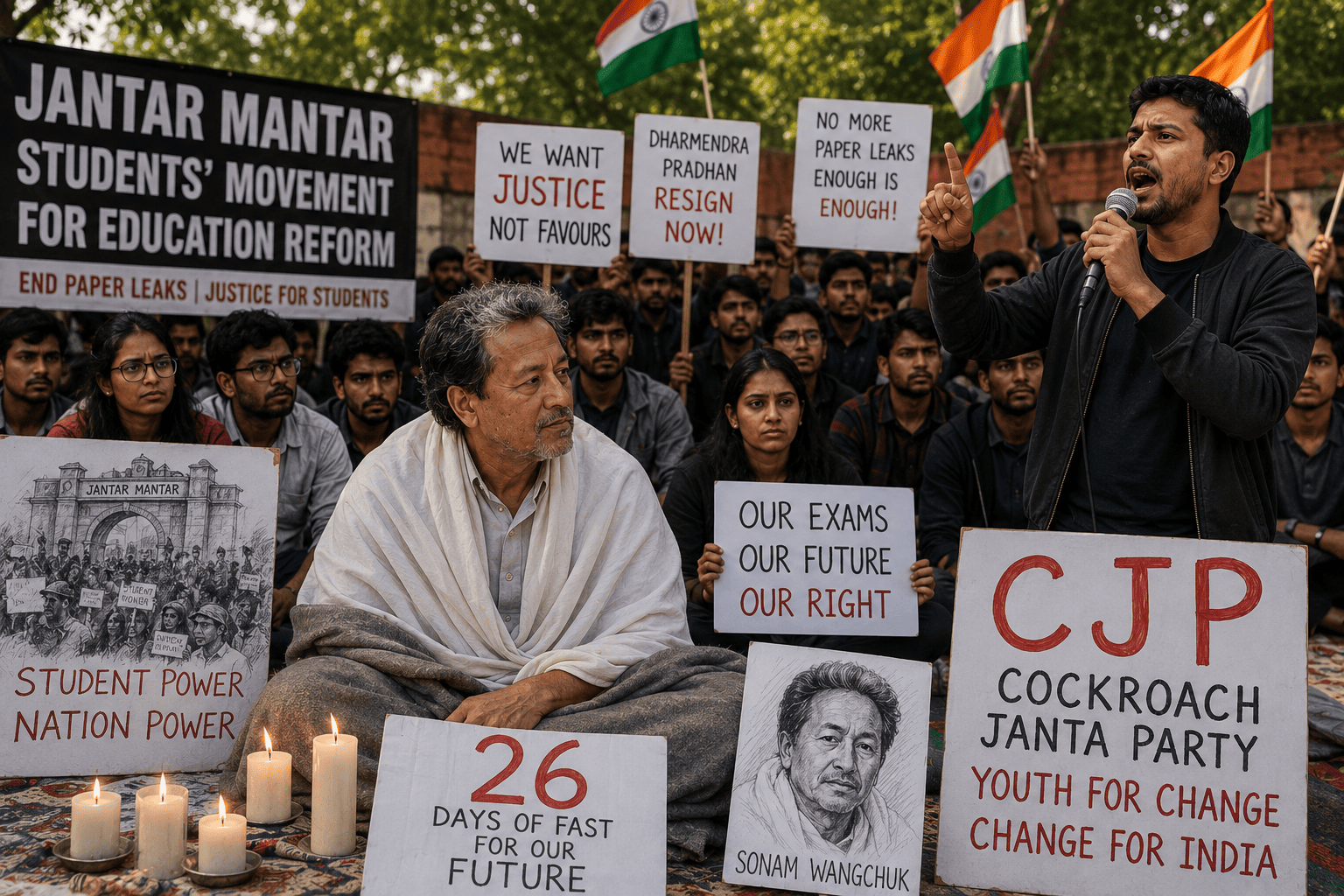
New Delhi’s Jantar Mantar has been the epicenter of one of India’s most closely watched protest movements in 2026, and it just reached a major turning point. Climate and education activist Sonam Wangchuk has ended his 26-day hunger strike, but the protest itself is far from over.
The Fast Is Over, But Not the Fight
Sonam Wangchuk broke his 26-day hunger strike shortly after midnight on July 24, 2026. The moment came at Medanta Hospital in Gurugram, where he’d been under medical care after his health took a turn for the worse at the protest site.
He wasn’t alone when he ended it. Union Ministers J.P. Nadda and Jitendra Singh were there, along with senior leaders from the Apex Body of Leh Ladakh and his wife, Gitanjali Angmo, who stayed by his side.
At Jantar Mantar itself, Wangchuk had begun the fast. But as his condition worsened, Delhi Police moved him to Safdarjung Hospital on July 18, and he was later shifted to Medanta, where he continued the strike until it finally came to an end.
In his own words, Wangchuk said he called off the fast after “a long negotiation on various conditions,” made partly “in view of possible violence in the country.” He indicated he would lay out the specific terms of that negotiation in a separate video message soon.
For 26 days, Wangchuk’s fast had turned a student-led protest into a national flashpoint, drawing attention from political leaders, the media, and millions of concerned citizens tracking his health day by day.
Dipke’s Reaction: Relief, Gratitude, and a Warning
Abhijeet Dipke, the founder of the Cockroach Janta Party (CJP), the youth-led movement behind the protest, responded to the news with visible emotion. He said he was relieved and grateful that Wangchuk had ended his strike, thanking him for his extraordinary courage and sacrifice and crediting him with awakening the conscience of the nation.
But Dipke’s message carried a clear warning too: the CJP’s peaceful sit-in at Jantar Mantar isn’t going anywhere. The protest, he said, will continue until Union Education Minister Dharmendra Pradhan resigns.
What Sparked the Protest
The demonstrations trace back to June 6, 2026, when the CJP, joined by student groups including the Students Federation of India, the All India Students Association, and the All India Students Federation, began mobilizing at Jantar Mantar. Pradhan’s resignation due to the 2026 NEET paper leak and anomalies in the CBSE’s on-screen marking procedure, as well as more extensive changes to the way public exams are administered in India, are their main demands.
Wangchuk’s decision to join the cause with an indefinite fast on June 28 elevated what had started as a student grievance into a nationwide movement, drawing comparisons to earlier hunger-strike protests in Indian history.
The Government’s Response
Wangchuk’s decision came just hours after Prime Minister Narendra Modi released a video address on the issue. It is a “matter of great pain” for hundreds of thousands of students, according to Modi. He said the Union Cabinet would take up a draft law the very next day, one proposing fast-track courts and stricter punishment for those involved in paper leaks. Once finalized, the government plans to push the bill through Parliament as soon as its second week of session begins.
Whether this response is enough to satisfy protesters remains to be seen. Dipke’s statement made clear that ending the fast is not the same as ending the movement.
What Happens Next
With Wangchuk’s health reportedly still fragile, attention has now shifted to two things: the specific conditions he negotiated before breaking his fast and whether Pradhan will actually step down. Until then, the sit-in at Jantar Mantar continues, and the CJP shows no sign of backing off its central demand.
This post reflects developments as of July 24, 2026. As this is an evolving story, check current news sources for the latest updates.