For the past several years, generative AI was dominated by tools that answered questions, drafted emails, and generated images. You typed a prompt, waited for a response, and then manually copied that data where it needed to go. That model is changing.
The industry focus has shifted toward autonomous AI agent systems designed to take high-level goals, plan multi-step actions, and execute tasks across software tools without needing step-by-step human intervention. According to industry tracking, adoption is moving rapidly: research from Gartner projects that 40% of enterprise applications will feature task-specific AI agents, up from fewer than 5%.
Understanding this architecture, its practical applications, and its governance model provides a clear view of how modern digital workflows are evolving.
Key Takeaways
- Action over Answers: While chatbots generate text, AI agents execute multi-step workflows directly inside enterprise software.
- System Integration: Agents bridge the gap across CRM, ERP, and communication platforms to eliminate manual context-switching.
- Multi-Agent Teams: Organizations are increasingly deploying specialized, coordinated networks of agents rather than single monolithic bots.
- Human-in-the-Loop Governance: High-ROI deployments maintain explicit human approval points for critical, risk-sensitive decisions.
What Distinguishes an AI Agent from a Chatbot?
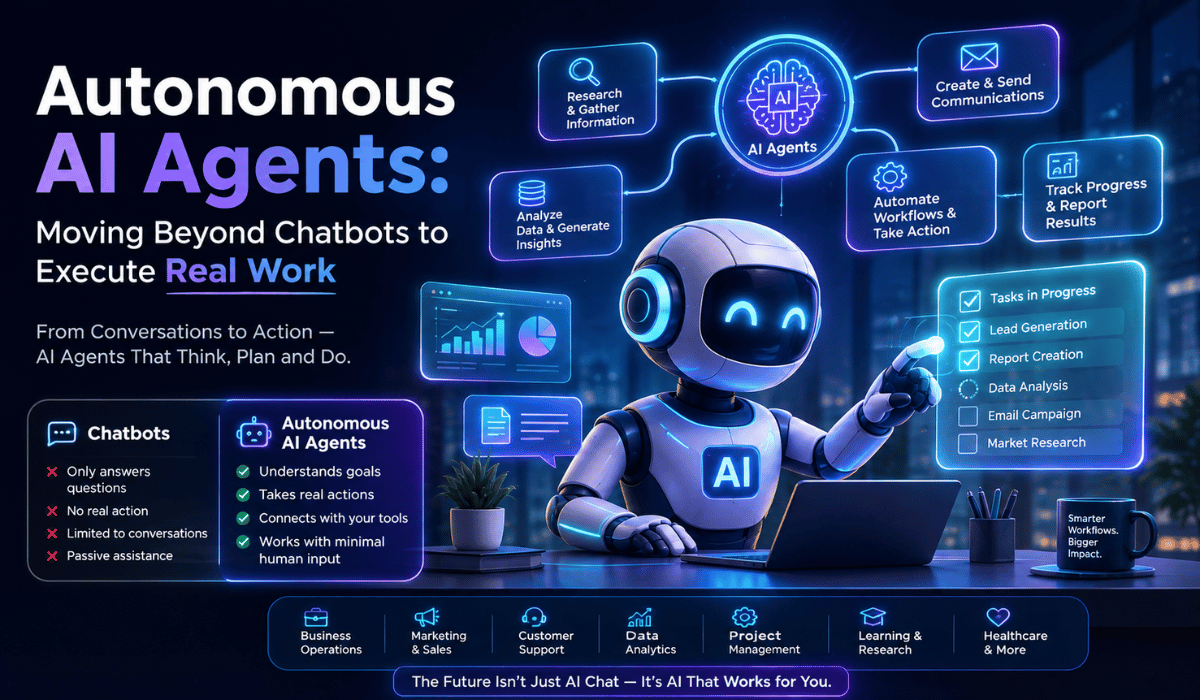
The core difference between traditional generative AI and an autonomous AI agent comes down to execution.
Chatbot Model:
[ User Prompt ] —> [ LLM Reasoning ] —> [ Text Output ]
Agentic Model:
[ High-Level Goal ] —> [ Multi-Step Plan ] —> [ API / System Actions ] —> [Verified Result]
A standard assistant answers questions based on its training data or linked documents. An autonomous AI agent, by contrast, operates with three additional capabilities:
- Tool Access & API Calls: The agent has direct access to email servers, databases, CRMs, and financial ledgers.
- Multi-Step Reasoning: Given a goal like “Onboard this vendor,” the agent breaks the task into logical steps: verify registration, run compliance checks, input tax details into the ERP, and notify procurement.
- Adaptive Error Recovery: If an API call fails or an anomaly appears, the agent adjusts its route or routes the task to a human for exception handling.
Where Autonomous AI Agents Deliver Value
Real-world business applications prioritize high-volume, rule-governed workflows that involve navigating multiple applications. Workers routinely context-switch across a dozen enterprise applications during a single workflow: a source of cognitive friction that agents directly resolve.
| Functional Area | Traditional Approach | Autonomous Agent Approach |
| Document Processing | Manual invoice cross-checking across emails, PDFs, and ERPs. | Multi-system matching, automatic exception flagging, and ledger updates. |
| Employee Onboarding | Multi-department tickets for email creation, system permissions, and hardware ordering. | Automated credential provisioning across platforms based on department rules. |
| Customer Operations | Support reps looking up orders in one system while updating refund status in another. | End-to-end lookup, status validation, and automated refund processing. |
The Shift to Multi-Agent Architectures
Rather than relying on one massive AI bot to handle an entire department, modern deployments favor multi-agent systems.
In a multi-agent environment, specialized digital workers collaborate on complex tasks:
- Data Extraction Agent: Reads incoming documents and parses unstructured data.
- Compliance Agent: Verifies extracted data against corporate policies and regulatory rules.
- Execution Agent: Writes approved changes into the enterprise database or schedules payments.
Assigning constrained, clear responsibilities to each agent reduces hallucinations, simplifies debugging, and produces a transparent audit trail.
Governance, Realities, and the “Human-in-the-Loop” Standard
While adoption is accelerating, the transition is not without hurdles. In fact, Gartner projects that over some percentage of agentic AI projects will be canceled by 2027 due to unclear ROI, escalating costs, or weak risk controls.
To bridge the gap between hype and successful enterprise deployment, organizations rely on clear guardrails:
- Defined Autonomy Boundaries: Establishing explicit limits on what an agent can do independently (e.g., automatically issuing refunds up to $200, but requiring human approval for anything higher).
- Least-Privilege Access: Granting agents access only to the specific tools and data necessary for their designated roles.
- Complete Audit Trails: Timestamping every prompt, tool call, API interaction, and output to ensure compliance transparency.
Summary
The transition from generative text creation to autonomous execution represents a fundamental shift in software design. By handling repetitive, multi-system coordination, autonomous AI agents allow teams to spend less time on routine data entry and more time on high-level decision-making.
Frequently Asked Questions
What is an autonomous AI agent?
An autonomous AI agent is software powered by artificial intelligence that can interpret a goal, plan necessary steps, and perform actions across tools and databases with minimal step-by-step human intervention.
How do AI agents differ from Robotic Process Automation (RPA)?
RPA relies on strict, hard-coded scripts that break when a UI layout or data format changes. AI agents use language model reasoning to adapt to unstructured inputs, varied formats, and unexpected exceptions.
Are AI agents intended to replace human employees?
In enterprise settings, AI agents are designed to handle mechanical, high-friction tasks (such as copying data between tools or cross-checking invoices). This delegates routine processing to software while reserving critical judgment, strategy, and relationship management for human team members.