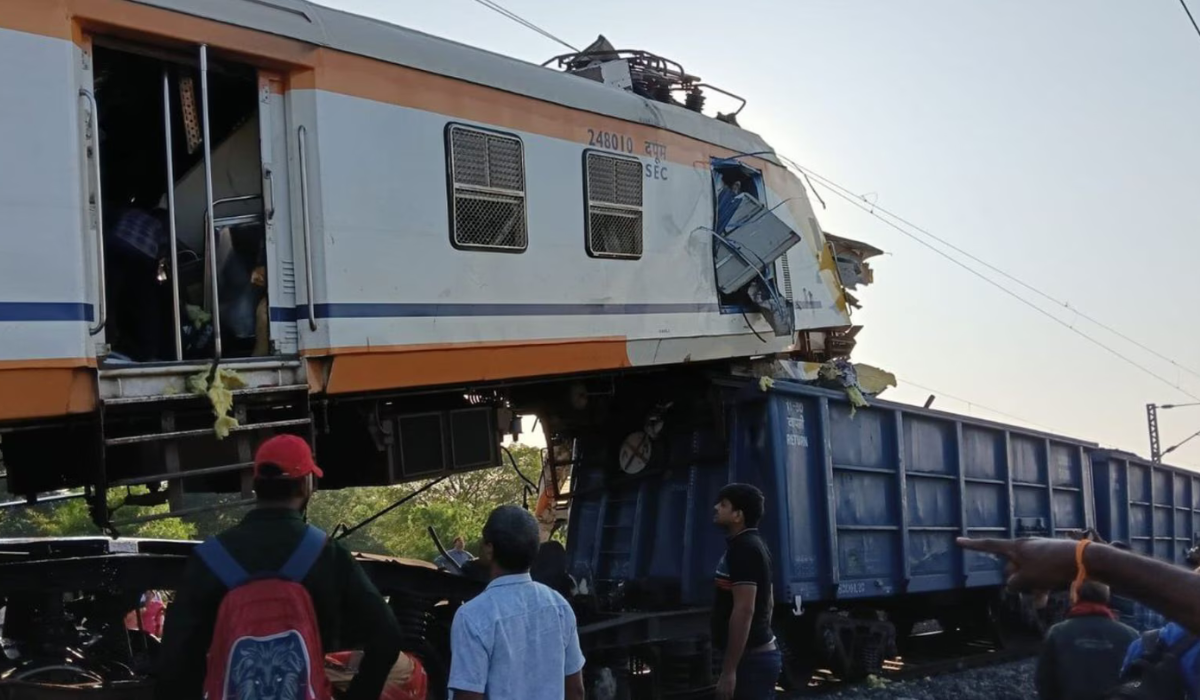
A major train accident shook Chhattisgarh’s Bilaspur district on Tuesday evening when a MEMU passenger train collided with a stationary goods train near Lalkhadan on the Gevra Road–Bilaspur route. The impact was so severe that several compartments of the passenger train climbed onto the goods train, leaving a trail of devastation on the tracks.
Railway officials confirmed that the accident killed 11 people and injured 20 others. Teams completed rescue and restoration operations, but the tragedy raised serious questions about railway safety and accountability.
What Happened at Bilaspur
The collision happened around 4:10 PM. A MEMU local train from Gevra Road hit the rear of a stationary freight train on the same track. The South East Central Railway (SECR) said the crash likely occurred due to a signal overshoot, meaning the passenger train crossed a stop signal before impact.
Eyewitnesses reported a massive jolt followed by panic as the motor coach of the MEMU train rammed into the guard cabin of the goods train. The collision completely crushed the front coach and scattered debris across the track.. Local residents rushed to the scene, helping rescue teams pull survivors and bodies from the mangled compartments.
Rescue and Relief Operations
Rescue efforts began immediately after the crash. Teams from the Railway Protection Force (RPF), National Disaster Response Force (NDRF), and local authorities reached the spot. After nearly three hours of intense effort, the body of the train driver, identified as Vidyasagar, was recovered from the wreckage.
Officials confirmed the deaths of 11 passengers, while 20 others are undergoing treatment at nearby hospitals. The Chhattisgarh government, under Chief Minister Vishnudev Sai, announced immediate financial assistance of ₹50,000 in cash to the injured and compensation for the families of the deceased.
Investigation and Accountability
The railway administration has ordered a Commissioner-level safety investigation into the incident. According to sources from SECR, early reports suggest that the MEMU train’s driver may have failed to stop at the red signal, leading to the fatal crash. However, the inquiry will determine whether it was a human error or a technical failure.
Officials are also examining whether the train’s braking and signaling systems were functioning correctly. Manufacturers equip MEMU trains with advanced safety features, and experts note that such accidents rarely occur unless a mechanical or communication lapse happens.
Railway Minister’s Response
Union Railway Minister Ashwini Vaishnaw is closely monitoring the situation from Delhi. He has instructed senior officials to ensure immediate medical aid for victims and to expedite the investigation process. Senior railway executives, including GM Tarun Prakash and DRM Rajmal Khoiwal, visited the site to oversee relief efforts and assess damage.
Key Questions After the Bilaspur Accident
The tragedy has sparked nationwide concern over railway safety standards.
Some key questions being raised include:
- Why did the MEMU train overshoot the signal?
- Was it a human error or a system malfunction?
- How can such collisions be prevented in the future?
- When will accountability be fixed?
As the investigation continues, families of victims and passengers demand transparency and justice.
Also Read: India vs Australia Highlights, Women’s World Cup 2025 Semi-Final
Conclusion
The Bilaspur Train Accident 2025 reminds us of the urgent need to strengthen safety protocols and real-time communication in Indian Railways. Rescue operations have ended and compensation has been announced, but a major question remains — how will the system prevent such tragedies in the future?