There is a reason Indore has been named India’s cleanest city multiple times but ask any food lover, and they’ll tell you the real reason to visit is its food. Indore doesn’t just have a food culture; it is a food culture. From the legendary Sarafa Bazaar that comes alive at midnight to the bustling Chappan Dukan (56 shops) strip that never seems to sleep, this city in Madhya Pradesh wears its love for food like a badge of honour.
Indori food is bold, unapologetic, and deeply joyful. It’s the kind of food that makes you forget about everything else you’re just standing at a cart, eating with your hands, completely happy.
What makes it truly special is the sheer variety. Indore sits at a cultural crossroads where Rajasthani, Gujarati, Maharashtrian, and North Indian influences all converge and its food is the most delicious proof of that meeting point.
1. Poha Jalebi — The Iconic Indori Breakfast
If there’s one food combination that is inseparably linked to Indore’s identity, it is poha and jalebi. This is not just breakfast it is a morning ritual, a social event, and a cultural institution all at once.
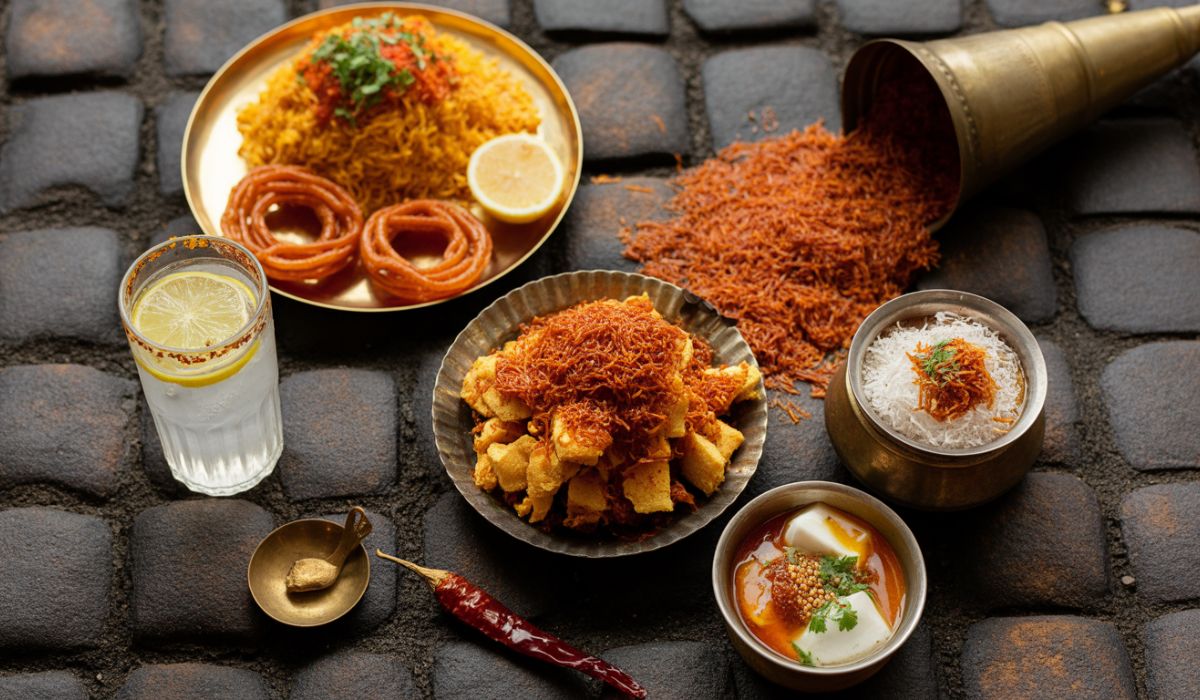
Indori poha is unlike any poha you’ve had elsewhere. The flattened rice is cooked light and fluffy, topped with a generous squeeze of lemon, finely chopped onions, sev, fresh coriander, fennel seeds (saunf), and a sprinkle of namkeen for texture. What sets it apart is the balance not too spicy, not too bland, with layers of flavour in every spoonful.
Alongside it comes a crispy, syrupy jalebi the contrast of the savoury poha with the warm, sweet jalebi is one of those flavour combinations that shouldn’t work on paper but is absolutely perfect in practice. Every Indori will defend this pairing fiercely, and after one bite, so will you.
2. Bhutte ka Kees — Indore’s Most Unique Street Snack
Bhutte ka kees is one of those dishes that you won’t find anywhere else quite like you find it in Indore. Fresh corn (bhutte) is grated raw and then cooked in ghee and milk with green chillies, ginger, mustard seeds, and turmeric until it becomes a soft, creamy, slightly coarse preparation — neither quite a curry nor a dry dish, but something wonderfully in between.
It is served with a squeeze of lemon and a sprinkle of fresh coconut and coriander. It’s eaten as a breakfast item or an evening snack and it has a homeliness to it — the kind of food that reminds you of someone’s grandmother’s kitchen. Simple, nourishing, and unforgettable.
3. Dahi Vada — Soft, Cool, and Deeply Comforting
Indore’s dahi vada has earned a reputation that extends well beyond the city limits. Soft, spongy lentil dumplings soaked in chilled, sweetened yoghurt and topped with tamarind chutney, green chutney, red chilli powder, roasted cumin, and a generous handful of sev — every element is calibrated to perfection.
What distinguishes the Indori version is the balance between the sweet yoghurt and the tangy chutneys, and the quality of the vadas themselves — always soft, never dense. On a hot afternoon in Indore, a plate of dahi vada from a good local shop feels like pure relief.
4. Garadu — The Winter Street Treasure
Come winter in Indore, and the streets fill with the smoky, spiced aroma of garadu deep-fried yam (purple-fleshed taro) tossed in a special masala made with rock salt, black pepper, dry mango powder (amchur), and cumin. The result is crispy on the outside, soft and earthy on the inside, with a tangy, spicy coating that makes it absolutely addictive.
Garadu is a seasonal delicacy, available only in the cooler months, which makes it even more special for locals and visitors alike. It’s sold on roadside carts and is best eaten piping hot, straight from the pan. If you visit Indore in winter, this is non-negotiable.
5. Sabudana Khichdi — A Breakfast Staple Done Right
While sabudana khichdi is made across India, the Indori version holds a special place. Tapioca pearls are soaked overnight and then tossed in ghee with peanuts, green chillies, cumin, and a touch of sugar creating a dish that is simultaneously light and filling, with a lovely chew to each pearl.
It is particularly popular during fasting days but eaten freely on any morning. The Indori touch lies in the quality of the peanuts used and the restraint in spicing the simplicity is the point, and it’s executed beautifully here.
6. Shikanji — The Legendary Indori Lemonade
No visit to Indore’s Sarafa Bazaar is complete without a glass of shikanji but not just any lemonade. Indori shikanji is a complex, layered drink made with lemon juice, black salt, roasted cumin, ginger, black pepper, and sometimes a pinch of asafoetida. Served chilled over crushed ice, it is simultaneously refreshing, digestive, and deeply flavourful.
It has a savoury-tangy quality that sets it apart from regular lemonade, and it pairs brilliantly with the richness of Indore’s fried street food. In summer, it’s as essential as water.
7. Namkeen — Indore’s Crunchy Obsession
Indore is arguably the namkeen capital of India. The city produces and consumes more savoury snacks per capita than almost anywhere else in the country, and its varieties are extraordinary: ratlami sev (thick, spiced sev with a peppery bite), bikaneri bhujia, poha chivda, chakli, mixture, and dozens of other crunchy creations.
Namkeen is not just a snack here it’s a gift, a gesture of hospitality, and a source of genuine civic pride. Shops line entire streets dedicated solely to namkeen, with owners who have been perfecting their recipes for three or four generations. You will not leave Indore without buying several packets to take home.
8. Mawa Bati — The Sweet That Defines Indori Festivity
Mawa bati (also called mawa baati) is a traditional Indori sweet — a deep-fried dumpling made from khoya (reduced milk solids), filled with dry fruits, and soaked briefly in sugar syrup. It is richer than a gulab jamun, more complex in texture, and has a beautiful golden exterior with a dense, milky interior.
Found in mithai shops across the city, it is a festive favourite and the kind of sweet you find yourself thinking about long after you’ve left. Paired with a cup of hot masala chai on a winter evening, it is sublime.
9. Sarafa Bazaar — A Night Market Like No Other
No discussion of Indore’s food would be complete without mentioning Sarafa Bazaar a jewellery market by day that transforms completely after 10 PM into one of India’s most celebrated night food markets. The same lanes that gleam with gold and silver during the day fill at night with food stalls, frying pans, and hungry crowds.
Here you’ll find everything from moong dal bada and kachori to rabdi, malpua, and Indore’s own version of chaat all made fresh, all bursting with flavour, under the glow of street lights and the chatter of a city that simply refuses to stop eating.
What Makes Indori Food Culture Unique
“In Indore, food isn’t something you consume — it’s something you participate in.”
Several qualities distinguish the food culture of Indore from anywhere else in India:
- Accessibility: The best food in Indore is on the streets, not in fancy restaurants. A meal that costs ₹30 at a roadside cart can outperform a dish served in a five-star hotel.
- Community: Eating in Indore is inherently social. Food stalls are gathering places. Strangers share tables. Everyone has an opinion and isn’t shy about sharing it.
- Variety in a single meal: An Indori breakfast might include poha, jalebi, sev, and chai all at once the city has no concept of “too much.”
- Namkeen culture: The sheer depth and variety of savoury snacks produced here is unmatched anywhere in India.
- Pride of ownership: Indoris are genuinely, passionately proud of their food. They will take you to their favourite stall with the same enthusiasm as showing you a great monument.
FAQs
Why is Indore called the street food capital of India?
Indore has earned this title through sheer variety, quality, and culture. The city has an extraordinary density of street food stalls, iconic night food markets like Sarafa Bazaar and Chappan Dukan, and a population that is deeply invested in its food traditions. The food is affordable, consistently excellent, and represents a unique confluence of regional culinary influences. Multiple food surveys and travel publications have recognized Indore as one of India’s top street food destinations.
What is the most famous food of Indore?
Poha jalebi is the most iconic and culturally significant food combination associated with Indore. It is eaten every morning by thousands of people across the city and is considered a defining symbol of Indori identity. However, bhutte ka kees, garadu, and ratlami sev are equally famous among food enthusiasts who explore the city’s culinary depth.
Is Indori food mostly vegetarian?
Yes, the overwhelming majority of Indore’s famous street food is vegetarian. The city has a large Jain and vegetarian Hindu population, which has deeply shaped its food culture. From breakfast to late-night snacks at Sarafa Bazaar, vegetarians will find an extraordinary abundance of options. Non-vegetarian food is available but is not central to the city’s culinary identity.
When is the best time to visit Indore for food?
Indore’s food scene is excellent year-round, but winter (October to February) is particularly special. Seasonal delicacies like garadu appear on the streets, the cool weather makes standing at food stalls more comfortable, and the festive season brings special sweets like mawa bati to mithai shops. For Sarafa Bazaar, any clear night is a great night — it operates all year after 10 PM.
What should I eat at Sarafa Bazaar?
At Sarafa Bazaar, must-try items include moong dal bada, kachori with sabzi, malpua with rabdi, shikanji, garadu (in season), various chaats, and Indori dahi vada. Go with an empty stomach, go with friends, and plan to spend at least two to three hours grazing through stalls. Arrive after 10 PM when the market is in full swing.
What namkeen should I buy to take home from Indore?
The top picks for namkeen to bring home from Indore are ratlami sev (the spicy, thick variety with a distinctive pepper flavour), poha chivda, bikaneri mixture, and chakli. The best shops are concentrated around Chappan Dukan and the old city area. Buy from shops that sell loose, freshly made namkeen rather than pre-packaged varieties for the best quality. Most shops will pack them securely for travel.
Final Thoughts
Indore doesn’t need a Michelin star to prove its culinary greatness. Its credentials are written in the long queues outside a morning poha stall, in the laughter around a midnight garadu cart, and in the generational pride of a namkeen shop owner who has been perfecting the same recipe for forty years.
To eat in Indore is to understand why food, at its best, is never just about sustenance. It’s about identity, community, and joy served hot, on a leaf plate, at the side of a busy road, at any hour of the day or night.