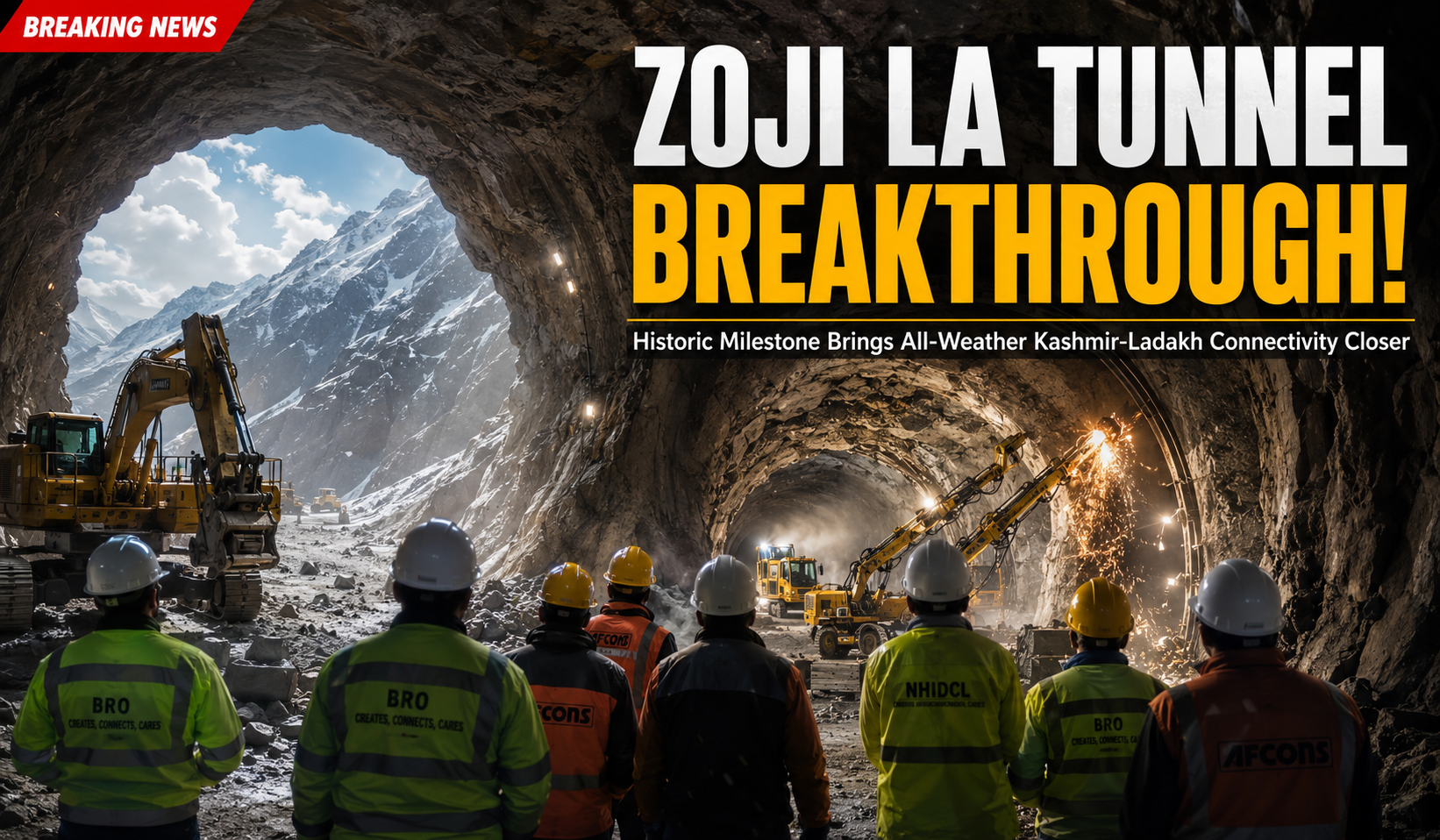
The Zoji La Tunnel project, one of India’s most ambitious and strategically significant infrastructure ventures, has achieved a major milestone with the successful breakthrough of the main tunnel. This landmark achievement marks a crucial step toward establishing year-round connectivity between the Kashmir Valley and Ladakh, a region that remains cut off for several months every year due to heavy snowfall and harsh weather conditions.
The breakthrough event, attended by senior government officials and engineers, represents the completion of the most challenging phase of the project. Once fully operational, the Zoji La Tunnel is expected to transform transportation, tourism, trade, and national security in the Himalayan region.
What is the Zoji La Tunnel Project?
The Zoji La Tunnel is being constructed beneath the Zoji La Pass on the Srinagar-Leh National Highway (NH-1). Situated at an altitude of approximately 11,500 feet, the pass serves as a critical link between the Kashmir Valley and Ladakh.
Every winter, heavy snowfall blocks the pass, often cutting off Ladakh from the rest of the country for months. The tunnel aims to eliminate this seasonal isolation by providing a safe and all-weather route throughout the year.
Stretching over approximately 13 kilometers, the tunnel is set to become one of Asia’s longest bi-directional road tunnels located at such a high altitude.
A Historic Engineering Achievement
The recent breakthrough signifies that excavation teams working from opposite ends of the tunnel have successfully met underground. This phase is considered one of the most technically demanding parts of tunnel construction.
Engineers faced numerous challenges, including:
- Harsh Himalayan weather conditions
- Fragile mountain geology
- High-altitude working environments
- Water seepage and rock instability
- Limited construction windows during winter
Despite these obstacles, the project team managed to complete the excavation phase while maintaining strict safety standards.
The breakthrough is a testament to India’s growing expertise in large-scale infrastructure and tunnel engineering projects.
Why the Zoji La Tunnel Matters
1. Year-Round Connectivity
Currently, the Srinagar-Leh highway remains closed for several months during winter due to heavy snowfall.
The tunnel will provide uninterrupted access between Kashmir and Ladakh throughout the year, ensuring reliable transportation for residents, businesses, tourists, and government agencies.
2. Reduced Travel Time
Travel across the Zoji La Pass can be slow and hazardous due to steep gradients, narrow roads, and unpredictable weather.
Once operational, the tunnel is expected to significantly reduce travel time and improve overall road safety.
This will make journeys more comfortable and dependable for thousands of travelers who use the route annually.
3. Boost to Tourism
Ladakh has become one of India’s most popular tourist destinations, attracting adventure enthusiasts, bikers, photographers, and nature lovers from around the world.
Year-round accessibility could extend the tourism season and encourage more visitors to explore the region even during colder months.
Hotels, local businesses, transport operators, and tourism service providers are likely to benefit from increased visitor numbers.
4. Economic Growth
Reliable connectivity plays a vital role in regional economic development.
The tunnel will facilitate:
- Faster transportation of goods
- Improved supply chains
- Better access to markets
- Enhanced business opportunities
- Increased investment potential
For residents of Ladakh, easier access to essential commodities and services could significantly improve quality of life.
5. Strategic Importance
The Srinagar-Leh highway is not only a civilian route but also a strategically important corridor.
The tunnel will strengthen logistical capabilities by enabling faster movement of personnel, equipment, and supplies throughout the year.
This aspect makes the project particularly significant from a national security perspective.
Advanced Safety Features
The Zoji La Tunnel is being designed with modern safety infrastructure to meet international standards.
Key features are expected to include:
- Advanced ventilation systems
- Emergency exits
- Fire detection and suppression systems
- CCTV surveillance
- Communication networks
- Intelligent traffic management systems
- Emergency response facilities
These features will help ensure safe and efficient operations even during adverse weather conditions.
Impact on Local Communities
The tunnel project is expected to bring long-term benefits to communities living in both Kashmir and Ladakh.
Improved connectivity can support:
- Better healthcare access
- Educational opportunities
- Tourism-related employment
- Local business growth
- Reduced transportation costs
Residents who previously faced isolation during winter months may experience greater social and economic integration with the rest of the country.
Environmental Considerations
Large infrastructure projects in fragile mountain ecosystems require careful environmental management.
Authorities have implemented various measures aimed at minimizing environmental impact during construction. Engineers have focused on sustainable construction practices while maintaining ecological sensitivity in the region.
Balancing development and environmental preservation remains an important aspect of the project’s execution.
What Happens Next?
Although the breakthrough marks a significant achievement, substantial work remains before the tunnel can become operational.
The next stages include:
- Tunnel lining and reinforcement
- Roadway construction
- Installation of ventilation systems
- Electrical and lighting works
- Safety infrastructure deployment
- Testing and commissioning
Officials expect the project to move steadily toward completion over the coming years.
A Symbol of Modern India’s Infrastructure Vision
The Zoji La Tunnel represents more than just a transportation project. It symbolizes India’s commitment to enhancing connectivity in remote regions through advanced engineering and infrastructure development.
Along with other major tunnel projects across the Himalayas, the Zoji La Tunnel showcases the country’s growing ability to overcome geographical challenges through innovation and technology.
As construction progresses toward completion, the tunnel is expected to become a transformative asset for Kashmir, Ladakh, and the nation as a whole.
Conclusion
The successful breakthrough of the Zoji La Tunnel marks a defining moment in India’s infrastructure journey. By overcoming some of the toughest engineering challenges in the Himalayas, the project has moved one step closer to delivering all-weather connectivity between Kashmir and Ladakh.
Once completed, the tunnel will improve transportation, strengthen economic growth, boost tourism, enhance regional development, and provide a strategic advantage through reliable year-round access. For millions of Indians, the Zoji La Tunnel stands as a powerful example of how modern infrastructure can bridge distances, unlock opportunities, and connect communities in even the most challenging terrains.