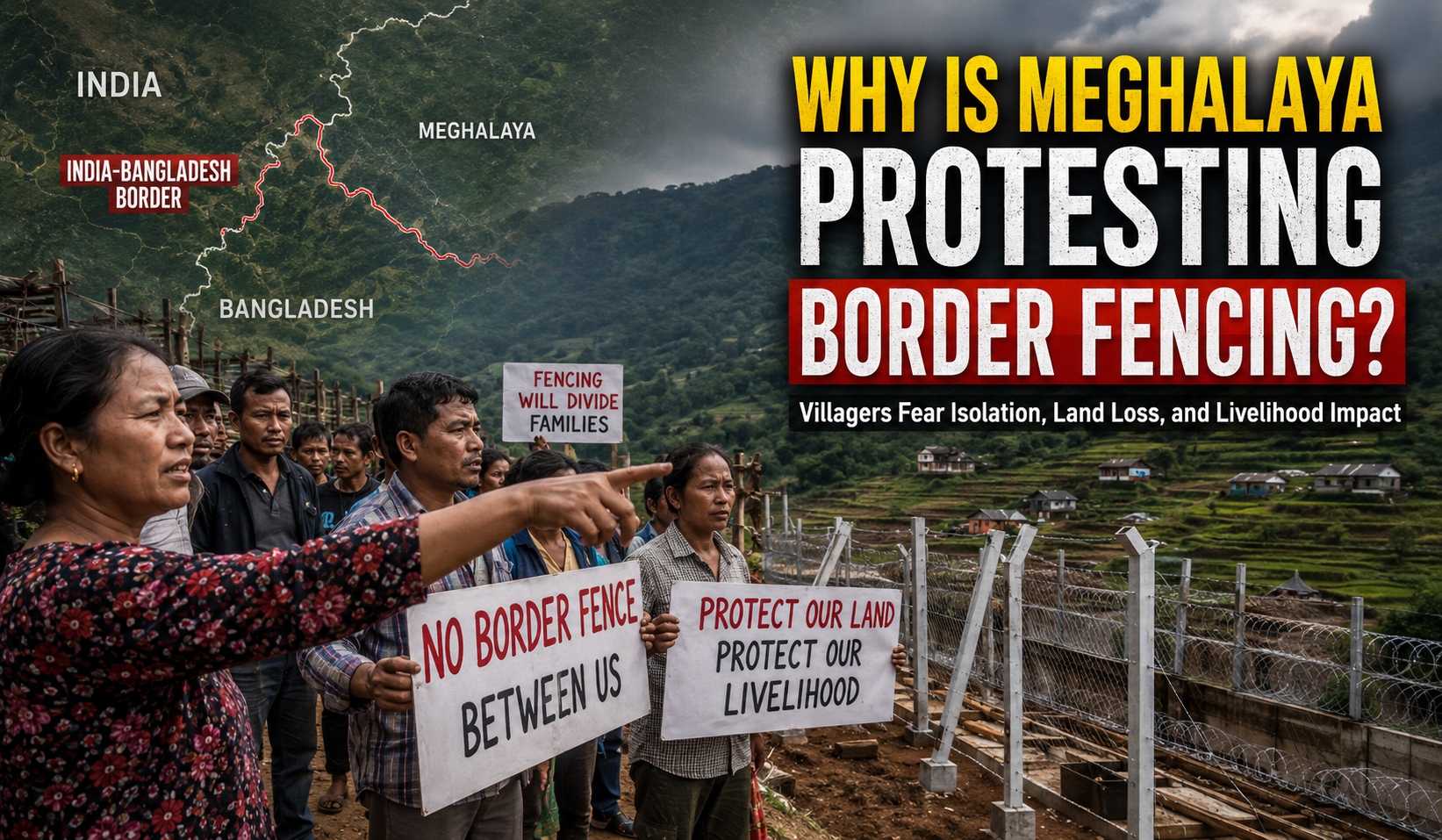
The ongoing construction of border fencing along the India-Bangladesh border has sparked protests in Meghalaya, drawing national attention to the concerns of residents living in the state’s border villages. While border fencing is generally seen as an important security measure, many communities in Meghalaya argue that the current fencing plans could have serious consequences for their livelihoods, land ownership, and daily lives.
The controversy highlights the delicate balance between national security and the rights of citizens residing in sensitive border areas.
Meghalaya’s Strategic Border with Bangladesh
Meghalaya shares a border of approximately 443 kilometers with Bangladesh. The region has long been considered strategically important due to concerns over illegal migration, cross-border smuggling, and security challenges.
To strengthen border management, the Indian government has been working on constructing fencing along the international boundary. According to officials, a significant portion of the fencing work has already been completed, with efforts underway to cover the remaining vulnerable stretches.
However, recent developments have triggered strong opposition from local communities in several border villages.
Why Are Villagers Protesting?
The protesters are not opposed to border fencing itself. Instead, their concerns revolve around the proposed location and alignment of the fence.
Many residents fear that the fencing will be built significantly inside Indian territory rather than directly along the international border. As a result, some villages, agricultural lands, and community resources could end up on the outer side of the fence.
Villagers argue that if the fence is constructed in its current proposed alignment, they could effectively become isolated from the rest of India despite remaining Indian citizens.
This concern has led to demonstrations and public gatherings in affected areas, where residents have demanded a reconsideration of the fencing plans.
Fear of Losing Agricultural Land
Agriculture remains the primary source of livelihood for many families living near the border.
Residents claim that large portions of their farmland could fall beyond the fence if the current alignment is implemented. This would make accessing their fields more difficult and could negatively impact farming activities.
Farmers worry that movement restrictions, security checks, and limited access could reduce productivity and create economic hardships for communities already dependent on agriculture for survival.
Many villagers have stated that they have cultivated these lands for generations and fear losing practical control over them.
Concerns Over Daily Life and Mobility
Beyond agricultural issues, residents are worried about their day-to-day lives.
Border communities often rely on nearby roads, markets, schools, healthcare centers, and government facilities. If villages are left outside the fencing structure, accessing essential services could become more complicated.
Local leaders have argued that residents should not be forced to face additional barriers while carrying out routine activities such as attending school, visiting hospitals, or accessing government welfare services.
For many families, the concern is not merely about land but about maintaining normal social and economic life.
The 150-Yard Rule and Its Impact
One of the key reasons behind the controversy is a long-standing border management practice that generally requires fencing to be constructed approximately 150 yards (around 137 meters) from the international boundary in many sectors.
This arrangement exists due to agreements and practical considerations related to border maintenance and security operations.
However, in areas where villages and farmlands are located very close to the border, the rule can result in Indian land and settlements being situated outside the fenced zone.
Critics argue that applying a uniform approach to all regions does not adequately address the unique geographical and social realities of Meghalaya’s border communities.
What Are the Protesters Demanding?
The protesters have put forward several demands:
1. Fence Construction Near the Zero Line
Residents want authorities to build the fence as close to the international border as possible to ensure that Indian villages remain within the protected area.
2. Protection of Community Interests
Villagers are seeking assurances that homes, farmlands, schools, and public infrastructure will not be adversely affected by the fencing project.
3. Greater Consultation with Local Communities
Many local leaders believe that affected residents should be consulted before final decisions are made regarding fence alignment.
They argue that community participation can help identify solutions that balance security requirements with local needs.
Government’s Perspective
Indian authorities maintain that border fencing is essential for strengthening national security.
Officials argue that fencing helps prevent illegal crossings, curbs smuggling activities, and enhances surveillance capabilities along sensitive stretches of the border.
The government has emphasized that border infrastructure projects are being undertaken in the national interest and are critical for maintaining territorial integrity.
At the same time, authorities have indicated that concerns raised by local communities are being examined through administrative and security channels.
A Broader National Debate
The Meghalaya protests reflect a larger challenge faced by governments around the world: how to secure international borders without disrupting the lives of border residents.
For communities living in frontier regions, national boundaries are not just lines on a map. They directly influence access to land, livelihoods, education, healthcare, and social connections.
As India continues to strengthen border infrastructure, policymakers will need to find solutions that address both security concerns and the legitimate interests of citizens living along the border.
Conclusion
The protests against India-Bangladesh border fencing in Meghalaya are not a rejection of national security measures. Instead, they represent a call from border communities to ensure that development and security initiatives do not come at the cost of their land, livelihoods, and access to essential services.
As discussions continue between residents and authorities, the Meghalaya border fencing issue serves as an important reminder that successful border management requires not only strong security measures but also sensitivity toward the people who live closest to the border.