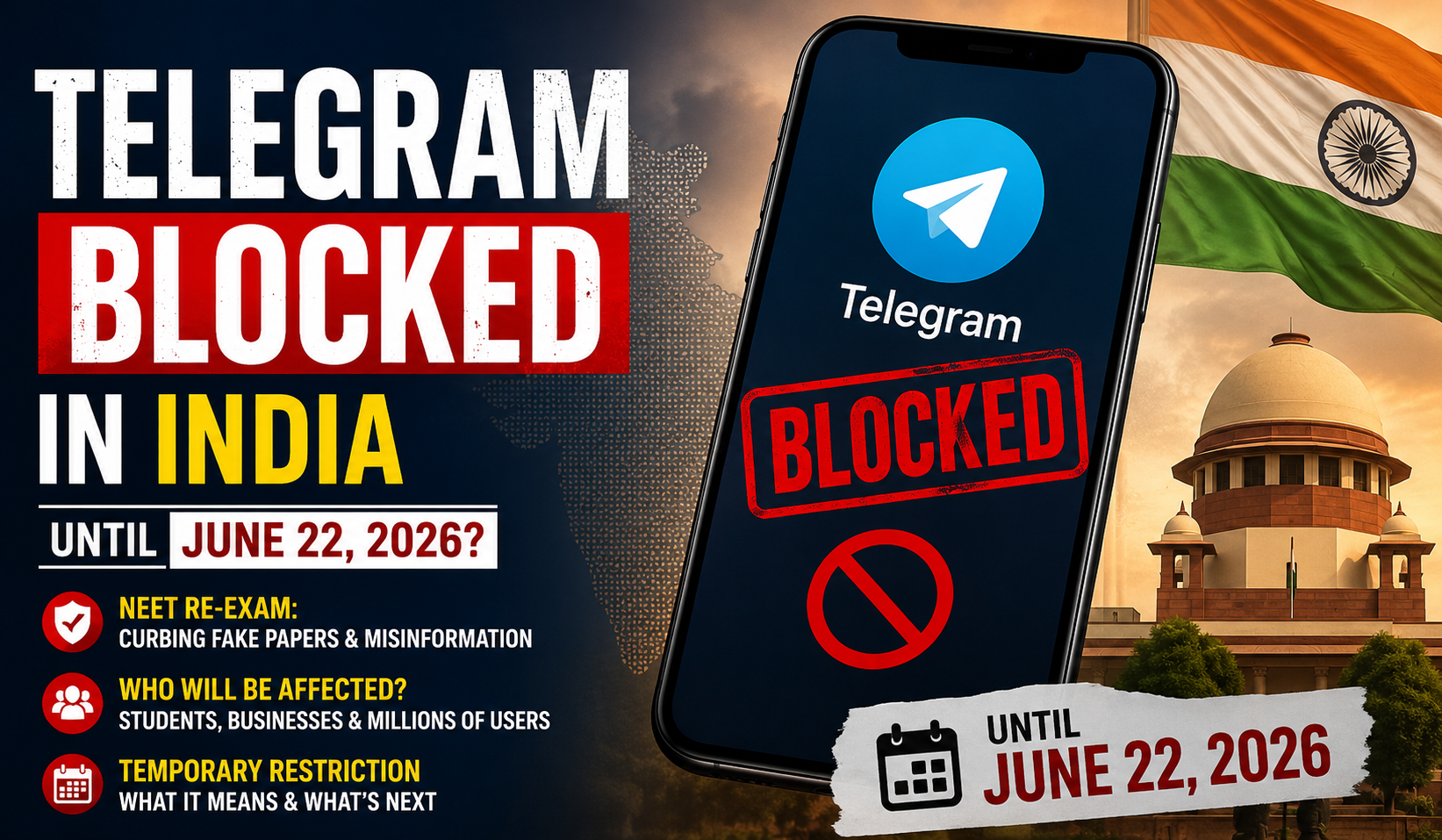
Reports on June 16, 2026, indicate that the Indian government has temporarily restricted access to Telegram until June 22, 2026, ahead of the NEET (UG) 2026 re-examination. The move is aimed at preventing the spread of fake question papers, misinformation, and exam-related fraud that authorities believe has been circulating on the platform.
What exactly happened?
According to official statements reported by multiple news outlets, the temporary restriction was recommended in connection with concerns raised by the National Testing Agency (NTA). Authorities allege that Telegram has been used to distribute fake paper leaks and misleading claims that could undermine the integrity of the upcoming re-examination.
The restriction is currently reported to last until June 22, 2026, while additional measures such as disabling message editing in India for a limited period have also been discussed.
Why did the government take this step?
The government’s stated objective is to:
- Prevent the circulation of fake NEET papers.
- Reduce exam-related scams targeting students.
- Stop misinformation from spreading rapidly through large public channels.
- Protect the fairness and credibility of the NEET re-examination process.
Officials believe that temporarily limiting access to the platform can reduce opportunities for bad actors to coordinate or amplify fraudulent material during the sensitive examination period.
Is Telegram permanently banned?
No. Based on current reports, this is not a permanent nationwide ban. It is described as a temporary restriction tied to the NEET re-examination period, with the reported end date of June 22, 2026.
Policies can change, so users should monitor official announcements for any extensions or modifications.
Who will be affected?
The restriction could impact millions of legitimate users who rely on Telegram for purposes unrelated to exams, including:
- Students using study groups and educational channels.
- Businesses communicating with customers.
- Content creators managing communities.
- Developers and technology enthusiasts sharing files and updates.
- Families and friends using the app for messaging.
Some users may continue to experience intermittent access depending on network providers and rollout timing, while others may be unable to connect normally. Reports on social media have shown mixed experiences during the implementation period.
Will blocking Telegram stop paper leaks?
The answer is not straightforward.
Supporters argue that restricting a major distribution channel can reduce the rapid spread of fake papers and misinformation during a critical period.
Critics counter that:
- Individuals engaged in malpractice can migrate to other messaging apps or private communication methods.
- Legitimate users lose access to educational resources and communities.
- The root causes of exam leaks may lie elsewhere and require broader enforcement efforts.
Ultimately, whether the temporary restriction achieves its intended goal will depend on enforcement and whether alternative channels are used for similar activities.
Impact on students
Many students use Telegram for:
- Lecture notes
- Practice questions
- Previous-year papers
- Discussion groups
- Coaching materials
Those resources may become temporarily inaccessible if the restriction is fully enforced. Students should ensure they have offline copies of essential materials and use official sources for examination updates.
Impact on businesses and creators
Telegram is widely used for:
- Marketing broadcasts
- Customer support
- Premium communities
- File sharing
- Course delivery
A temporary block could interrupt communication and engagement, prompting businesses to rely on email, websites, or alternative messaging platforms during the restriction period.
Final thoughts
The reported temporary restriction on Telegram reflects the government’s effort to protect the integrity of the NEET (UG) 2026 re-examination by limiting the spread of alleged fake leaks and exam-related fraud. At the same time, it raises broader questions about balancing platform restrictions with the needs of millions of legitimate users who depend on Telegram for education, work, and everyday communication.
As of now, the measure is described as temporary rather than permanent, and users should watch for further official updates after June 22, 2026.