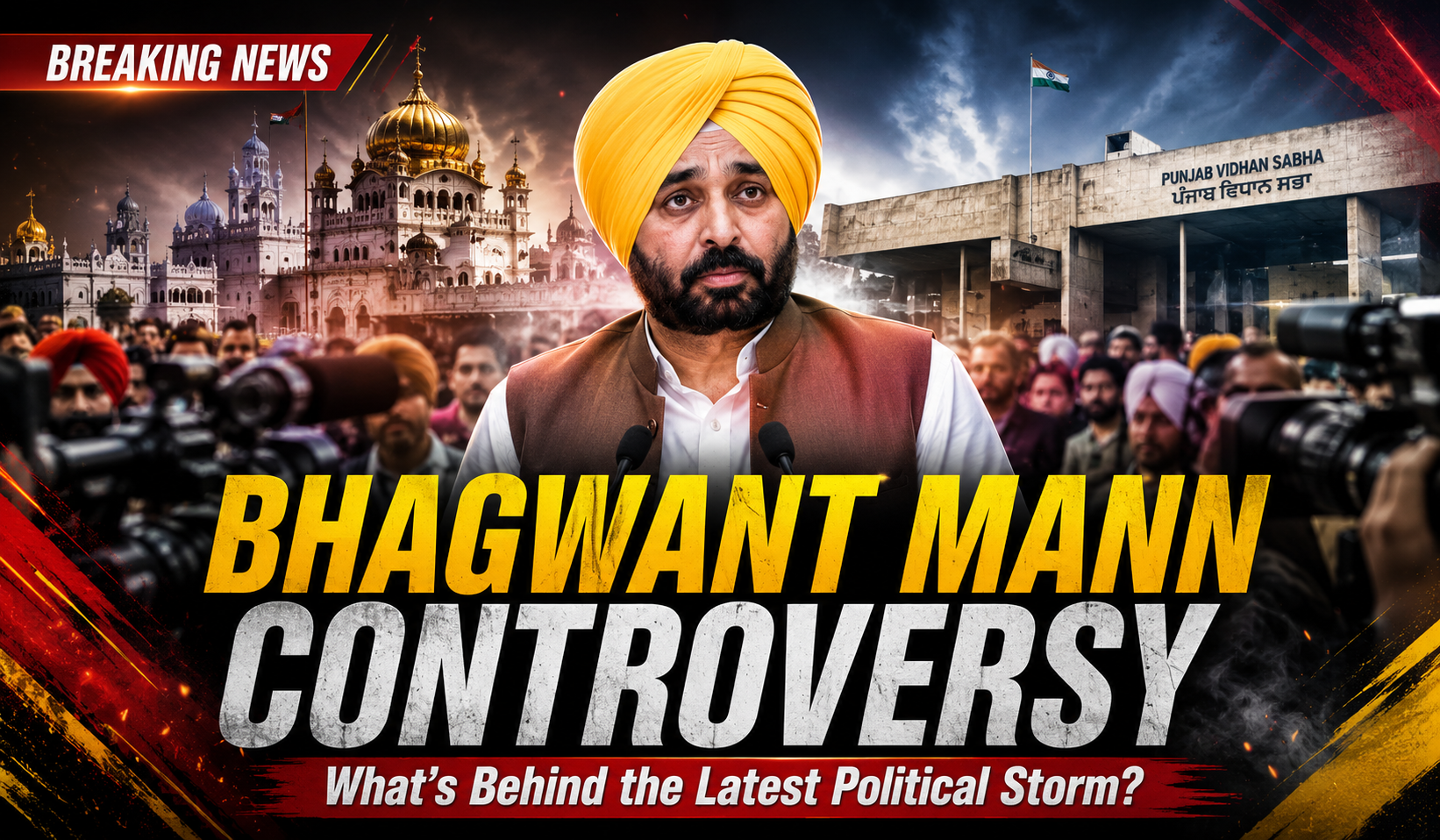
Punjab Chief Minister Bhagwant Mann has found himself at the center of one of the most significant controversies of 2026 after a viral video sparked intense political debate and drew the attention of the Akal Takht, the highest temporal authority in Sikhism. The issue has quickly evolved from an online dispute into a matter with serious religious and political implications.
What Triggered the Controversy?
The controversy began when a video circulated on social media that allegedly showed a man resembling Bhagwant Mann engaging in an act that critics claimed hurt Sikh religious sentiments. The clip generated widespread discussion across Punjab, with opposition parties and religious leaders demanding clarification.
Following the dispute, the Akal Takht announced that forensic examinations it relied upon indicated the circulating video was authentic and subsequently declared Mann “Guru Dokhi” and “Khalsa Panth Virodhi,” while also summoning members of the Punjab Cabinet in connection with the matter.
Bhagwant Mann’s Response
Bhagwant Mann has firmly rejected the allegations. He has maintained that the individual seen in the video is not him and has argued that the controversy is being used for political purposes. The ruling Aam Aadmi Party (AAP) has also questioned the conclusions being drawn from the forensic findings, stating that the reports cited do not conclusively establish the identity of the person shown in the footage.
This disagreement over both the authenticity of the video and the identification of the individual at its center has become the core of the ongoing dispute.
Why the Issue Matters
The Akal Takht occupies a position of immense religious importance for Sikhs around the world. Any public declaration issued by it can carry significant moral and social influence, particularly in Punjab.
Because of this, the controversy extends beyond party politics. It has raised broader questions about:
- The relationship between religious institutions and elected governments.
- The role of forensic technology in evaluating viral media.
- The challenges posed by misinformation and AI-related claims.
- The political consequences of controversies involving public officials.
Political Reactions
The controversy has prompted strong reactions from across the political spectrum.
Opposition parties have criticized Bhagwant Mann and, in some cases, demanded that he accept responsibility or resign. On the other hand, AAP leaders have defended the Chief Minister and accused political rivals of exploiting religious institutions to gain electoral advantage.
As a result, the issue has intensified political tensions in Punjab and is likely to remain a prominent topic ahead of future elections.
The Debate Over Digital Evidence
An important aspect of this controversy is the growing challenge of verifying digital content. With advances in artificial intelligence and video editing technology, public trust increasingly depends on independent forensic analysis and transparent investigations.
Even when forensic reports are cited, disagreements may continue regarding interpretation, methodology, or whether the evidence conclusively identifies a specific individual.
Public Sentiment
Public opinion remains divided. Some believe the allegations warrant serious concern and accountability, while others argue that conclusions should not be drawn until all evidence is independently verified and due process is completed.
The debate has played out extensively on social media, television debates, and within Punjab’s political circles, reflecting the sensitivity of issues involving religion and governance.
Conclusion
The Bhagwant Mann controversy represents a complex intersection of politics, religion, technology, and public perception. While the Akal Takht’s declaration has added considerable weight to the debate, Bhagwant Mann continues to deny the allegations and insists that the video does not depict him.
Until the matter is conclusively resolved through transparent evidence and any applicable legal or institutional processes, the controversy is likely to remain a major issue in Punjab’s political landscape, with significant implications for governance and public trust.