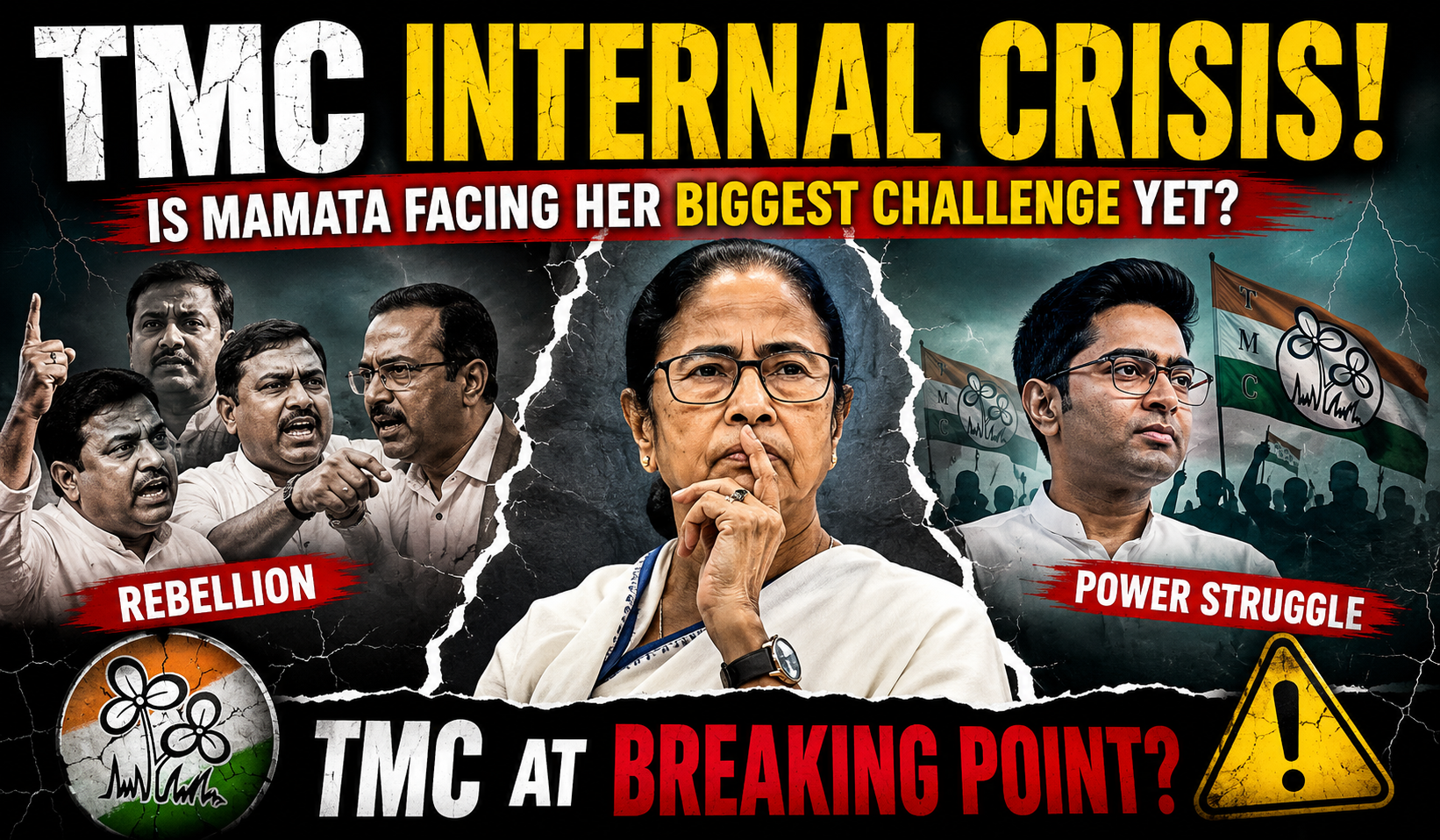
The All India Trinamool Congress (TMC), one of India’s most influential regional political parties, is facing a period of unprecedented internal turmoil. After years of projecting an image of unity under the leadership of Mamata Banerjee, recent developments have exposed deep divisions within the party. Allegations of favoritism, leadership disputes, rebellion among legislators, and organizational restructuring have sparked discussions about the future of the party and its role in West Bengal politics.
Political analysts are describing the situation as one of the most serious internal crises the TMC has experienced since its formation in 1998. While the party leadership insists that the organization remains united, the growing dissent among party members has raised questions about whether Mamata Banerjee can maintain control over the party during this turbulent period.
This article explores the origins of the crisis, the key players involved, the impact on West Bengal politics, and what the future may hold for the Trinamool Congress.
Understanding the TMC Crisis
The current crisis did not emerge overnight. It is the result of years of simmering tensions within the party. As TMC expanded its influence beyond West Bengal and attempted to establish itself as a national political force, internal power struggles gradually became more visible.
Several party leaders reportedly felt sidelined by the increasing influence of a younger leadership group. At the center of these concerns is Abhishek Banerjee, Mamata Banerjee’s nephew and one of the party’s most prominent leaders.
While supporters view Abhishek as a dynamic leader capable of modernizing the party, critics within the organization argue that decision-making has become increasingly centralized around a small group of individuals.
The dissatisfaction eventually evolved into open rebellion, creating what many observers now call the “TMC Internal Crisis.”
The Rise of Internal Dissent
The rebellion became public when several party leaders and legislators began questioning organizational decisions and leadership practices.
Key grievances reportedly include:
- Lack of internal democracy.
- Concentration of power among a select group of leaders.
- Limited opportunities for senior leaders to influence policy decisions.
- Concerns about candidate selection and organizational appointments.
- Frustration over disciplinary actions against dissenting voices.
The situation escalated when some rebel leaders openly criticized the party leadership, something rarely seen within TMC’s highly disciplined structure.
Political observers note that public dissent within the party reflects a deeper organizational problem rather than isolated disagreements.
The Controversial “Signgate” Episode
One of the most damaging episodes during the crisis has been the alleged forged-signature controversy, popularly referred to as “Signgate.”
The controversy emerged after claims surfaced regarding irregularities in internal party communications and documentation. Opposition parties quickly seized upon the issue, while dissenting TMC leaders used it to question the transparency of party operations.
Although investigations and political debates continue, the incident significantly damaged the party’s image and intensified existing tensions.
The controversy also provided rebels with an opportunity to challenge the leadership’s credibility.
Rebel Leaders Challenge the Leadership
A major factor contributing to the crisis has been the emergence of organized dissent within the party.
Some rebel legislators have claimed that a significant number of MLAs support internal reforms and greater organizational accountability. While exact figures remain disputed, reports of large-scale dissatisfaction have alarmed the party leadership.
The rebels argue that:
- Internal discussions are discouraged.
- Critical opinions are often viewed as disloyalty.
- Organizational decisions are increasingly controlled by a limited leadership circle.
These concerns have transformed what began as internal disagreements into a broader political challenge for the party leadership.
Mamata Banerjee’s Response
Mamata Banerjee has long been regarded as one of India’s strongest regional political leaders. Throughout her political career, she has successfully navigated numerous crises, including electoral battles, opposition campaigns, and organizational challenges.
In response to the current situation, the party leadership has taken several measures:
Organizational Restructuring
The party dissolved multiple committees and organizational wings in an effort to regain control and streamline decision-making.
Disciplinary Measures
Action has reportedly been taken against certain rebel members who were accused of anti-party activities.
Public Messaging
Senior TMC leaders have repeatedly emphasized that the party remains united and capable of overcoming internal differences.
Direct Intervention
Mamata Banerjee has personally engaged with party workers and leaders to reassure supporters and maintain organizational discipline.
Despite these efforts, critics argue that structural reforms may be necessary to address the root causes of the crisis.
The Role of Abhishek Banerjee
No discussion of the TMC crisis is complete without examining the role of Abhishek Banerjee.
As the party’s national general secretary, Abhishek has become one of the most influential figures within TMC. His supporters credit him with strengthening the party’s organizational machinery and expanding its national profile.
However, critics claim that his growing influence has altered the internal power balance.
The debate surrounding Abhishek Banerjee highlights a broader question facing the party:
Is TMC preparing for a generational transition in leadership?
Many political analysts believe that uncertainty regarding succession planning has contributed significantly to the current tensions.
Impact on West Bengal Politics
The internal crisis comes at a crucial time for West Bengal politics.
A weakened TMC could create opportunities for opposition parties seeking to expand their influence in the state.
Potential Benefits for Opposition Parties
The crisis may benefit:
- The Bharatiya Janata Party (BJP)
- The Communist Party of India (Marxist)
- The Indian National Congress
These parties could use the turmoil to attract dissatisfied TMC leaders and voters.
Governance Concerns
Political instability within the ruling party can also affect governance by:
- Delaying policy decisions.
- Diverting leadership attention from public issues.
- Creating uncertainty among government officials.
While TMC remains a dominant political force, prolonged internal conflict could impact its effectiveness.
Could TMC Actually Split?
One of the biggest questions surrounding the crisis is whether the party could eventually split.
At present, there is no formal indication that a split is imminent. However, several warning signs have emerged:
- Growing factionalism.
- Public criticism of leadership.
- Disputes over organizational control.
- Challenges to disciplinary decisions.
Historically, many political parties have experienced similar tensions before major divisions occurred.
Nevertheless, TMC retains a significant advantage: Mamata Banerjee’s personal popularity and political authority.
Many analysts believe that as long as Mamata remains actively involved, a complete split is unlikely.
Lessons from Other Political Parties
India’s political history offers numerous examples of parties facing internal rebellions.
Parties such as:
- Shiv Sena
- Nationalist Congress Party (NCP)
- Janata Dal factions
- Congress at various stages
have all experienced internal disputes that reshaped their political futures.
The outcome often depends on:
- Leadership response.
- Organizational flexibility.
- Ability to accommodate dissent.
- Electoral performance.
TMC’s future may similarly depend on how effectively it manages these challenges.
What Happens Next?
The coming months are likely to be critical for the Trinamool Congress.
Several scenarios are possible:
Scenario 1: Reconciliation
The leadership successfully addresses concerns and restores party unity.
Scenario 2: Continued Internal Conflict
Dissent remains unresolved, weakening the party’s organizational strength.
Scenario 3: Formation of a Breakaway Group
Rebels create a separate political platform or align with another party.
Scenario 4: Leadership Reforms
The party introduces structural changes to increase participation and reduce tensions.
The direction chosen by the leadership will significantly influence TMC’s future trajectory.
Conclusion
The TMC Internal Crisis represents one of the most serious tests of Mamata Banerjee’s leadership in recent years. While the party remains a powerful political force in West Bengal, the emergence of organized dissent has exposed vulnerabilities within its structure.
Questions regarding leadership, succession, organizational democracy, and accountability are now at the center of political debate. Whether the party emerges stronger or weaker from this crisis will depend on its ability to address internal grievances while maintaining unity.
For now, all eyes remain on Mamata Banerjee and the Trinamool Congress as they navigate a defining moment in the party’s history. The outcome could shape not only the future of TMC but also the political landscape of West Bengal for years to come.