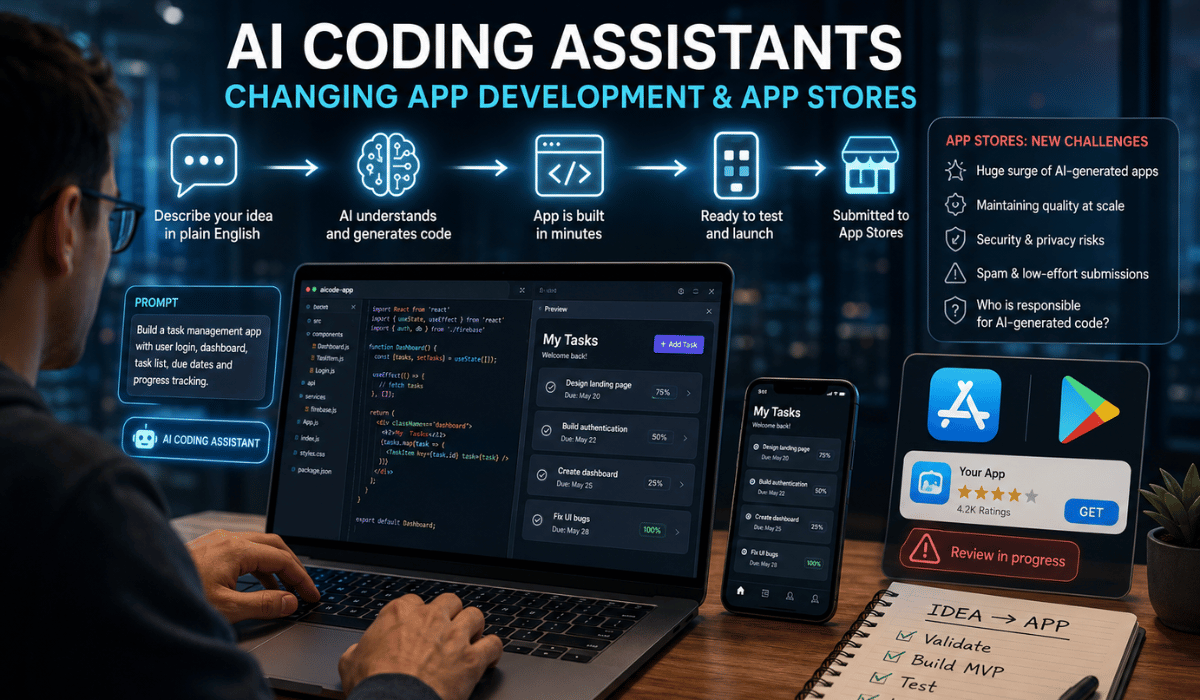
Building an app used to require months of learning, planning, and writing code line by line. Today, a new generation of AI coding assistants is changing that reality entirely. Instead of hiring a full technical team or learning a programming language from scratch, anyone with an idea can now describe what they want in plain English and watch AI turn it into a working application.
This shift, widely known as “vibe coding,” is reshaping not just how software gets built but who gets to build it, and it’s creating new challenges for the platforms that host these apps.
What Are AI Coding Assistants?
AI coding assistants are tools that use artificial intelligence to help generate, edit, and debug code based on natural language instructions. Rather than manually writing every function, developers and non-developers alike can describe the outcome they want, and the AI produces working code, interface designs, and even backend logic in response.
Several tools now support vibe coding by allowing users to create apps through natural language prompts rather than manually writing code. Some of the most widely used platforms driving this shift include:
- Replit
- Cursor
- Lovable
- Bolt.new
- Vercel’s v0
- GitHub Copilot
- Google Gemini and Google’s AI development tools
- OpenAI Codex
According to reporting from The New York Times, these tools now allow people with limited coding experience to create working apps within hours or days instead of weeks or months.
Why AI App Development Is Gaining Momentum
The rise of natural language coding isn’t a small, niche trend; it’s becoming a mainstream part of how software gets built.
In 2026, 82 percent of developers already use AI tools like GitHub Copilot, Cursor, or dedicated AI app builders to speed up their workflow. And this is only anticipated to increase. Gartner predicts that by 2028, 90 percent of enterprise developers will use AI coding assistants.
This momentum isn’t limited to professional developers either. By 2026, an estimated 80 percent of no-code users are expected to come from outside traditional IT roles, with four times more citizen developers building software than professional engineers. In other words, product managers, marketers, and small business owners are now building their own tools using no-code AI app builders instead of waiting on a dev team.
How This Is Changing the Developer’s Role
For working developers, AI coding assistants aren’t replacing the job; they’re changing what the job actually involves.
AI will automate an estimated 40 to 60 percent of coding tasks, enabling natural language-to-code generation and shifting developer roles from writing code to reviewing AI-generated solutions. Instead of spending hours writing boilerplate code, developers increasingly focus on system design, architecture decisions, and validating what the AI produces.
The talents that are most important have also altered as a result. Key skills for 2026 include AI fluency and prompt engineering, system design and architecture, debugging and code review of AI output, cloud-native development, and DevSecOps practices. Knowing how to effectively direct an AI coding tool is quickly becoming just as valuable as traditional programming knowledge.
Why This Matters for Startups and Business Owners
For non-technical founders, this shift removes one of the biggest historical barriers to building a product: cost and technical dependency.
A founder can now describe an app idea, generate a working prototype, and test it with real users, all without hiring a developer first. As one industry guide puts it, a non-technical founder can use no-code tools, AI-assisted builders, and structured prompts to build an MVP, as long as they stay narrow and focus on validating one core workflow rather than building a full platform immediately.
That said, AI-generated development isn’t a fit for every project. Apps involving sensitive user data, complex integrations, or strict compliance requirements still benefit significantly. While AI coding assistants can accelerate software development, businesses still rely on an experienced AI-Powered Clone App Development Company to build secure, scalable, and production-ready digital platforms. From ride-hailing and food delivery to multi-service super apps and other on-demand solutions, expert development teams ensure every application is customized, thoroughly tested, and ready for real-world business growth.
The Real Challenge: What This Means for App Stores
AI coding tools are giving developers new opportunities, but the platforms that host these apps are having a real headache as a result.
As AI-generated, or “vibe-coded,” apps have surged, the number of these apps submitted to Apple’s App Store has increased sharply. This flood of new, AI-built submissions raises questions app stores haven’t had to fully answer before:
- How do you maintain quality control when creating an app no longer requires technical expertise?
- How do you filter out low-effort, duplicate, or spammy apps at scale?
- Who is responsible when AI-generated code contains security vulnerabilities that reach real users?
Apple has already begun responding. Following its Worldwide Developers Conference (WWDC) 2026, Apple updated its App Store Review Guidelines to place greater emphasis on apps that deliver meaningful value, rather than approving every AI-generated submission automatically. This signals a broader shift: app stores are being forced to rethink how review processes work in a world where anyone can generate a fully functional app from a single conversation with AI.
The Risks Behind the Speed
The convenience of AI code generation comes with real trade-offs that developers and businesses need to take seriously before shipping an AI-built app to production.
- Hidden bugs and security flaws. Model hallucination occurs when an AI coding assistant suggests code that looks functional on the surface but contains structural logic errors or hidden security vulnerabilities, often because it was trained on outdated or insecure dependencies.
- The need for human oversight. To catch these issues before real users are affected, teams need to enforce strict human-in-the-loop code review, requiring experienced engineers to run AI-generated code through rigorous regression testing.
- Emerging regulatory questions. As adoption grows, questions around bugs, privacy, and potential exploitation by bad actors will increasingly demand answers from both companies and regulators.
Should You Use AI Coding Tools for Your Next Project?
For fast, early-stage validation, AI coding assistants are proving to be one of the most effective tools available. They let founders test ideas quickly, let developers move faster on repetitive tasks, and let non-technical teams build their own internal tools without waiting in a dev queue.
But speed shouldn’t come at the cost of security or quality. The businesses seeing the best results are the ones treating AI as a starting point, not a finish line, using it to move fast, then applying human review, testing, and oversight before anything goes live.
Final Thoughts
AI coding assistants are fundamentally changing who can build software and how quickly they can do it. For developers, the shift means focusing more on direction and review than manual code-writing. For founders and business owners, it means faster, cheaper paths from idea to working product. And for app stores, it means confronting a new reality where quality control, security, and trust need to be rebuilt for a world where building an app no longer requires knowing how to code.
The organizations and developers who adapt to this shift, learning to work with AI coding tools rather than around them, are likely to be the ones who benefit the most as this technology continues to mature.