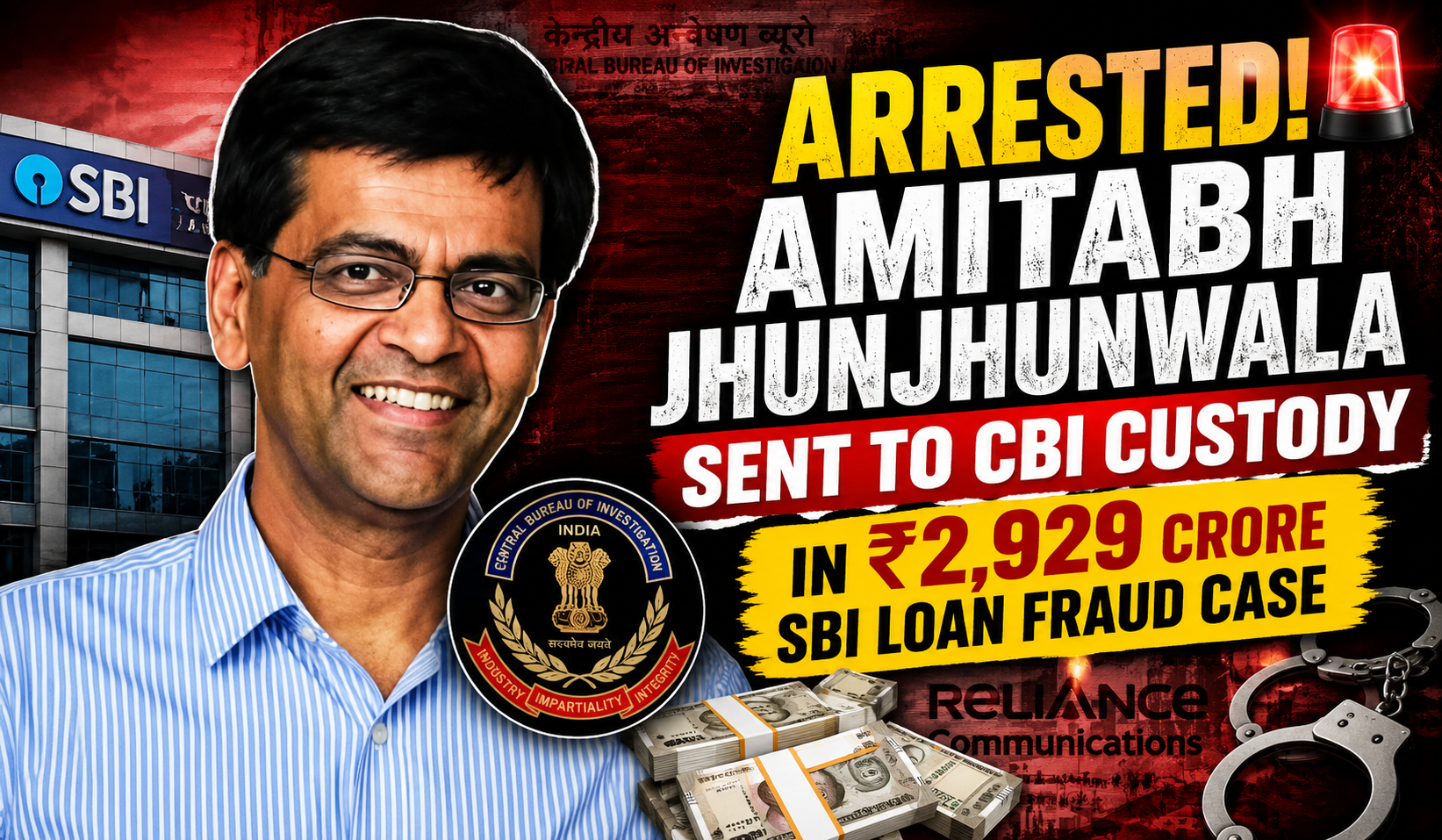
Former Reliance Communications Executive Faces Investigation Over Alleged ₹2,929 Crore Loan Diversion
In a major development in one of India’s high-profile banking fraud investigations, the Central Bureau of Investigation (CBI) has arrested Amitabh Jhunjhunwala, a former senior executive associated with the Anil Dhirubhai Ambani Group (ADAG), in connection with an alleged loan diversion and fraud case involving State Bank of India (SBI).
A special CBI court has reportedly granted the agency custody of Jhunjhunwala for further interrogation as investigators continue to examine allegations surrounding the misuse of loan funds and financial irregularities linked to Reliance Communications (RCom).
The arrest marks another significant chapter in the long-running investigations into the financial affairs of companies associated with the ADAG group, which have faced scrutiny from multiple agencies over the past several years.
Who Is Amitabh Jhunjhunwala?
Amitabh Jhunjhunwala served as a key executive within the Reliance ADAG ecosystem and held important responsibilities related to corporate finance, banking operations, treasury management, and utilization of borrowed funds.
During his tenure, he was considered one of the senior-most financial executives overseeing various financial transactions and banking relationships within the group. According to investigators, his position placed him at the center of decisions concerning the handling and movement of funds obtained from lenders.
The CBI alleges that Jhunjhunwala played a significant role in overseeing financial activities connected to loans extended by a consortium of banks led by SBI.
Understanding the SBI Loan Fraud Case
The case revolves around loans amounting to approximately ₹2,929 crore granted by State Bank of India and other lenders to entities associated with Reliance Communications.
According to allegations made by investigating agencies, funds obtained through these loans were not utilized for their intended purposes. Instead, investigators suspect that portions of the money were diverted through various transactions involving multiple entities.
The alleged diversion of funds eventually contributed to substantial losses for lending institutions, prompting complaints and subsequent investigations by enforcement agencies.
Investigators are attempting to determine:
- How loan proceeds were utilized after disbursement.
- Whether funds were transferred to unrelated entities.
- Whether company officials knowingly misrepresented the use of borrowed funds.
- The role played by various executives and decision-makers in approving financial transactions.
- Whether banking regulations and loan conditions were violated.
The investigation seeks to establish the complete trail of funds and identify individuals responsible for any wrongdoing.
Why Did the CBI Arrest Jhunjhunwala?
According to reports, the CBI believes Amitabh Jhunjhunwala possessed detailed knowledge regarding the utilization of loan funds and the movement of money among various entities connected to the case.
The agency has argued that custodial interrogation is necessary to:
- Trace the flow of funds.
- Examine financial records and transactions.
- Identify other individuals potentially involved.
- Verify statements made by witnesses and company officials.
- Gather evidence related to the alleged diversion of funds.
Investigators reportedly told the court that Jhunjhunwala held a crucial position within the company structure and was directly connected to key financial decisions.
Link to the Reliance Communications Financial Crisis
The case is closely linked to the financial troubles that engulfed Reliance Communications over the past decade.
Once among India’s leading telecom operators, Reliance Communications struggled under mounting debt, intense competition, regulatory challenges, and industry consolidation.
The company’s financial situation deteriorated significantly following the telecom sector’s price war and changing market dynamics. Eventually, Reliance Communications entered insolvency proceedings, leaving lenders exposed to billions of rupees in unpaid debt.
As banks sought to recover losses, questions emerged regarding the utilization of borrowed funds and whether all loan proceeds had been used in accordance with sanctioned purposes.
These concerns ultimately triggered investigations by multiple agencies, including the CBI and the Enforcement Directorate (ED).
Enforcement Directorate Investigation
The arrest also comes amid ongoing investigations by the Enforcement Directorate.
The ED has been examining potential money laundering aspects linked to the same set of financial transactions. Authorities are investigating whether proceeds generated through alleged fraudulent activities were layered, transferred, or concealed through various entities.
Money laundering investigations typically focus on tracing financial transactions after an alleged crime has occurred and determining whether funds were disguised or moved to hide their origin.
The ED’s probe and the CBI’s investigation are separate but interconnected, as both agencies are examining different aspects of the broader case.
What Happens Next?
Following the court’s order granting CBI custody, investigators are expected to conduct extensive questioning of Jhunjhunwala.
During this phase, officials may:
- Analyze banking records.
- Review company communications.
- Examine transaction trails.
- Cross-check statements from various witnesses.
- Gather additional documentary evidence.
The findings could influence future legal proceedings and may potentially lead to further action against other individuals if investigators uncover additional evidence.
Once the custody period concludes, the court will decide whether further custody is required or whether the accused should be remanded to judicial custody.
Legal Perspective: Arrest Does Not Mean Guilt
It is important to note that an arrest is part of the investigative process and does not constitute proof of guilt.
Under Indian law, every accused person is presumed innocent until proven guilty in a court of law.
The allegations made by investigating agencies will need to be supported by evidence and examined during judicial proceedings. The accused will have the opportunity to present a defense and challenge the claims made against them.
The final determination regarding criminal liability will ultimately rest with the courts.
Impact on India’s Banking Sector
Cases involving large-scale loan defaults and alleged diversion of funds continue to attract significant public attention because of their impact on the banking system.
Public sector banks manage funds belonging to depositors and taxpayers, making accountability in lending practices a matter of national importance.
Investigations into major financial frauds are often viewed as efforts to:
- Strengthen corporate governance.
- Improve financial transparency.
- Protect banking institutions.
- Recover public money.
- Deter future financial misconduct.
Authorities have repeatedly emphasized the importance of ensuring that large borrowers comply with lending conditions and that any misuse of funds is thoroughly investigated.
Conclusion
The arrest of Amitabh Jhunjhunwala represents a significant development in the ongoing SBI loan diversion and fraud investigation involving companies linked to the Reliance ADAG group. With allegations centered on the diversion of nearly ₹2,929 crore in loan funds, investigators are now focusing on uncovering the complete financial trail and determining the responsibilities of key individuals involved.
As the CBI continues its probe and related investigations by the Enforcement Directorate progress, the case is expected to remain under close scrutiny. However, the legal process is still underway, and all allegations will ultimately be tested in court before any conclusions regarding guilt or liability can be reached.