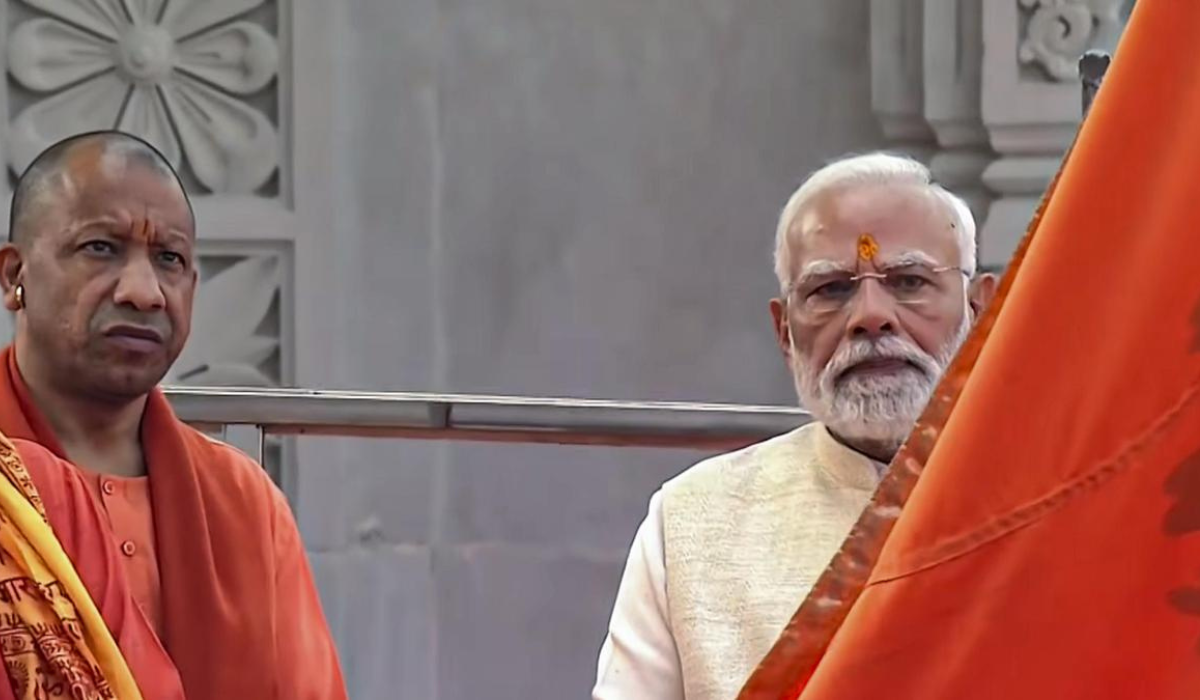
The holy city of Ayodhya witnessed another landmark moment on November 25, 2025, as Prime Minister Narendra Modi hoisted the saffron Dharma Dhwaj atop the newly completed Shri Ram Janmabhoomi Temple. The ceremony marked the spiritual culmination of decades of devotion, legal battles, cultural movements, and the long-awaited construction of one of India’s most revered temples.
A Historic Moment in Ayodhya
As dawn broke over the city, Ayodhya glowed with diya lights, saffron flags, and the echo of Ram bhajans. Devotees from across the country gathered to witness a moment they believed they would never see in their lifetime.
PM Modi, addressing the nation from the temple complex, described the day as a turning point in India’s spiritual journey, saying that the completion of the Ram Temple represents the “closing of painful chapters” and the beginning of a new, harmonious era.
He said,
“Today, Ayodhya is witnessing another turning point in India’s cultural consciousness. Old wounds are healing.”
The Dharma Dhwaj: Meaning Behind the Sacred Flag
The saffron flag hoisted during the ceremony carries deep symbolism rooted in Hindu tradition.
The 10-foot high and 20-foot long triangular flag features:
- A radiant sun, representing Lord Ram’s valour and the victory of righteousness
- The sacred Om symbol, signifying the cosmic sound of creation
- The Kovidara tree, associated with Lord Ram’s journey and spiritual growth
Saffron, or bhagwa, stands for sacrifice, purity, and dharma — values central to Lord Ram’s life.
A Never-Seen-Before Hoisting Mechanism
The ceremony attracted attention not only for its spiritual significance but also for the unique way the flag was hoisted.
Unlike traditional flag ceremonies involving ropes or mechanical levers, the Ayodhya ceremony followed an ancient-style ritualistic mechanism. After priests completed Vedic rituals, PM Modi and RSS chief Mohan Bhagwat walked to a podium designed in the shape of a ‘Namaskara’ hand gesture.
When the sacred gesture was activated, the flag ascended smoothly — a concept created to symbolize the divine rising above human effort. The system combined traditional symbolism with modern engineering, allowing the flag to unfurl in a dignified, spiritually aligned manner.
Dignitaries Who Witnessed the Ceremony
Several notable personalities were present during the Dharma Dhwaj hoisting, including:
- Mohan Bhagwat, RSS Sarsanghchalak
- Anandiben Patel, Governor of Uttar Pradesh
- Yogi Adityanath, Chief Minister of Uttar Pradesh
Their presence represented the collective contribution of spiritual, political, and administrative pillars in shaping this historic milestone.
Ayodhya Celebrations: A City in Divine Festivity
As the flag soared above the gleaming white temple shikhar, the entire city of Ayodhya erupted in chants of “Jai Shri Ram!” Streets were decorated with rangolis, floral arches, and saffron drapes. Drone shows, musical performances, and cultural programs narrated the story of Lord Ram’s legacy.
Hotels, dharamshalas, and temples were filled with pilgrims, while the Saryu riverfront witnessed grand aartis that illuminated the night sky. The atmosphere reflected both celebration and emotional healing — for many devotees, this was the conclusion of a centuries-long spiritual wait.
Completion of Ram Temple Construction
The ceremony also marked the formal completion of the Ram Temple’s construction, including:
- The main sanctum housing the idol of Balak Ram
- Carved sandstone pillars and intricate Nagara-style architecture
- A massive temple complex featuring pilgrim facilities, pathways, and cultural museums
- Security and crowd-management infrastructure designed for millions of visitors
The entire project has transformed Ayodhya into a major global pilgrimage destination.
Also Read: 10 Best Ways to Stay Healthy in Winter: Stay Warm, Strong & Energized
Cultural and National Significance
The Ram Temple is more than a religious structure — it represents a cultural revival deeply connected to India’s identity. Generations of devotees, historians, artists, and legal scholars consider this moment a closure of disputes and the beginning of unity.
For millions in India and abroad, the hoisting of the Dharma Dhwaj symbolizes:
- Restoration of heritage
- Victory of truth (satya) and dharma
- The resilience of faith
- Unity beyond political and social lines
A New Chapter for Ayodhya
With the completion of the temple and the unfurling of the sacred flag, Ayodhya has entered a new era. Infrastructure upgrades, tourism growth, cultural festivals, and global attention are expected to follow.
But beyond all, the event stands as a spiritual milestone — one that connects the ancient legacy of Lord Ram with modern India’s aspirations.