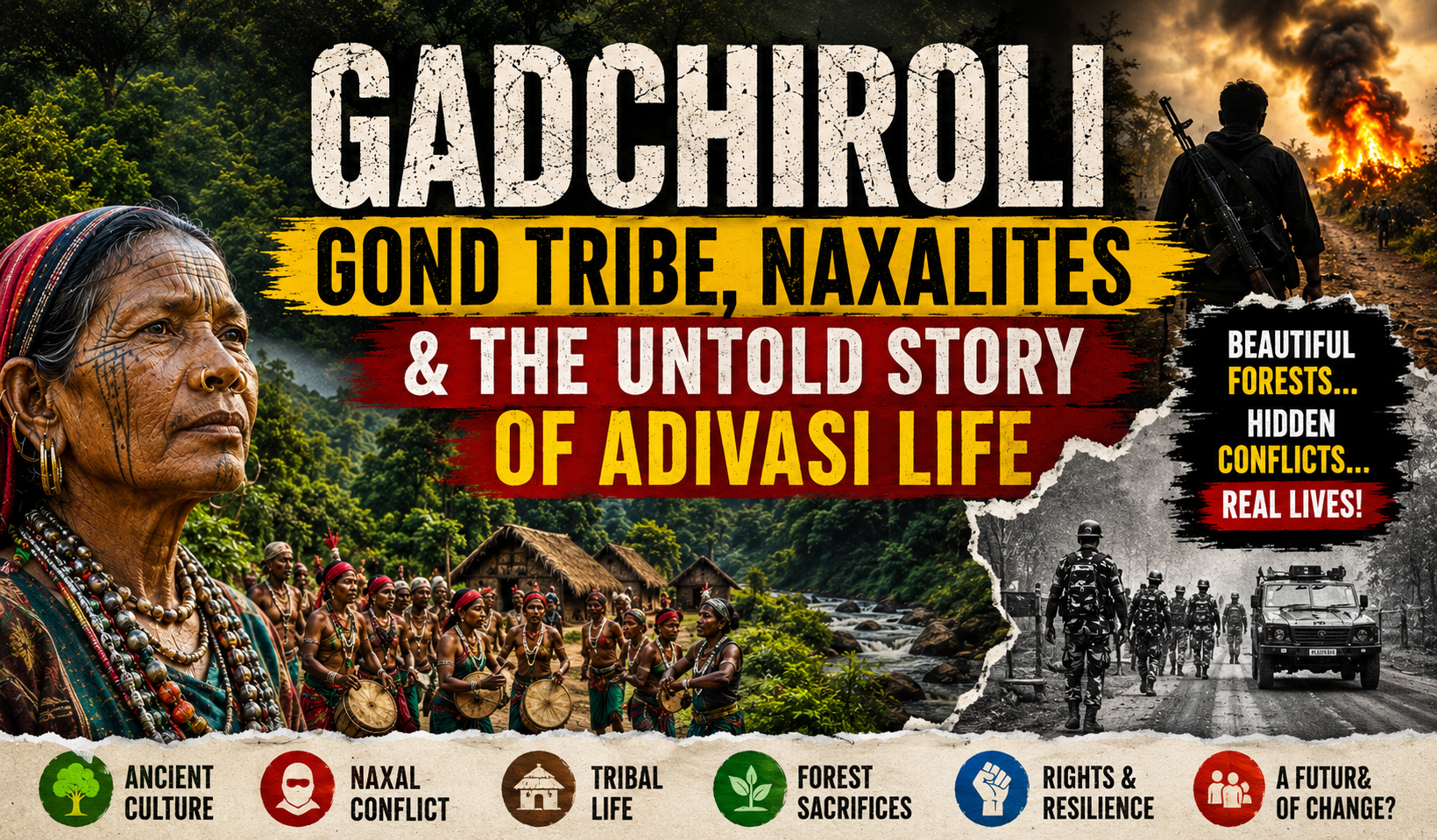
Deep inside the forests of Gadchiroli lies a world very different from modern city life. Known for its dense jungles, rich tribal traditions, and decades-long Naxalite conflict, Gadchiroli remains one of the most mysterious and misunderstood regions of India.
For many Indians, the name “Gadchiroli” immediately brings images of Naxal violence, police encounters, and security operations. But beyond the headlines exists another reality — the life of the Gond Tribe and other Adivasi communities who have lived in these forests for generations.
Their story is about survival, identity, culture, nature, and resilience.
Where Is Gadchiroli?
Gadchiroli is located in the eastern part of Maharashtra and shares borders with Chhattisgarh and Telangana. The district was officially formed in 1982 after being separated from Chandrapur district. The area is heavily forested and forms part of India’s famous “Red Corridor,” once known for strong Maoist influence.
Nearly 70–75% of the region is covered with forests, earning Gadchiroli the nickname “Lungs of Maharashtra.” These forests are filled with teak, bamboo, rivers, hills, and remote tribal villages.
The Gond Tribe: Original Guardians of the Forest
The Gond Tribe is among India’s largest tribal communities and has lived across central India for centuries. In Gadchiroli, many belong to the Madia or Maria Gond communities.
Their lifestyle remains deeply connected to forests and nature.
Traditional Lifestyle
Most Gond families depend on:
- Farming
- Forest produce
- Bamboo work
- Fishing
- Tendu leaf collection
- Small-scale animal husbandry
Villages are usually surrounded by forests, and homes are often built using mud, wood, and natural materials.
Unlike city life driven by technology and speed, Gond culture values:
- Community living
- Nature worship
- Traditional knowledge
- Oral storytelling
- Folk music and dance
Their festivals include colorful dances performed with drums and traditional instruments.
The Spiritual Connection With Nature
For the Gond community, forests are not just resources — they are sacred.
Mountains, rivers, animals, and trees are often connected with spiritual beliefs. Many Gond rituals revolve around forest gods and ancestral spirits.
The tribe has preserved unique myths, astronomy traditions, and cultural systems that researchers consider among the oldest surviving indigenous knowledge systems in India.
Why Did Naxalism Reach Gadchiroli?
The history of Naxalism in Gadchiroli is complex.
The region’s:
- Dense forests
- Remote geography
- Poor infrastructure
- Poverty
- Lack of healthcare and education
- Land disputes
created conditions where Maoist groups found support and shelter.
The Communist Party of India (Maoist) used forest regions in Gadchiroli and neighboring states as operational zones for decades.
Many tribal villagers became trapped between:
- Maoist groups
- Police and security forces
- Mining interests
- Political systems
Adivasis Caught Between Two Worlds
One of the harshest realities in Gadchiroli is that ordinary tribal villagers often suffer the most during conflict.
Some villages have experienced:
- Fear of violence
- Forced migration
- Suspicion from both sides
- Economic isolation
- Poor access to hospitals and schools
An Outlook India report described heartbreaking stories where families struggled to access healthcare because hospitals were extremely far away and transport was almost unavailable.
In many remote villages:
- Mobile networks barely work
- Roads are incomplete
- Public transport is limited
- Schools lack teachers
- Healthcare facilities are minimal
For years, many villagers lived disconnected from mainstream India.
Mining vs Forest Rights
Gadchiroli is rich in minerals, especially iron ore. This has created another major issue: mining projects.
Supporters of mining argue it can bring:
- Jobs
- Roads
- Development
- Investment
But many tribal groups fear:
- Loss of forests
- Displacement
- Environmental destruction
- Cultural erosion
For Adivasi communities, forests are identity, not just land.
This tension between “development” and “tribal rights” remains one of the biggest debates in the region.
The Changing Security Situation
In recent years, security forces in Maharashtra have intensified anti-Maoist operations.
Reports suggest Maoist influence in Maharashtra has reduced significantly compared to previous decades. Several operations, arrests, and surrenders have weakened insurgent networks in Gadchiroli.
Recent reports even claim Maharashtra has moved close to becoming “Maoist-free” after major operations in Gadchiroli.
However, the emotional and social impact of decades of conflict still remains in many villages.
The Human Side Rarely Seen in News
National media often focuses only on:
- Encounters
- Explosions
- Security operations
But Gadchiroli is also:
- Beautiful rivers and forests
- Tribal markets
- Ancient traditions
- Indigenous food culture
- Warm village communities
Travel documentaries and creators visiting the area have shown a different side — one filled with hospitality, simplicity, and cultural richness.
Many visitors describe the people of Gadchiroli as:
- Quiet
- Resilient
- Nature-loving
- Spiritually connected
- Deeply community-oriented
A New Generation of Change
Today, younger tribal generations are slowly connecting with:
- Education
- Mobile technology
- Government jobs
- Sports
- Social media
Roads and transport connectivity are improving in several regions that were once isolated.
Some families affected by Maoist violence are now joining police and public service systems, symbolizing a changing future.
But many activists say true development must include:
- Respect for tribal identity
- Forest rights
- Better healthcare
- Quality education
- Sustainable development
without destroying indigenous culture.
The Real Story of Gadchiroli
The story of Gadchiroli is not simply about Naxalites or conflict.
It is a story about:
- India’s forgotten forests
- Indigenous survival
- Cultural heritage
- Poverty and resilience
- Development debates
- Human struggle
The Gond Tribe and other Adivasi communities of Gadchiroli continue to protect traditions that have survived for centuries.
While the region changes with roads, mining projects, and security operations, one question still remains:
Can modernization happen without destroying the soul of tribal life?