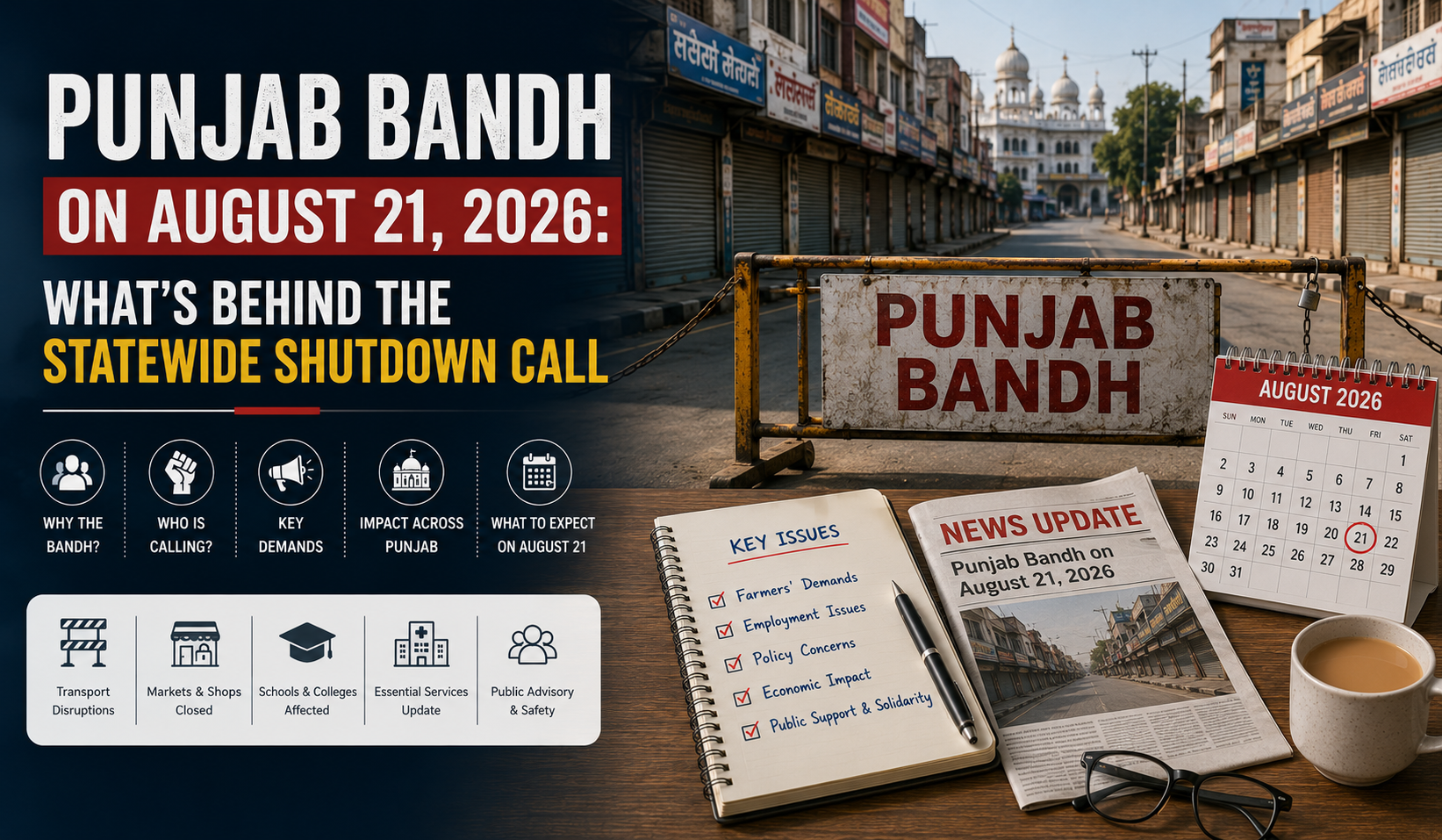
Punjab is bracing for a state-wide shutdown on August 21, 2026, as a coalition of Sikh organizations pushes for the release of long-serving prisoners it says have completed their sentences but remain behind bars.
Who Called the Bandh, and Why
The Qaumi Insaaf Morcha issued the call for the bandh on August 15, urging people across Punjab to observe the shutdown to protest alleged police action against their supporters, the filing of lawsuits, and the ongoing imprisonment of Sikh inmates known as Bandi Singhs.
The announcement followed a confrontation between demonstrators and police near the Chandigarh-Mohali border on August 15, when protesters tried to march toward Punjab Governor Gulab Chand Kataria’s residence in Chandigarh to press the same demand. Police used tear gas and water cannons to disperse the crowd after protesters attempted to breach barricades near Lok Bhavan. Shiromani Akali Dal (Amritsar) president Simranjit Singh Mann was among those detained during that confrontation.
According to protest organizers, police also fired tear gas shells during the standoff, including near Guru Granth Sahib, and registered cases against some protesters over carrying kirpans. Alongside the Bandi Singhs demand generally, the Morcha has separately raised the issue of parole for Jagtar Singh Hawara, who is serving a life sentence for the 1995 assassination of then Punjab Chief Minister Beant Singh.
Morcha leaders have directed criticism at the state government too, accusing Chief Minister Bhagwant Mann’s administration of failing to stand with the protesters and alleging that police action took place on Punjab soil without the state government intervening.
Who’s Backing the Shutdown
Support for the bandh has come from several major Punjabi organizations and religious figures:
- Shiromani Gurdwara Parbandhak Committee (SGPC): SGPC president Advocate Harjinder Singh Dhami extended full support to the bandh, and all SGPC offices and institutions will remain closed on August 21. The committee has rescheduled its Interim Committee meeting, originally set for August 21, to August 22 at its Amritsar headquarters.
- Shiromani Akali Dal (Amritsar): Party president Simranjit Singh Mann said schools, colleges, shops, and railway services would remain closed during the bandh and that the shutdown would extend beyond Punjab to areas with a significant Punjabi population, including Rajasthan, Uttar Pradesh, Delhi, Haryana, Himachal Pradesh, and Jammu and Kashmir.
- Waris Punjab De: The organization’s Manpreet Singh Ayali confirmed the group’s backing, calling the prisoners’ continued detention unjust and asking why they remain jailed.
- Akal Takht: Giani Harpreet Singh has also announced his support for the bandh, tying his backing to both Bandi Singhs demand and the police conduct during the August 15 protest.
The response on the ground has been mixed rather than uniform. In Ludhiana, bus operators announced that around 800 buses would stay off the roads for the duration of the bandh, while local Congress leaders said they were still awaiting a decision from the party’s state leadership before taking a position.
Timing and What to Expect
The bandh is scheduled to run for seven hours, from 7 AM to 2 PM on August 21. The Morcha has appealed to shops, markets, factories, educational institutions, and transport organizations to join and has said it wants highways and bus services shut for the duration. Organizers have also appealed to the government to suspend train services during the bandh window, warning that protesters could attempt to block rail operations if trains continue to run.
Several exemptions have been built into the call. Organizers have said people traveling to airports, attending weddings, appearing for exams, or heading to dhabas will be allowed to move freely and that hospitals and medical stores are expected to stay open throughout. The Morcha has also said it does not intend to force anyone to participate, framing the seven-hour window as an attempt to limit inconvenience to the wider public.
Importantly, no state bank holiday has been declared solely because of the bandh call, so banking operations are expected to continue as usual unless individual branches or the government issue a separate notification. The same applies to government offices: a bandh call by civil society groups does not by itself close government institutions, so any closures there would depend on separate departmental decisions.
Because the shutdown is organized by civil society and religious bodies rather than mandated by the state government, the extent of closures will likely vary by district and by individual business or institution. Areas immediately tied to the protest movement, including YPS Chowk in Mohali and the Chandigarh-Mohali border, are expected to see the most direct disruption and possible route diversions. Residents are advised to plan important travel in advance, confirm transport and institutional schedules locally, and avoid barricaded protest areas.
The Broader Context
This isn’t a standalone flashpoint. Earlier in the same month, Punjab sanitation workers separately called for a bandh over alleged police action against their union in Barnala, though that protest was rescheduled and is a distinct issue from Bandi Singhs demand. The current bandh reflects a broader pattern of civil unrest in the state through much of 2026, with police conduct during protests emerging as a recurring point of friction between demonstrators and the state government.
This summary reflects reporting as of August 20, 2026, the day before the scheduled bandh. Details such as which institutions close, the scale of transport disruption, and the state government’s response may change as the day unfolds. Readers should check local news sources on August 21 for real-time updates.