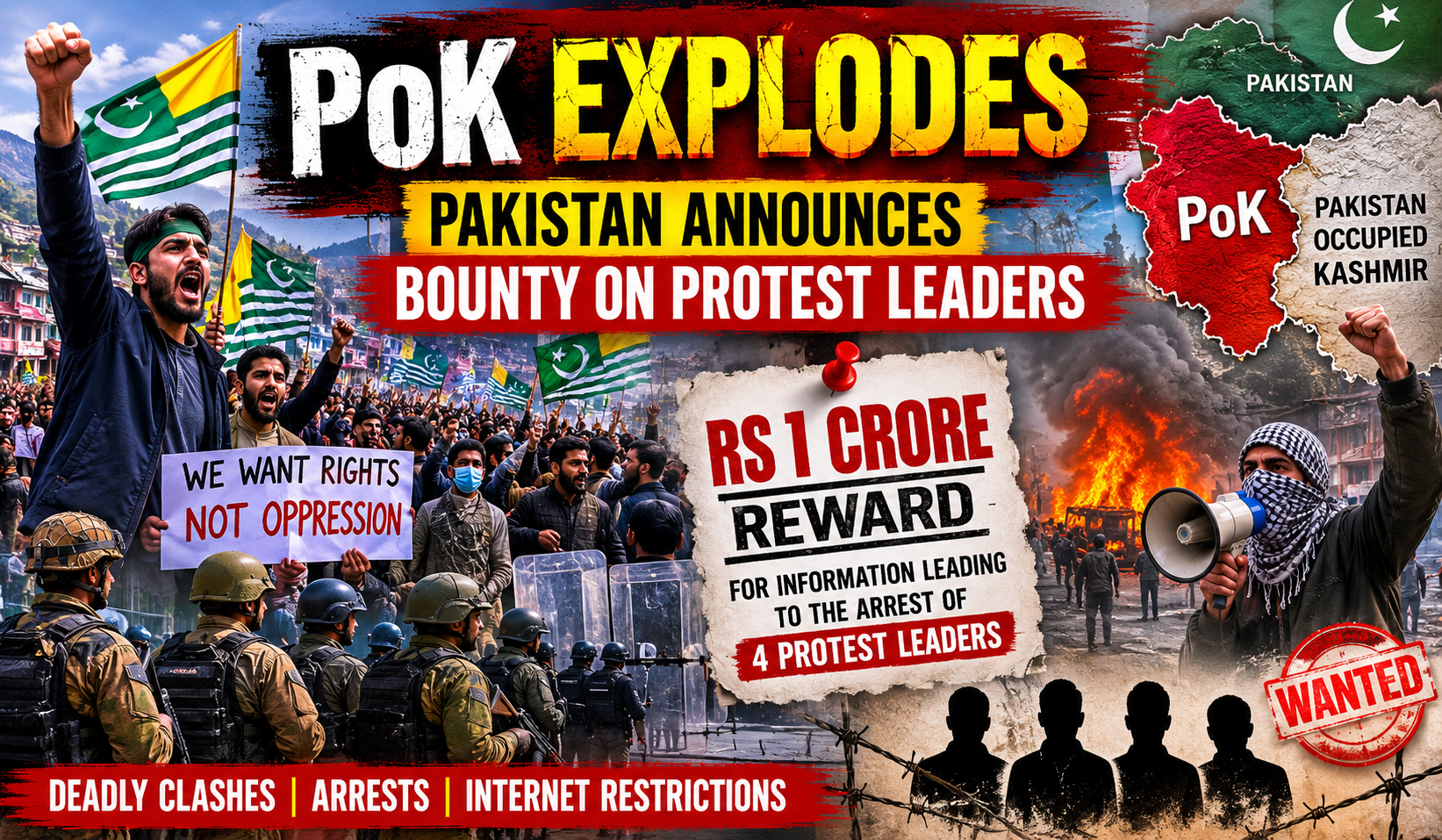
Pakistan-occupied Kashmir (PoK) is witnessing one of its most significant political crises in recent years after authorities announced a bounty of 10 million Pakistani rupees (approximately ₹1 crore) on four prominent protest leaders. The decision comes amid widespread demonstrations, strikes, and violent clashes between protesters and security forces across the region.
The four individuals are reportedly linked to the Joint Awami Action Committee (JAAC), an organization that has been at the forefront of recent anti-government protests. Pakistani authorities accuse the leaders of inciting unrest and threatening public order, while supporters claim they are being targeted for raising legitimate public concerns.
Why Are People Protesting?
The protests began as public frustration grew over rising inflation, unemployment, electricity shortages, and increasing living costs. Residents across PoK have expressed anger over what they describe as government inaction on economic hardships affecting ordinary families.
In addition to economic concerns, political grievances have also fueled the demonstrations. Several activist groups have raised questions about governance, representation, and policy decisions affecting the region. These issues have led to growing public dissatisfaction and a series of large-scale rallies in multiple districts.
Pakistan Announces Bounty on Protest Leaders
The situation escalated dramatically when authorities announced a reward of 10 million Pakistani rupees for information leading to the arrest of four protest leaders. The government argues that these individuals played a key role in organizing demonstrations that allegedly turned violent.
Officials maintain that the bounty is part of broader efforts to restore stability and prevent further unrest. However, critics view the move as an attempt to suppress dissent and intimidate opposition voices.
The announcement has generated significant attention on social media, where many users questioned whether offering a reward for the arrest of protest leaders would help calm tensions or further inflame public anger.
Clashes Turn Deadly
As protests intensified, confrontations between demonstrators and security personnel were reported in several areas. Eyewitness accounts and local reports suggest that multiple people were killed and dozens injured during clashes.
Security forces reportedly used crowd-control measures to disperse protesters, while demonstrators accused authorities of excessive force. The violence has transformed what began as a protest movement into a broader political crisis that continues to dominate headlines.
The deaths and injuries have further fueled public outrage, leading to calls for independent investigations and accountability.
Massive Security Crackdown Underway
In response to the unrest, authorities have launched a large-scale security operation throughout the region. Several activists and organizers have reportedly been detained, while legal cases have been registered against individuals accused of participating in unlawful activities.
Additional security personnel have been deployed in sensitive areas to prevent further demonstrations. Restrictions on movement and communication have also been reported in some locations as officials attempt to contain the situation.
Government representatives insist that these measures are necessary to maintain law and order, while protest groups argue that such actions undermine democratic rights and freedoms.
International Attention Grows
The developments in PoK have attracted attention from political analysts, human rights organizations, and neighboring countries. Observers have expressed concern about the escalating violence and the potential impact on regional stability.
Human rights advocates have called on all parties to exercise restraint and engage in dialogue rather than confrontation. They have also urged authorities to respect the right to peaceful protest while ensuring public safety.
India has also criticized the reported crackdown, highlighting concerns over the treatment of protesters and the broader situation in Pakistan-occupied Kashmir.
What Happens Next?
With tensions remaining high, there appears to be no immediate resolution to the crisis. Protest groups continue to demand economic relief, political reforms, and greater accountability from authorities. Meanwhile, the government remains focused on restoring order through security measures and arrests.
The coming days are expected to be crucial as both sides determine their next course of action. Whether dialogue can replace confrontation remains uncertain, but one thing is clear: the ongoing unrest has become one of the most significant political developments in the region this year.
As demonstrations continue and public frustration grows, the situation in PoK remains highly volatile, with the potential to shape the region’s political landscape for months to come.